

Sandrine Codis, an astrophysicist in the “Cosmology and Galaxy Evolution” division of the Department of Astrophysics (DAp) // UMR AIM at IRFU, has just been awarded a European ERC Starting Grant for her project COLIBRI.
Cosmology is entering a new era — the era of precision cosmology — with revolutionary studies aiming to map dark matter at different epochs of our cosmic history in order to better understand the nature of dark energy. The European space satellite Euclid will measure cosmological parameters with unprecedented accuracy (around 1% on the dark energy equation of state).
To achieve this ambitious goal, a number of sources of systematic errors must be quantified and understood. The COLIBRI project aims to rigorously control the effect of visible matter (baryons) on the joint analysis of data from the two main cosmological probes: weak gravitational lensing and galaxy clustering (i.e., their spatial distribution).

Dark matter is a major component of the Universe, over six times more abundant than ordinary visible matter. Its key feature is that it emits no radiation and interacts only through gravity. To uncover its distribution in space, astronomers rely on the way it bends light with its own gravity — an effect known as gravitational lensing.
Light from distant galaxies travels through space and passes through concentrations of matter (galaxy clusters, cosmic filaments, etc.) on its way to us. Its path is slightly bent, and this tiny deviation provides information on the distribution and quantity of matter — whether visible or invisible — encountered along the way.
These gravitational distortions make it possible to map dark matter across cosmic history. Knowing how dark matter is distributed in space is essential for understanding how galaxies form and evolve in the Universe.
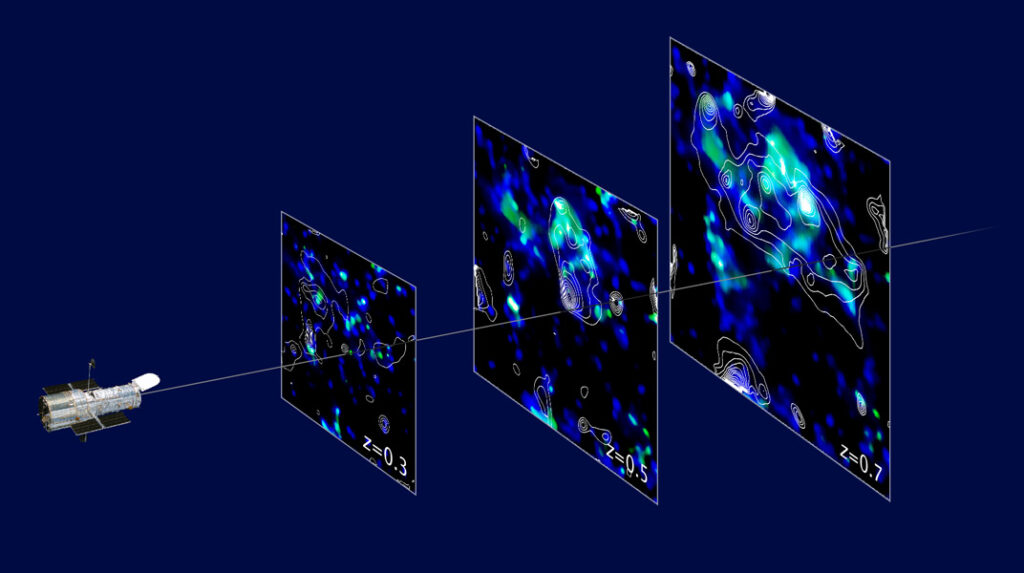
Mapping of dark matter by distance in three slices of the Universe (7, 9, and 10 billion years ago), showing the progressive concentration of dark matter over cosmic time.
Credit: R. Massey / NASA
However, the observables from our telescopes are always tied to visible matter (baryons), which acts as a biased tracer of dark matter.
Indeed, baryons are subject to much richer and more complex physics than dark matter — including thermodynamic effects, heating, cooling, shocks, star formation and stellar winds, black holes and their jets. These effects leave imprints even on cosmological scales.
Moreover, baryons also influence the distribution of dark matter itself through gravity.
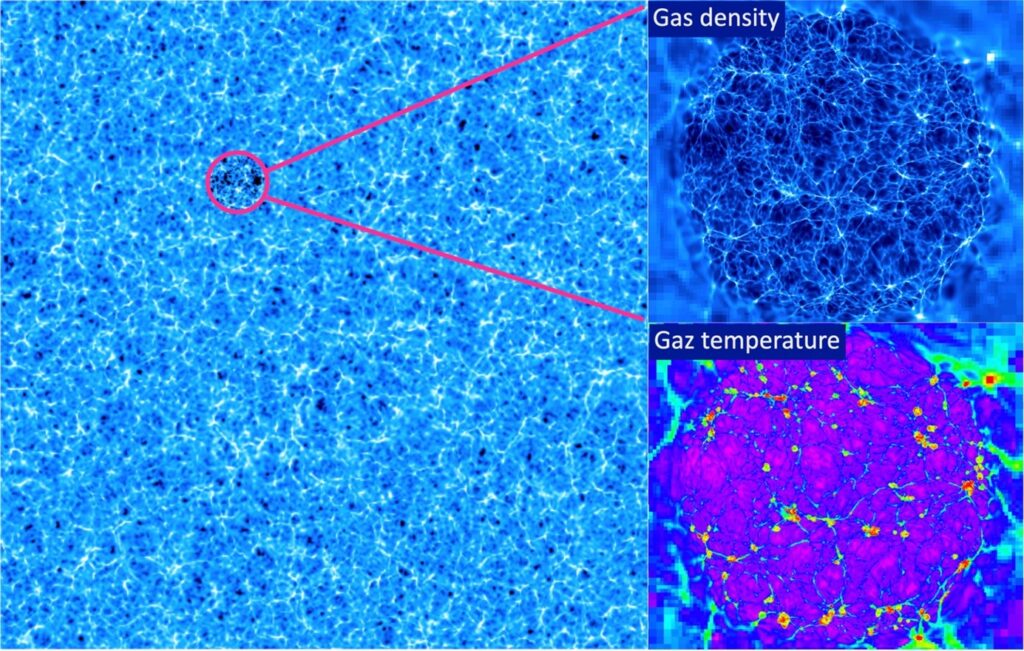
Numerical simulation of a 2 Gpc-wide region of the Universe, with a high-resolution zoom to follow galaxy evolution. This simulation was run at the CEA’s Très Grand Centre de Calcul and will help better understand the influence of baryons on the large-scale structure of the Universe.
Credit © Sandrine Codis / 2023
Thus, baryonic physics has a significant impact on the overall matter distribution in the Universe (as probed by gravitational lensing) and on the distribution of galaxies — the two main observables used to study cosmology through large-scale galaxy surveys.
Even though our Universe is dominated by dark matter (25%) and dark energy (70%), baryons (ordinary “visible” matter, just 5%) represent a major source of systematic bias that can significantly affect cosmological probes. This could lead to substantial measurement errors in the parameters of the cosmological model, ultimately distorting our theoretical interpretations.
In fact, baryonic effects could be responsible for apparent tensions — some already observed — between different cosmological studies and surveys.
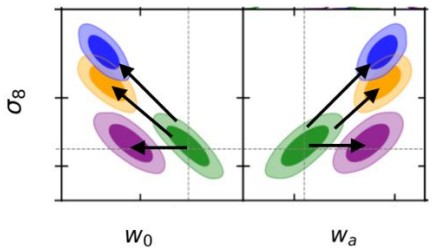
Cosmological constraints on the dark energy equation of state (with w₀ as the constant term and wₐ as its time dependence), and the matter fluctuation amplitude σ₈, for a Euclid-like simulated survey. Different colors show models with various baryonic correction schemes (purple, orange, blue), and the green shows results ignoring baryons.
Baryonic effects and their uncertainties exceed the precision targeted by instruments.
(Martinelli et al., 2020)
The COLIBRI project proposes to rigorously control the impact of baryons on the joint analysis of weak lensing and galaxy clustering data by:
- Developing new theoretical models of the large-scale structure of the Universe that can efficiently capture cosmological information at mildly non-linear scales smaller than current capabilities.
- Producing new hydrodynamical simulations that accurately resolve baryonic physics within unprecedentedly large volumes (spanning several billion light-years), made possible by innovative simulation techniques (such as “multi-zoom”) and the evolution of computational resources in Europe in the exascale era.
These simulations and theoretical models will enable a robust characterization of baryons on cosmological scales, in order to accurately interpret current (DESI) and future (Euclid, Vera Rubin) large-scale galaxy surveys. This effort is crucial to make the most of the rich datasets that will be observed, particularly the upcoming data releases from Euclid.
Contact : Sandrine CODIS