

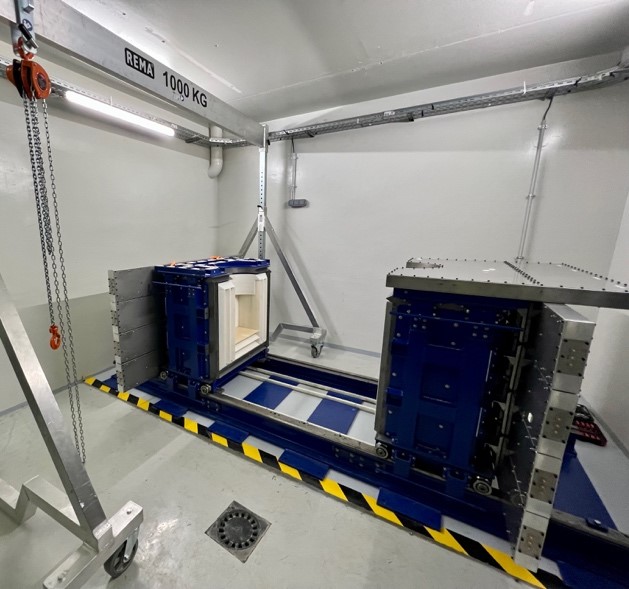
After successful tests of the detectors and an initial background measurement campaign at the underground laboratory of the Technical University of Munich (TUM), the first key components of the experiment — the passive shielding and muon veto, designed and built under the responsibility of IRFU — have been dismantled, transported, and reassembled in the basement of the inter-reactor building at the Chooz Nuclear Power Plant (NPP). Despite particularly demanding constraints in terms of access and space, all steps of this delicate operation were carried out with rigor and efficiency. This protective cocoon, now in place, is ready to receive by the end of the year the cryostat housing the core of the experiment: the cryogenic detectors.
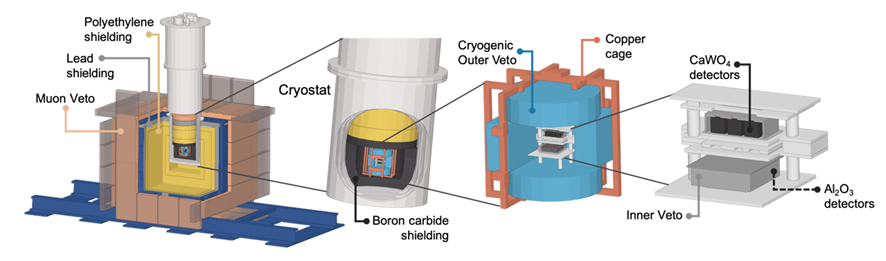
The NUCLEUS experiment [1] aims to detect reactor antineutrinos via a rare interaction process: coherent elastic neutrino-nucleus scattering (CEvNS). To achieve this, it uses cryogenic calorimeters made of CaWO4 crystals, which convert the energy deposited by the recoil of a tungsten nucleus into a tiny rise in temperature. This thermal variation is measured with extreme precision by a superconducting transition-edge sensor (TES), read out by electronics based on SQUIDs1 (Superconducting Quantum Interference Devices). The entire setup is maintained at a temperature of 10 millikelvin using a dedicated cryostat.
This level of sensitivity enables detection of energy deposits as low as 100 eV, but also makes the detectors highly vulnerable to the slightest disturbance, whether environmental (ambient radioactivity, neutrons, atmospheric muons) or instrumental (vibrations, cabling, connectors). To ensure the least noisy environment possible, a system of passive and active shielding has been installed, both inside and outside the cryostat.
1High-sensitivity reading device based on a superconducting loop interrupted by two Josephson junctions. A SQUID is essentially an ultra-sensitive magnetometer that measures extremely weak magnetic field variations induced by changes in the current flowing in the TES following a rise in temperature in the crystal.As presented in a first highlight in February 2025, the experiment was first installed in 2023 at the TUM underground laboratory, where the shielding and muon veto system were tested, along with the first detectors (see Figure 1). These components have since been transferred and reassembled at Chooz, marking a crucial step towards the full commissioning of the experiment.
The NUCLEUS experiment has been installed in the Very Near Site (VNS), located in the basement of the NPP’s inter-reactor building. This room, initially used for archiving, was completely refurbished under the direction of IRFU— and more specifically the DIS division — to meet the requirements of the experiment (Figure 1):
- Reinforcement of the floor with a concrete slab capable of supporting the rails and 5 tons of shielding
- Installation of a cooling unit with a dedicated water circulation loop for the cryostat compressor, located in an adjacent room
- Complete overhaul of the electrical system to power the cryostat, control modules, detectors, and data acquisition electronics
- Installation of an optical fiber linking the VNS to the outside of the plant, enabling the daily data transfer (approximately 5 TB/day)
- Remote operation capability from a control room set up in CEA offices outside the NPP site
The components transferred to Chooz largely correspond to the deliverables for which IRFU is responsible (Figure 2), in particular the external passive shielding and the muon veto system. DIS was responsible for the design and manufacturing supervision of the following components:
- Rails supporting the two half-carts of the shielding
- The half-carts themselves, carrying the metal structure and the lead shielding
- The boron-doped high-density polyethylene, used for neutron attenuation, recovered from the STEREO experiment
- The 22 modules of the muon veto system, essential for rejecting events induced by atmospheric muons, made from plastic scintillators recovered from the CAMERA experiment
- Custom tools for handling and installing the shielding
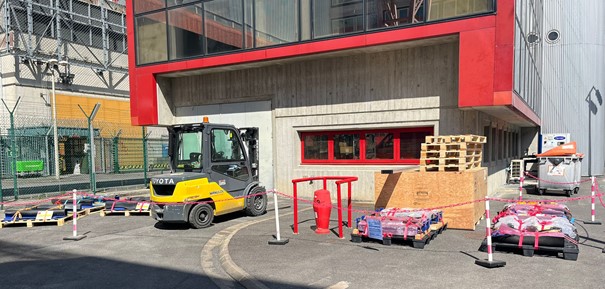
The transportation of the lead parts, which could not be stacked for safety and structural integrity reasons, required two semi-trailers and a mid-route transfer, as access to the NPP is restricted to authorized drivers. But the real challenge lay in the integration of the components into a cramped underground room with limited access (Figure 3). Each handling step had to be planned with millimeter precision after months of preparation to ensure the hatch could be opened and the site met EDF safety standards. The NUCLEUS team (5 people), led by DEDIP, then spent an additional week assembling and adjusting the shielding in this constrained environment.
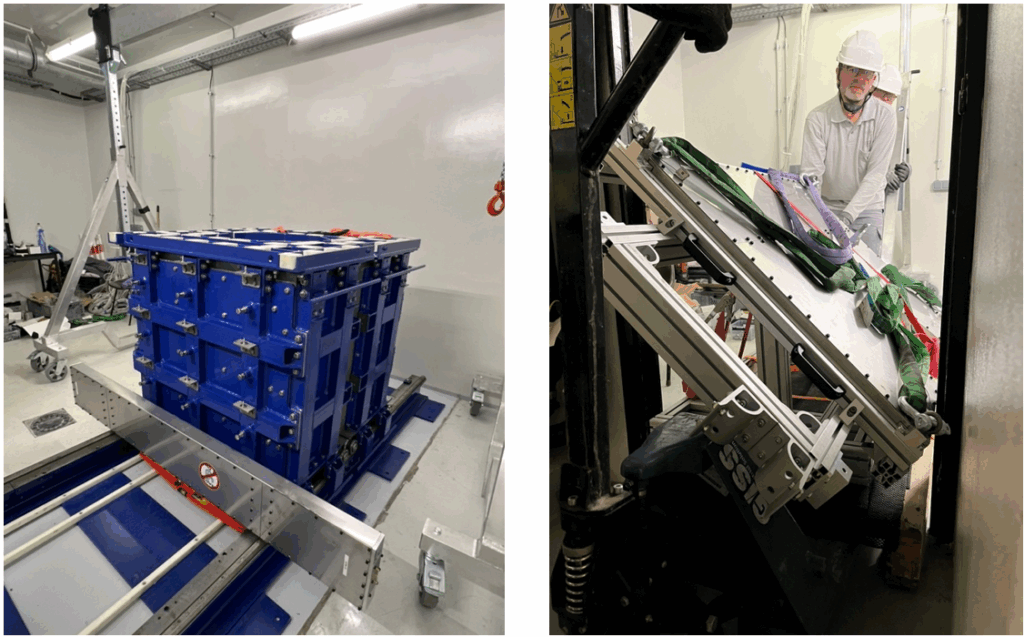
Figure 4 : View of the mechanical structure and tools (left). Example of a handling tool used to move one of the parts through the room’s entrance door (right).
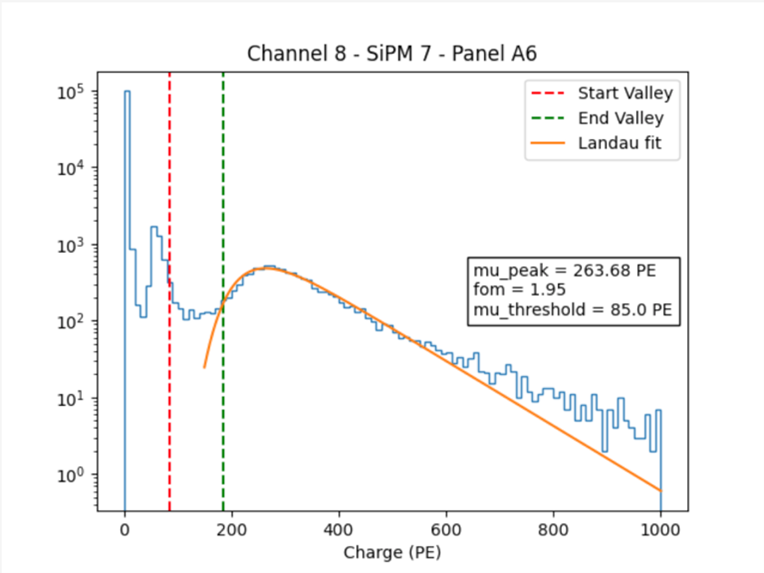
A second team recently completed the commissioning of the muon veto system (see Figure 2). This system prevents the recording of signals caused by muons passing through the volume of the cryogenic detectors, as these can mimic the nuclear recoils being searched for, and thus constitute a major source of background noise that must be eliminated. Data acquisition is therefore suspended as soon as a muon is detected in coincidence in the panels surrounding the experiment, resulting in a dead time of about 10%.
The panels are already detecting muons (Figure 5), and the data are currently being analyzed. First results indicate a detection rate of 312 Hz, which is in good agreement with the simulation predictions (325 Hz). Moreover, a reduction factor of 1.6 is observed at Chooz compared to the TUM underground laboratory, due to the shallower depth of the VNS.
With the shielding and veto system operational, NUCLEUS is ready to enter its final installation phase by the end of 2025: the installation of the cryostat and cryogenic detectors. These are currently being finalized at TUM and will enable the detection of reactor antineutrinos with unprecedented sensitivity.
Contacts :
Hubert Neyrial (Irfu/DIS)
Fabien Jeanneau (Irfu/DEDIP)
Références :
[1] Angloher, G et al. Eur. Phys. J. C 79, 1018 (2019).
[2] V. Wagner et al 2022 JINST 17 T05020