

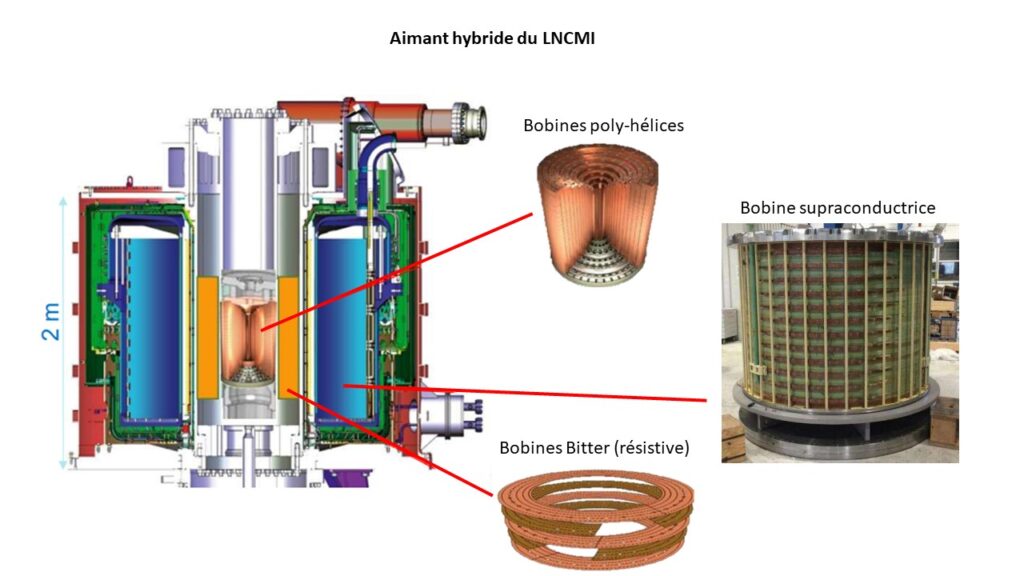
The hybrid magnet of the Laboratoire National des Champs Magnétiques Intenses (LNCMI) in Grenoble, developed in collaboration with IRFU, has joined the very exclusive group (after the USA and China) of facilities reaching a magnetic field greater than 40 T. The hybrid station, which achieves such a field by combining a superconducting coil validated in 2024 with resistive magnets, is now available for physics experiments across many research domains—from solid-state physics to the development of ultra-high-field superconducting magnets using innovative materials.
The superconducting coil project of the 43 T “CEA-design” hybrid magnet, which began in 2009, reached a decisive milestone in 2024. After the design, construction, assembly, and partial testing of the cryogenic satellite, three cooldowns were required to fully validate the standalone superconducting coil, which weighs 20 tons and has an inner winding diameter of 1.1 m.
The superconducting coil operates in superfluid helium at 1.8 K (–271 °C) and produces a magnetic field of 8.5 T with a nominal current of 7,150 A. The Bitter (resistive) coils, located inside the superconducting coil, generate a magnetic field of 8.5 T within a cylinder of 380 mm in diameter, at the center of which polyhelix coils generate the remaining 25 T in a 34 mm bore—just 2 mm larger than the competing American and Chinese projects! On November 13, 2024, the station reached 42 T on its very first attempt while consuming only 21 MW.
But the road was not entirely smooth. We encountered some difficulties with a quench of the superconducting coil, which reverted to a resistive state during the ramp-up of the Bitter coils to 9 T. This transition occurred at 8.9 T, triggering the protection system, which worked perfectly: all the helium that had warmed up and partially vaporized was recovered, thanks to a cold buffer reservoir. On another occasion, the power supply for the superconducting coil overheated and even began to burn during a discharge, revealing a design flaw that required a modification of the thyristor protection circuit.
The next step will be crucial: to verify whether the superconducting coil can operate with the Bitter coils ramped up to 9 T. Then, with the polyhelix coils adding 25.5 T at the center, the hybrid magnet will be able to reach its initial target of a 43 T magnetic field.
But first, it is time for the first users—and for science.
Contact: Christophe Berriaud
Reference: Ref. : P. Pugnat and Al., “The Grenoble Hybrid Magnet Reached 42 T as a First Stept”, MT29 Special Issue of the IEEE Transactions on Applied Superconductivity.