


In March 2025, the European Space Agency (ESA) and the Euclid Consortium released the first 63 square degrees (out of the 14,000 deg² planned for the six-year survey) of calibrated Euclid images, accompanied by technical papers and early scientific results. In early November, seven new papers based on this data were published, addressing questions about the formation and evolution of galaxies over cosmic time.
Discovery About the Processes Shaping Galaxy Morphology
A team led by Fabrizio Gentile, a postdoctoral researcher at the Astrophysics Department (IRFU) of CEA Paris-Saclay, analyzed a sample of nearly one million galaxies, spanning a period from 6 billion years ago to the present. Their key discovery reveals that the evolution of star formation activity and galaxy morphology (e.g., spiral or elliptical) is closely linked to their environment—whether they are isolated or part of clusters or groups.
Euclid Collaboration: Gentile et al., 2025 : “Euclid Quick Data Release (Q1). Quenching precedes bulge formation in dense environments but follows it in the field“
When observing galaxies, they generally fall into two broad categories. Blue galaxies, rich in gas, forming stars, typically disk-shaped and Red galaxies, poor in gas, with little to no star formation, and spheroidal in shape. This distinction is usually explained by two closely related processes: Quenching (the cessation of star formation) and morphological transformation (the shift from a disk structure to a spheroidal shape).
Their main finding reveals that the evolution of star formation activity and galaxy morphology depends on their environment:
- In low-density environments (where galaxies are isolated or have few neighbors), morphological transformation precedes quenching.
- In high-density regions (such as galaxy groups or clusters), the sequence reverses: quenching occurs first, followed by morphological transformation.
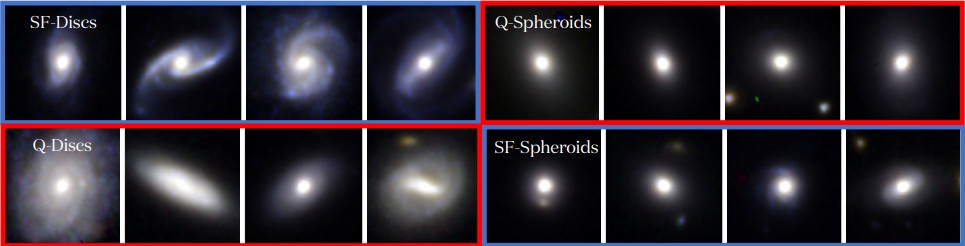
Figures showing examples of galaxies with active star formation (blue squares) or inactive (red squares), along with their respective disk or spheroidal morphologies. Credit: Euclid collaboration – Gentile et al. https://arxiv.org/abs/2511.02964
Such a result would not have been possible without the high-resolution data and exceptional statistical coverage provided by the Euclid satellite, which is ushering in a new era for the study of galaxy evolution and their cosmic environment.
Fabrizio Gentile states: “These early data demonstrate Euclid’s exceptional ability to provide a comprehensive view of galaxy formation and evolution across different masses, distances, and environments. The vast catalog of galaxy images from Euclid is just beginning. We will continue to study the processes shaping galaxy morphology over cosmic time, such as the environments in which they were born, the influence of star formation and explosions, or mergers with other galaxies—factors whose roles and importance are only partially understood.“
Euclid’s Galaxy Image Catalog Expands
The Euclid Consortium took the opportunity of these seven new publications to highlight the imaging capabilities and vast coverage of Euclid’s sky survey. They recreated a modern version of the classic morphological classification diagram of galaxies, showcasing the diversity of observed structures—using only data from the Q1 dataset.
Jean-Charles Cuillandre, an astronomer at DAP, along with collaborators E. Bertin (DAP) and G. Anselmi, produced these images, illustrating the power of the space telescope, which combines fine resolution with a wide field of view.
- A new mosaic of 28 nearby galaxies, observed in visible and infrared light, was presented by ESA on its COSMOS website to highlight their ESASky browser, which allows detailed exploration of high-resolution Euclid images.
- Here are two examples: PGC 2693358, PGC 061140
- A version of the Galaxy Morphological Classification (called “Hubble and de Vaucouleurs Tuning Fork”) diagram was recreated. It organizes the wide diversity of observable galactic structures in the sky.

Jean-Charles Cuillandre emphasizes: “It is remarkable that within just 0.5% of the Euclid survey, we already see the full known morphological diversity of galaxies, even though these early observations only probe a small volume of the nearby Universe.“
He hopes that “this new diagram, based solely on Euclid data, will be widely adopted for teaching astronomy, as it illustrates one of the fundamental pillars of introductory galaxy studies.“
« Hubble and de Vaucouleurs Tuning Fork »
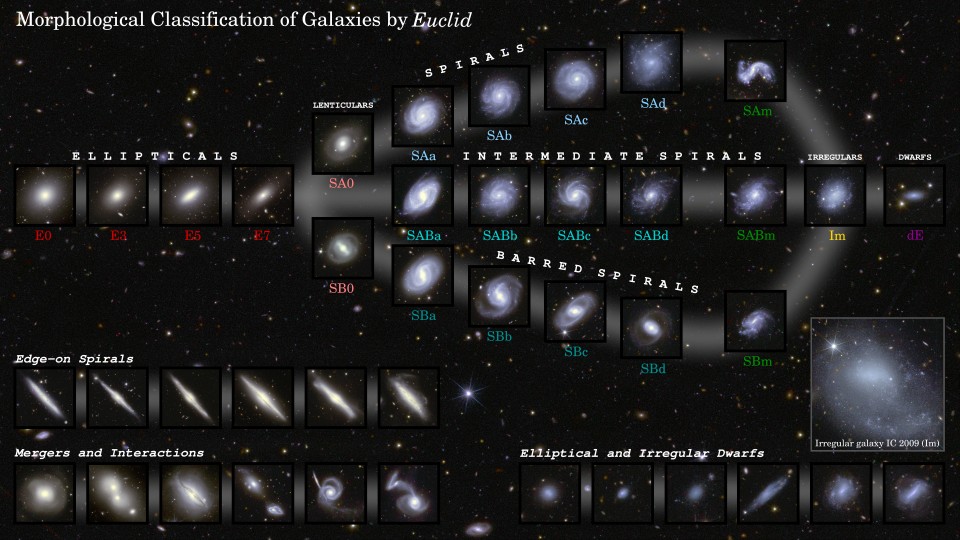
Credits: Diagram: ESA/Euclid/Euclid Consortium/NASA, Diagram by J.-C. Cuillandre, L. Quilley, F. Marleau. Images alone: ESA/Euclid/Euclid Consortium/NASA, image processing by J.-C. Cuillandre, E. Bertin, G. Anselmi
You can explore this “Galaxy Morphological Classification Diagram” with high-resolution Q1 data images here: Euclid Morphological Tuning Fork.
The Mission Continues Its 6-Year Survey
The Q1 data (63 deg2) represent only 7 days of observations with Euclid. This dataset provides a glimpse of the richness of the upcoming “Data Release 1” (DR1), which will cover one year of data and span 1,900 deg2.
In October 2025, the Euclid Consortium conducted its first full internal data release, covering approximately 1,900 deg2—about 1,400 deg2 in the southern hemisphere and 500 deg2 in the northern hemisphere. This internal release allows Euclid scientists to begin their analyses and make scientific progress before the public release (DR1), scheduled for autumn 2026.
Contacts (DAP-AIM): Jean-Charles Cuillandre, Fabrizio Gentile