

he hybrid magnet, composed of a commercial superconducting (LTS) magnetand the NOUGAT high-temperature superconducting (HTS) insert developed by IRFU, has surpassed 30 tesla (T) for the first time in a fully superconducting configuration. This milestone validated the magnetic and mechanical couplings between the two superconducting magnets, as well as the innovative winding technology of the HTS insert—key elements for achieving the targeted magnetic field strength. This achievement marks a significant step toward realizing the FASUM project, the world’s first fully superconducting hybrid magnet capable of delivering a magnetic field of 35 to 40 T to its users.
The DACM (Department of Accelerators, Cryogenics, and Magnetism), a major player in the design and construction of high-field superconducting magnets, is contributing to the FASUM Equipex project (Forty Tesla All Superconducting User Magnet) in collaboration with CNRS-LNCMI.
FASUM is a research platform dedicated to producing continuous, ultra-high-intensity magnetic fields, with a target range of 35 to 40 tesla, using fully superconducting hybrid magnet technology. Its goal is to provide the scientific community with an innovative experimental device capable of performing long-duration, high-quality measurements in magnetic fields exceeding the current limits of conventional superconducting magnets (~28 T, typical for commercial NMR magnets).
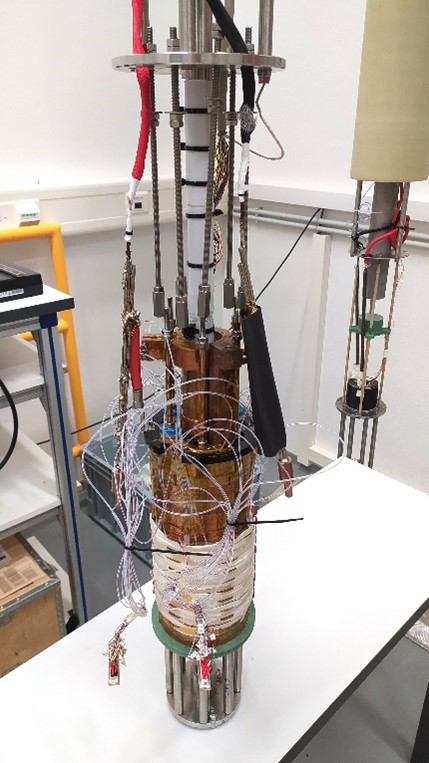
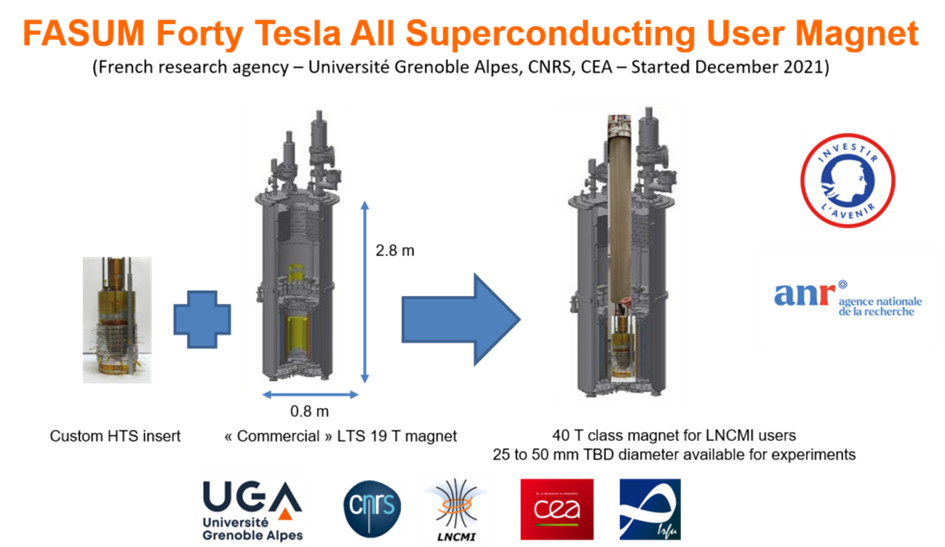
The platform relies on the combination of two complementary superconducting magnets:
- An outer low-temperature superconductor (LTS) magnet, a commercial-type magnet providing a maximum magnetic field of 19 T.
- An inner high-temperature superconductor (HTS) insert working at low temperature, designed to generate the additional intense magnetic field required to reach FASUM’s target values.
A major milestone was achieved in 2019 at LNCMI, where a total field of 32.5 T was reached by combining a resistive outer magnet (18 T) and the NOUGAT superconducting insert developed at DACM, which contributed 14.5 T.
In 2025, a critical breakthrough was achieved with the demonstration of a fully superconducting magnetic field. Tests were conducted at HZDR (Dresden), which provided a 19 T LTS magnet to test the NOUGAT insert. During the first phase of testing, the central field generated reached 28.2 T, with 10.2 T generated by the HTS insert—without quenching and with stable temperature.
A second phase of testing, carried out in December 2025 in collaboration with CNRS-LNCMI and HZDR, validated the system’s long-term stability. A central field exceeding 30 T was maintained for over 30 minutes without quenching, with more than 12 T generated by the HTS insert.
These results provide a strong technological basis for achieving FASUM’s 35 to 40 T goal. This milestone validated the magnetic and mechanical couplings between the two superconducting magnets, as well as the winding technology of the HTS insert—key elements for the planned increase in magnetic field strength.
Contacts Irfu: Philippe FAZILLEAU, Thibault LECREVISSE, Thibault DE CHABANNES LA PALICE, FRANCESCO STACCHI