


Two teams from the Laboratory of Cryogenics and Test Stations (LCSE) and the Laboratory for the Study of Superconducting Magnets (LEAS) at CEA/IRFU, within the Department of Accelerators, Cryogenics, and Magnetism, have achieved a world first: cooling a superconducting magnet using pulsating heat pipes operating at both cryogenic neon and helium temperatures.
As part of the PACIFICS project (ANR), a test station was specifically built to study and develop innovative cryogenic thermal links—here, pulsating heat pipes—for superconducting magnets. This is the MagicPHP station (Magnet Innovative Cooling by Cryogenic PHP), where a 10-tesla high-temperature superconducting (HTS) magnet was tested.
The cooling source is not a cryogenic fluid like helium but a cryocooler, thermally coupled to two pulsating heat pipes capable of operating in zero gravity. Pulsating heat pipes are highly efficient thermal links that use a two-phase fluid near saturation (liquid and vapor phases close to thermodynamic equilibrium), where capillary forces dominate. This allows them to function in gravity-free environments. Tests demonstrated that these heat pipes can not only cool such a magnet under nominal operation but also absorb dynamic thermal disturbances, such as quenches, with a responsetime compatible with the magnet’s operation. The first results were published in the journalCryogenics.
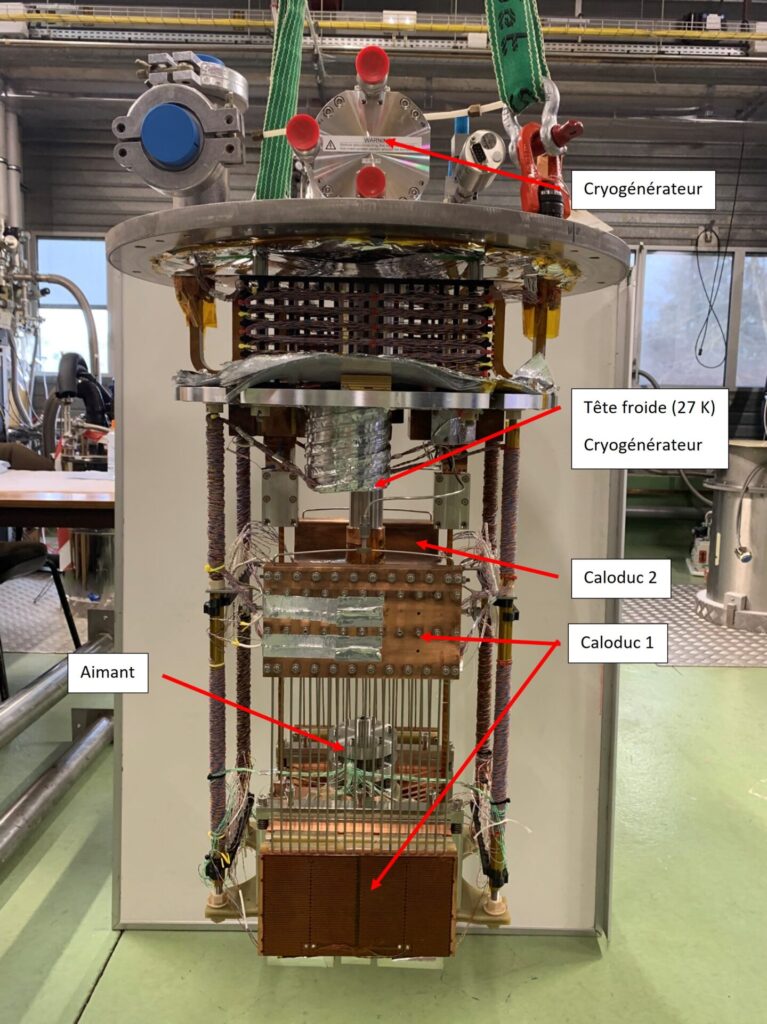
This achievement represents a major breakthrough, proving that this type of gravity-independent heat pipe can be used in applications where gravity is minimal—such as in high-field magnets, where magnetic forces can counteract gravity, or in cryogenic cooling systems for space applications.
This work was supported by the French National Research Agency (ANR) under the Investments for the Future Program (reference ANR-21-ESRE-0049, PACIFICS) and by DACM funding.
Contact: Bertrand Baudouy