


TMD distributions are essential to map the three-dimensional dynamics of quarks and gluons at the subnuclear scale. Their theoretical description involves two components: a perturbative part, calculable within Quantum Chromodynamics (QCD), and a non-perturbative part, which encodes the long-distance physics and cannot be computed from first principles. Until now, this non-perturbative contribution has typically been parametrized by relatively simple analytic functions with only a few parameters. While convenient, these forms are rigid and limit the ability to capture the full complexity of the hadronic structure encoded in modern data.
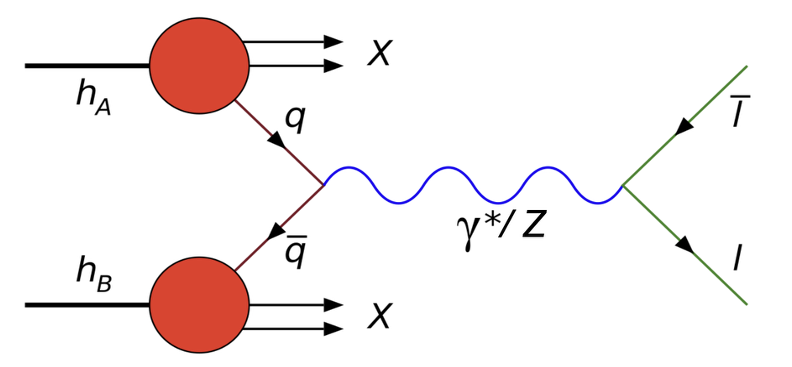
The new method overcomes these limitations by training a neural network directly on experimental measurements of the Drell-Yan process (see Fig. 1), a key reaction in which a quark and an antiquark annihilate to produce a pair of leptons. By learning the non-perturbative TMD component from data, the neural-network parametrization is able to capture subtle features of the hadronic structure that traditional models may miss. The neural-network parametrization is combined with state-of-the-art theoretical calculations and advanced statistical tools, enabling a more reliable extraction of TMDs from a broad set of measurements collected at past and modern colliders, such as the Large Hadron Collider (LHC) at CERN.
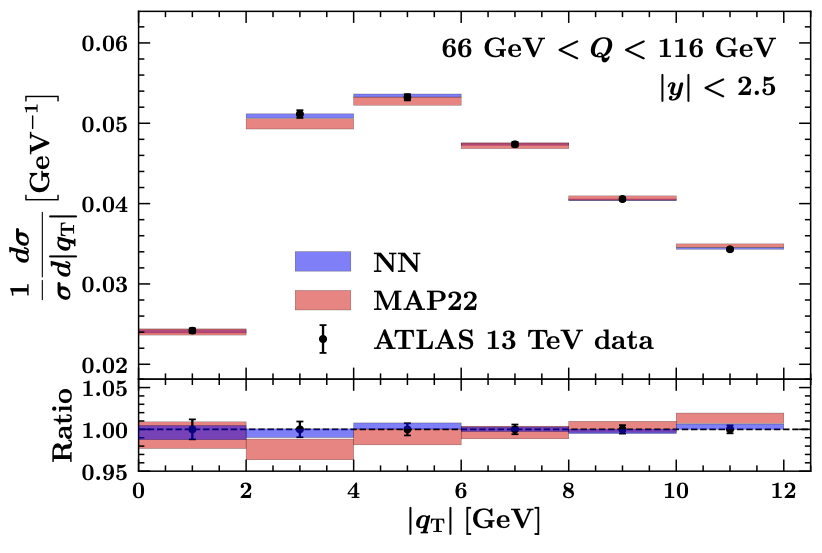
From a computational standpoint, the work relies on an open-source framework, NangaParbat [2], developed by researchers of DPhN at CEA-Irfu. This high-performance environment, one of the few dedicated tools in TMD phenomenology, offers excellent efficiency and extensibility.
This achievement highlights the growing synergy between hadron physics and artificial intelligence, and marks an important step towards an increasingly precise three-dimensional mapping of matter at the most fundamental level.
[1] A. Bacchetta, V. Bertone, C. Bissolotti, M. Cerutti, M. Radici, S. Rodini, L. Rossi, « A Neural-Network Extraction of Unpolarised Transverse-Momentum-Dependent Distributions », MAP Collaboration, Physical Review Letters 135 (2025) 2, 021904.