

A close collaboration between CEA (DRF, DAM, DES), EC-JRC (Geel), and CERN (n_TOF Collaboration) lead to a major breakthrough in the study of plutonium-241. Teams at JRC-Geel succeeded in producing plutonium samples specifically enriched in 241Pu, a key isotope for nuclear energy production but complex to handle. In parallel, the Department of Nuclear Physics (DPhN) and the Department of Electronics, Detectors and Computing for Physics (DEDIP) at DRF/Irfu, in partnership with the Nuclear Physics Service (SPhN) of DAM/DIF, designed and validated innovative detectors able of supporting extremely high counting rates. These instruments, designed to withstand intense α and β background noise – with 241Pu β activity reaching 23 GBq and total α activity (238Pu, 240Pu, 241Am) exceeding 34 MBq – enabled ambitious experimental campaigns at CERN and JRC-Geel in 2025 and early 2026.
The collected data, currently being analyzed, will provide precise measurements of the capture and fission cross sections of 241Pu. These results will contribute to improve the data used by physicists at the Reactor and Fuel Cycle Physics Service (SPRC) of DES/IRESNE, thereby enhancing the reliability of neutronic simulations.
These measurements are carried out within the framework of the n_TOF Collaboration and the CEA-JRC Collaboration Agreement for nuclear safety, with the support of the NACRE project from NEEDS[1], and the European projects APRENDE[2], EUFRAT[3] and EURO-LABS[4].
Motivation
Plutonium contributes to the energy production in nuclear reactors. Particularly at the end of the cycle, at high burnup rates – when most of 235U has been consumed – the energy production relies on the two main fissile isotopes of plutonium (239Pu and 241Pu). The amount of plutonium available at the end of the cycle depends on the reaction cross sections of capture (i.e., for 241Pu: n + 241Pu -> 242Pu + γ) and of fission (n + 241Pu -> fission fragments + γ). The final amount of 241Pu in the spent fuel is also important because the 241Am produced by β- radioactive decay (241Pu -> 241Am + e– + ν) is a problematic radiotoxic waste for reprocessing.
The cross sections of 241Pu are particularly poorly understood due to difficulties inherent in its experimental study. Firstly, its short half-life (14 years) induces a strong electron emission, generating significant background noise during measurements. Secondly, the inevitable presence of other plutonium isotopes, which produce intense alpha radiation (for example 240Pu -> 236U + α), also generates background noise in detectors. Furthermore, 241Am, resulting from the decay of 241Pu, is both an alpha emitter and the source of capture reactions that interfere with measurements. All these difficulties mean that the capture cross section of 241Pu in particular, has only been measured once, by the Oak Ridge National Laboratory [Weston], which is quite rare for an isotope of this importance. The OECD Nuclear Energy Agency therefore recommends improving the accuracy of the capture and fission cross sections of 241Pu [HPRL]. Several challenges had to be addressed to meet this need.
Samples
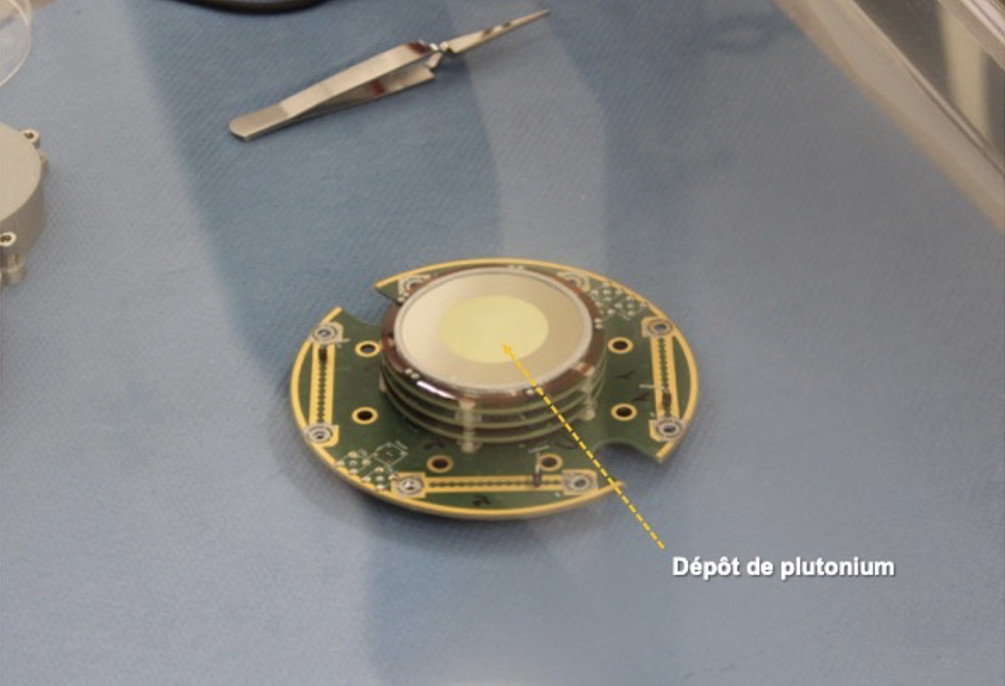
The first challenge was to produce samples of plutonium enriched in 241Pu (Figure 1). The European Commission’s Joint Research Centre in Geel, Belgium (JRC-Geel) has unique expertise and rare materials inherited from the production of previous samples, including a plutonium solution enriched in 241Pu in the 1970s. This solution was purified to remove the elements produced by successive radioactive decays, first americium (241Am), then neptunium (237Np) in collaboration with the military applications division of CEA (DAM/DIF), and finally residual uranium to eliminate any interference during mass spectrometry measurements. It was possible to recover approximately 12 milligrams of plutonium, which current isotopic composition was determined by mass spectrometry: 238Pu (0.1%), 239Pu (6%), 240Pu (23%), 241Pu (54%), and 242Pu (17%). The samples were then made by electrodeposition onto thin aluminum foils and characterized by alpha spectroscopy to precisely determine their mass.
Detectors
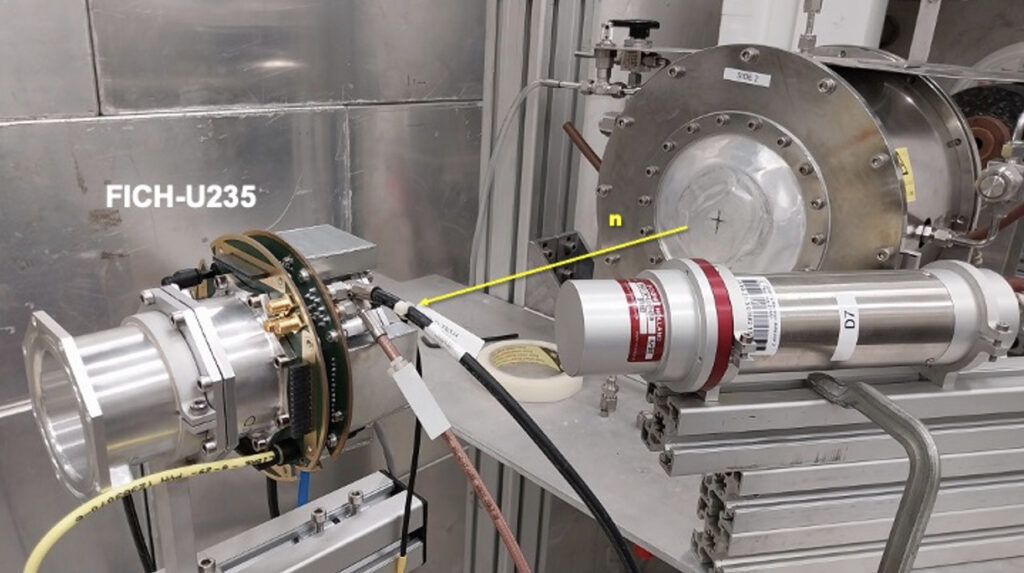
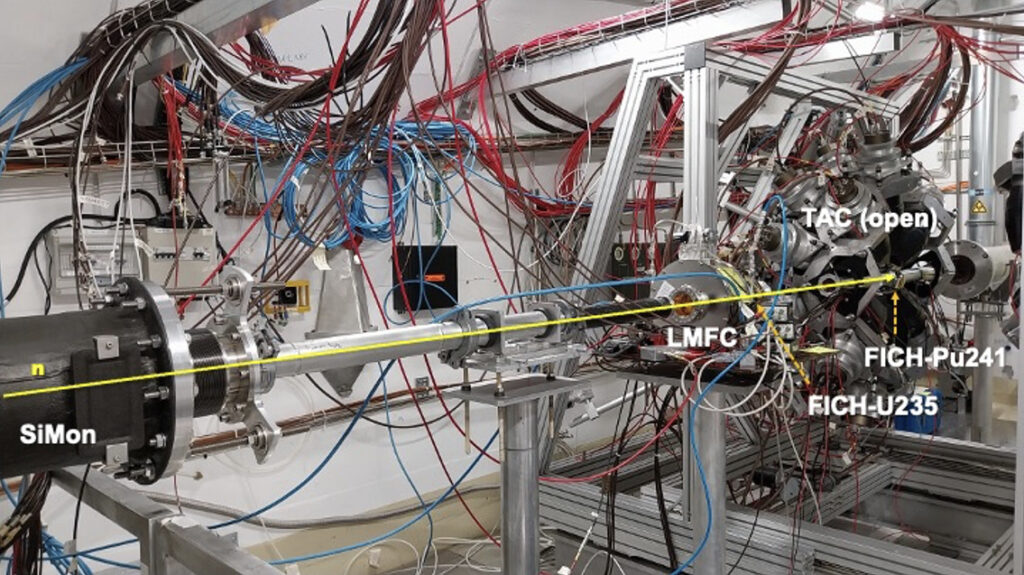
The second challenge was the development of detectors supporting high counting rates. DPhN and DEDIP (DRF/IRFU), in collaboration with SPhN (DAM/DIF), developed and tested detectors withstanding significant α and β background noises from the samples. In these samples, the β activity of 241Pu is of the order of 23 GBq, while the main α emitters (238Pu, 240Pu, and 241Am) have a total activity over 34 MBq. The detector must also have good energy resolution to allow separation between the signals from the 241Pu fission fragments and those from the radioactive background noise, particularly the α particles. The solution adopted is in line with the work carried out in collaboration with DAM/DIF [Taïeb, Bacak]. A multi-plate fission chamber containing several samples allowed the counting rate to be distributed across multiple electronic channels equipped with specific preamplifiers, minimizing signal widths and thus pile-up effects. An additional constraint is the compactness of this fission chamber, which must be located at the center of the Total Absorption Calorimeter (TAC) and used to identify events arising from fission reactions (see the measurement principle in the corresponding Scientific Highlight [FM]). Three fission chambers were produced by Irfu: the first for plutonium samples (FICH-Pu241), the second for uranium samples enriched in 235U (FICH-U235), which is used as a reference for measuring the fission cross-section, and the last without samples to measure the background noise of neutrons scattered in the calorimeter. The chambers were tested at DEDIP, then validated under conditions of use, first at CEA DAM/DIF with a deposit of 252Cf fissioning spontaneously, then with neutrons and 235U samples at JRC-Geel (Figure 2).
Data taking
The third challenge was to schedule and carry out, within a six-month window to minimize 241Am contamination, first the production of the plutonium samples and their transport, then the sequence of experimental campaigns at CERN and JRC-Geel.
The experimental phase was a success. The data collected during the first measurement at CERN on the n_TOF Experimental Area 1 using the TAC (Figure 3) will allow to determine the capture and fission cross sections of 241Pu, as well as the main characteristics of the gamma-rays emitted during these reactions. The measurement on the second n_TOF Experimental Area, which has a very high neutron flux at lower energies, will complement the measurement of the fission cross section in the thermal range. As for the fission cross section measurement carried out at GELINA at JRC-Geel, it will allow to consolidate the results, and in particular the uncertainties, by using a different neutron source.
The data are being analyzed and the results will be discussed with physicists from the Reactor and Fuel Cycle Physics Service (SPRC) of DES/IRESNE to improve the 241Pu data used in simulation codes.
These measurements are carried out within the framework of the n_TOF Collaboration and the CEA-JRC Collaboration Agreement for nuclear safety, with the support of the NACRE project from NEEDS[1], and the European projects APRENDE[2] , EUFRAT[3] and EURO-LABS[4]. Part of this work is conducted in the framework of the PhD of Aline Cahuzac, an engineer seconded by the Ministry of Armed Forces.
Contacts DPhN: E. Berthoumieux, A. Cahuzac, E. Dupont, F. Gunsing
[1] NEEDS – Nucléaire, énergie, environnement, déchets, société ; https://needs.in2p3.fr
[2] APRENDE – Addressing PRiorities of Evaluated Nuclear Data in Europe ; https://aprende-project.eu
[3] EUFRAT – Open access to JRC Research Infrastructure ; https://joint-research-centre.ec.europa.eu/open-access-jrc-research-infrastructures
[4] EURO-LABS – EUROpean Laboratories for Accelerator Based Sciences ; https://web.infn.it/EURO-LABS
References
[Bacak] M. Bacak, et al., A compact fission detector for fission-tagging neutron capture experiments with radioactive fissile isotopes, Nuclear Instruments and Methods in Physics Research A 969 (2020) 163981 ; https://doi.org/10.1016/j.nima.2020.163981
[HPRL] M. Salvatores et al., Uncertainty and target accuracy assessment for innovative systems using recent covariance data evaluations, WPEC Subgroup 26 Report, OECD/NEA (2008) ; HPRL request available at http://www.oecd-nea.org/hprl
[Taïeb] J. Taïeb, et al., A new fission chamber dedicated to Prompt Fission Neutron Spectra measurements, Nuclear Instruments and Methods in Physics Research A 833 (2016) 1 ; https://doi.org/10.1016/j.nima.2016.06.137
[Weston] L.W. Weston and J.H. Todd, Neutron Capture and Fission Cross Sections of Plutonium-241, Nuclear Science & Engineering 65, 454 (1978) ; https://doi.org/10.13182/NSE78-A27176