

Researchers from the DPhN of the IRFU (CEA), in collaboration with the international MAP collaboration (Multidimensional Analyses of Partonic Distributions), have developed a new method based on neural networks to determine the transverse momentum-dependent structure (TMD) of the proton. The theoretical description of the three-dimensional dynamics of quarks and gluons relies on two components: a part calculable within the framework of Quantum Chromodynamics (QCD), and a part that encompasses the 3D structure of the nucleon, described in terms of TMDs. The latter cannot currently be calculated analytically or numerically, but it is possible to infer it by analyzing experimental data.
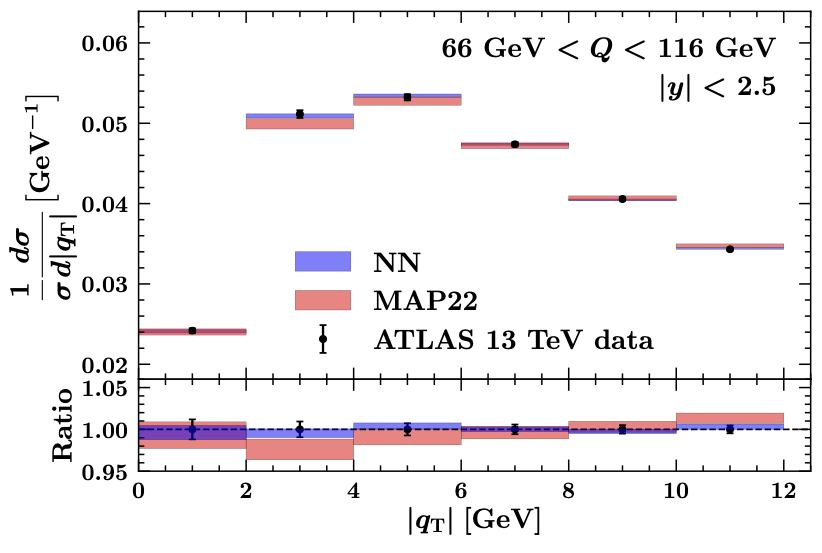
The new approach combines AI tools, cutting-edge theoretical tools, and modern statistical techniques to extract these partonic distributions (quarks and gluons) with unprecedented precision. This approach allows for the capture of subtle features of hadronic structure that traditional models might overlook. Physicists have thus resolved tensions between our understanding of physical experimental processes describing the proton and the data measured at ATLAS on the LHC. Indeed, the gap between theoretical predictions and data (from the Drell-Yan process measured by the ATLAS collaboration and presented in Figure 2) has been significantly reduced. This paves the way for a determination of the nucleon structure in momentum space with unparalleled precision.
This advancement illustrates the growing synergy between hadronic physics and artificial intelligence and marks an important step toward an increasingly precise three-dimensional mapping of matter at the most fundamental scale.
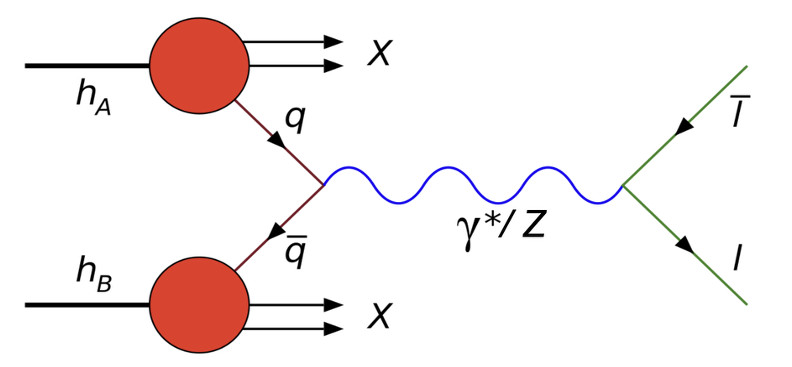
The new method overcomes these limitations by training a neural network directly on experimental measurements of the Drell-Yan process (see Fig. 1), a key reaction in which a quark and an antiquark annihilate to produce a pair of leptons. By learning the non-perturbative TMD component from data, the neural-network parametrization is able to capture subtle features of the hadronic structure that traditional models may miss. The neural-network parametrization is combined with state-of-the-art theoretical calculations and advanced statistical tools, enabling a more reliable extraction of TMDs from a broad set of measurements collected at past and modern colliders, such as the Large Hadron Collider (LHC) at CERN.
This study demonstrates that neural networks are significantly more flexible and sensitive to non-perturbative effects than traditional parametrizations. To prove this statement, in Fig. 2 we present a comparison between data collected by the ATLAS experiment at the LHC, and predictions obtained using a neural-network parametrisation (NN) and a more traditional parametrisation (MAP22). This plots shows that the neural network provides a more accurate description of experimental data and allows for better control over uncertainties. This is also demonstrated by the fact that the χ2 per data point for the ATLAS data set produced by the NN parametrisation is significantly lower than that of the MAP22 parametrization (1.38 vs. 3.51). This is essential for current and future efforts, including the upcoming Electron-Ion Collider (EIC), to build a precise and comprehensive picture of parton dynamics.
From a computational standpoint, the work relies on an open-source framework, NangaParbat [2], developed by researchers of DPhN at CEA-IRFU. This high-performance environment, one of the few dedicated tools in TMD phenomenology, offers excellent efficiency and extensibility.
This achievement highlights the growing synergy between hadron physics and artificial intelligence, and marks an important step towards an increasingly precise three-dimensional mapping of matter at the most fundamental level.
Contact: Valerio BERTONE (IRFU/DPhN)
[1] A. Bacchetta, V. Bertone, C. Bissolotti, M. Cerutti, M. Radici, S. Rodini, L. Rossi, « A Neural-Network Extraction of Unpolarised Transverse-Momentum-Dependent Distributions », MAP Collaboration, Physical Review Letters 135 (2025) 2, 021904.