

At CERN’s Large Hadron Collider (LHC), atomic nuclei are collided at high energies to investigate the quark-gluon plasma (QGP), believed to resemble the matter that filled the universe just microseconds after the Big Bang. By analyzing the spatial distribution of hadrons emitted from this plasma, scientists deduce not only the properties of the initial QGP but also, surprisingly, certain properties of the colliding nuclei. In recent years, several studies have shown that the shape of the colliding nuclei influences the spatial anisotropy of hadronic distributions, thus constituting a signature in the characterization of these high-energy experiments.
In a recent work [1], physicists from Irfu and their international partners sought to characterize the impact of nuclear structure on the study of QGP by considering, in addition to oxygen collisions (spherical nucleus), neon collisions (highly deformed nucleus).
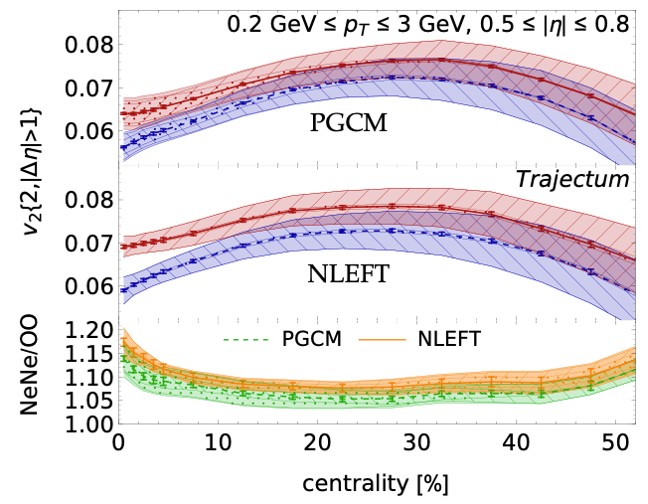
It is the comparison between the calculation of a particular observable—the ratio of elliptic flows (a measure of the elliptic anisotropy of the distribution of detected hadrons)—of the two studied ions and the experimental data that makes it possible to quantify the impact of deformation. Following this work, the CERN schedule was modified to free up beam time for neon-neon collisions.
The experiment with oxygen and neon took place in 2025, and the resulting elliptic flow ratios show remarkable agreement with theoretical predictions [2-4].
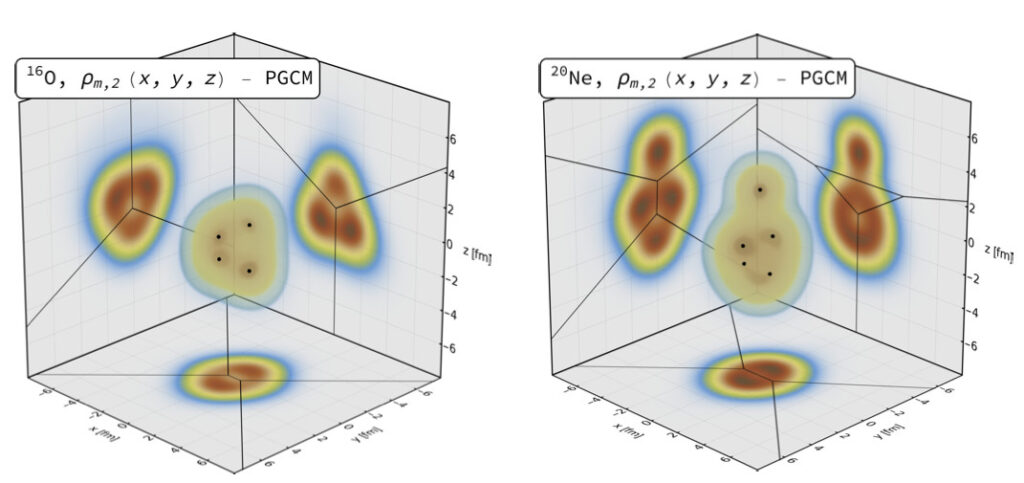
The theoretical collaboration first calculated the structure of oxygen-16 and neon-20 using two ab initio approaches: the Projected Generator Coordinate Method (PGCM) and Nuclear Effective Field Theory on a lattice (NLEFT). Despite very different strategies for solving the nuclear many-body problem, both methods produced highly consistent predictions, particularly regarding the exotic matter density distribution in both nuclei (see figure above).
Using these matter densities as a starting point, and a model for generating the hot nuclear matter droplet formed at the moment of impact, the collaboration performed hydrodynamic simulations of the spatial expansion of the QGP for oxygen-oxygen and neon-neon collisions at LHC energies. These simulations were then coupled with a hadronization formalism to predict the distribution of particles emitted in the transverse plane of the reaction.
In the figure above, the predicted elliptic flow in oxygen-oxygen and neon-neon collisions is shown for the nuclear structures predicted by the ab initio PGCM and NLEFT methods.
Due to the very different shapes of oxygen-16 and neon-20, the elliptic flows obtained in oxygen-oxygen and neon-neon collisions were predicted to be widely distinct (see figure above).
Furthermore, the ratio of these flows proved to be insensitive to hydrodynamic uncertainties and deviated from unity by an amount a priori detectable experimentally, particularly for the most central reactions where the nuclei collide head-on. Thus, measuring this deviation from unity was proposed as a clear signal of the hydrodynamic scenario and as evidence of the formation of a QGP in light nucleus collisions [1].
For the study of nuclear structure, these experiments constitute a new method for exploring and testing correlations between nucleons in the nucleus, as predicted by ab initio methods [5]. For the study of high-energy collisions, the success of experiments with light nuclei (such as oxygen and neon, compared to lead) represents an important advance in understanding the emergence of collective dynamics in strongly interacting matter. This work, at the interface between nuclear structure and quark-gluon plasma physics, builds a bridge between two very distant regimes of the strong interaction.
Contacts: Thomas DUGUET, Vittorio SOMA
References
[1] G. Giacalone et al., Phys. Rev. Lett. 135 012302 (2025)
[2] La collaboration ATLAS, arXiv :2509.05171 (2025)
[3] La collaboration ALICE, arXiv :2509.06428 (2025)
[4] La collaboration CMS, arXiv :2510.02580 (2025)
[5] T. Duguet, G. Giacalone, S. Jeon, A. Tichai, Phys. Rev. Lett. 135 182301 (2025)