

A group of researchers from APC, IRFU, and IPAG have compiled, in a forthcoming publication in Reviews of Modern Physics, the main results of studies on high-energy emission from the central regions of the galaxy, obtained by various teams of astrophysicists over the past 25 years. These include X-ray and gamma-ray observations by space missions such as XMM-Newton, Chandra, and Integral, as well as ground-based observatories like H.E.S.S.
The synthesis focuses on describing the central 600 parsecs (pc) of the Milky Way, a region called the Central Molecular Zone (CMZ), dense with stars, interstellar matter, magnetic fields, non-thermal filaments, supernova remnants, and other objects and sources. These overlap and interact with each other, generating extreme and unique phenomena in the galaxy. At the heart of the CMZ lies the closest supermassive black hole to Earth (4 million solar masses), identified with the compact radio source Sagittarius A* (Sgr A*). Since its discovery in 1974, it has been the subject of frequent observations across all wavelengths.
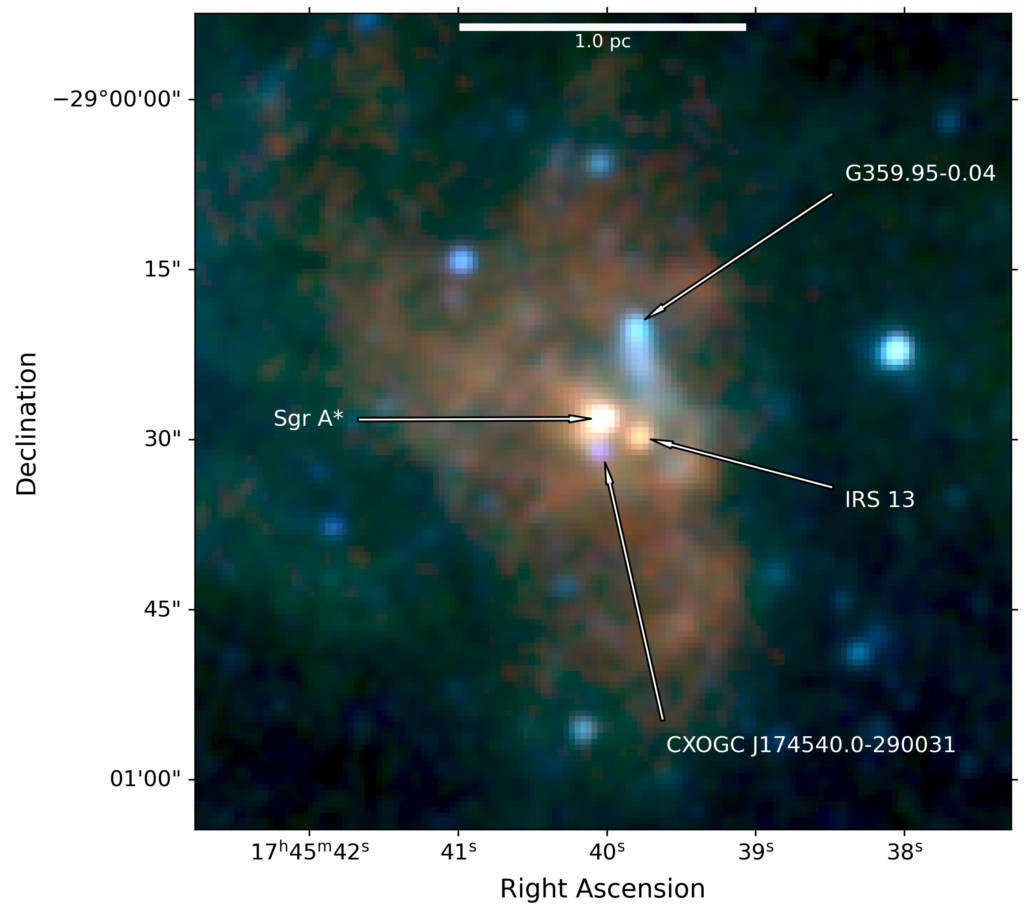
As early as the 1990s, teams from DAp/Irfu demonstrated (using Sigma/GRANAT) ([1] Sigma 1994, [2] Integral 2004) that this specimen, although surrounded by a great deal of matter and thus potentially capable of generating powerful high-energy emission, was particularly inactive for a black hole of its size. Extensive study programs were launched with the new major X-ray and gamma-ray observatories starting in the 2000s.
These programs, including large surveys of the Galactic Center ([2] Integral 2004, [3] XMM 2015) and specific observations of Sgr A* and other CMZ sources—many led by Irfu and APC teams with international collaborators and CNES support—have yielded remarkable results, including the observation of:
- The persistent X-ray emission (2–10 keV) of Sgr A* and its erratic daily X-ray and infrared flares, lasting 1 to 2 hours and with a luminosity 100 times its persistent emission ([4] XMM 2003).
- A stable central emission compatible with Sgr A* in hard X-ray photon energies (>20 keV), later attributed to a pulsar wind nebula and a population of X-ray binary systems ([2] Integral 2004–2006).
- X-ray and hard X-ray light echoes reflected by the molecular clouds of the CMZ, revealing past X-ray outbursts from Sgr A* (less than 1000 years ago) with luminosities a million times its current level ([5] XMM 2010).
- Lobes and chimneys of hot gas extending from the center toward the poles up to 150 pc on either side of the Galactic plane, indicating even more powerful and ancient activity, possibly linked to the generation of the large gamma-ray bubbles at GeV and X-ray energies observed by the Fermi and eROSITA satellites, spanning distances of 10 kpc toward the Galactic halo ([3] XMM 2015, [6] XMM and Chandra 2019).
- A central source of TeV gamma-ray emission compatible with Sgr A*, which cannot, however, be definitively attributed to the black hole, and diffuse emission at the same energies, correlated with interstellar matter, revealing the presence of a powerful central accelerator of cosmic rays ([7] H.E.S.S. 2016).
Map of the Galactic Center features discussed in the review (below), with a zoom on the central part (further below).
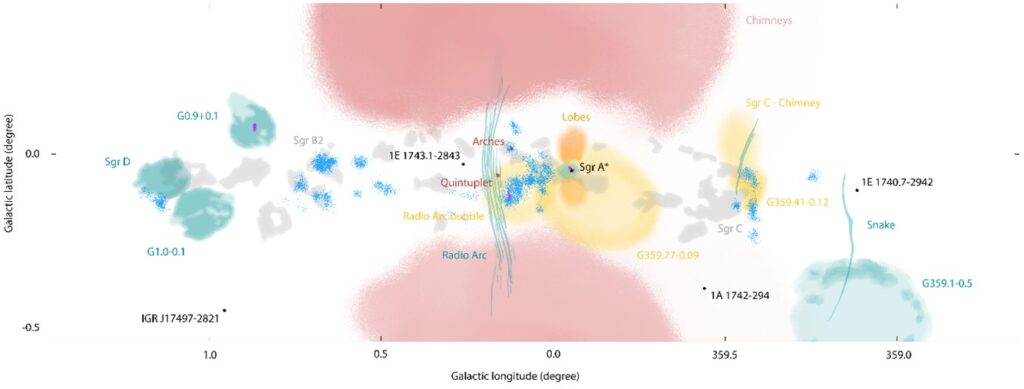
- The position of Sgr A* and a selection of X-ray point sources is indicated in black (star and dots).
- Diffuse thermal structures in X-rays are represented in yellow, orange, and pink (e.g., the Radio Arc bubble, the Lobes, and the Chimneys).
- Reflection features detected at 6.4 keV are shown in dashed blue.
- The three young stellar clusters (YSC, Arches, and Quintuplet) are indicated in red.
- Three pulsar wind nebulae (PWNe), potentially associated with gamma-ray counterparts, are highlighted in purple (G359.95–0.04, G0.13–0.11, and the one within G0.9+0.1).
- To facilitate comparison with maps at other wavelengths, radio supernova remnants (also emitting in X-rays, such as Sgr A East and Sgr D) as well as a selection of non-thermal radio filaments (such as the Radio Arc) are traced in blue-green,
- and a catalog of CMZ molecular clouds is represented in light gray (e.g., Sgr B2 and Sgr C).
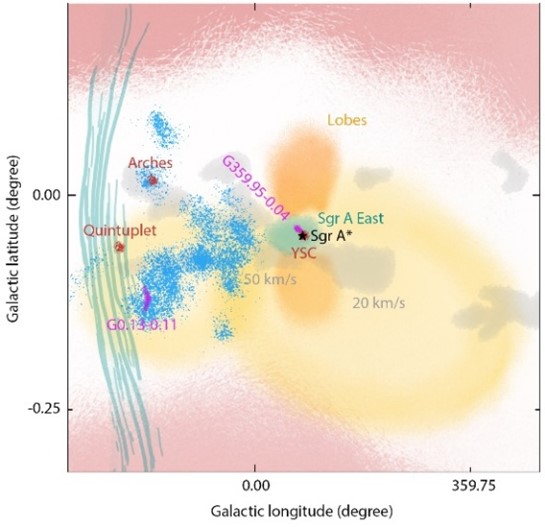
Figures 24 et 25 from the Publication – credit @ Maïca Clavel
The review describes all these high-energy results and phenomena and frames them within the broader context of knowledge about the Galactic Center, comparing them with results from observations at longer wavelengths (radio and infrared).
The authors hope that this synthesis will become a reference for future studies and help stimulate observation programs to be conducted with the next generation of instruments, including CTAO for gamma rays and New-Athena for X-rays.
Contacts:
- Irfu: Andrea GOLDWURM
- APC: Andrea Goldwurm, Régis Terrier, Stefano Gabici
- IPAG: Maïca Clavel
Publication: High Energy Emission from the Galactic Center, A. Goldwurm, M. Clavel, S. Gabici, R. Terrier, 2026, Reviews of Modern Physics, Vol. 98, Issue 2, in press,
Pre-print: “High Energy Emission from the Galactic Center”
References:
- Sigma 1994 (Nature, https://doi.org/10.1038/371589a0)
- Integral 2004 (ApJ, https://doi.org/10.1086/381738) 2006 (ApJ, https://doi.org/10.1086/497629)
- XMM 2015 (MNRAS, references in the pages)
- https://irfu.cea.fr/dap/lepche/2015/08/bulles-et-filaments-au-coeur-de-la-voie-lactee/
- https://www.esa.int/Science_Exploration/Space_Science/The_tumultuous_heart_of_our_Galaxy
- XMM 2003 (ApJ, references in the pages)
https://irfu.cea.fr/dap/2003/01/sursaut-au-centre-de-la-galaxie/
- XMM 2010 (ApJ) INTEGRAL 2010 (ApJ) Chandra 2013 (A&A) (references in the pages)
- https://irfu.cea.fr/dap/lepche/2010/05/reflet-du-passe
- https://irfu.cea.fr/Phocea/Vie_des_labos/News/index.php?id_news=3004
- http://www.nasa.gov/mission_pages/chandra/news/sagittariusA-black-hole.html
- XMM et Chandra 2019 (Nature, references in the pages)
- https://www.cea.fr/Pages/actualites/sciences-de-la-matiere/fumee-trou-noir-galaxie.asp
- http://irfu.cea.fr/Phocea/Vie_des_labos/Ast/ast.php?t=fait_marquant&id_ast=457
- https://www.in2p3.cnrs.fr/fr/cnrsinfo/des-cheminees-rayons-x-geantes-au-centre-la-voie-lactee
- HESS 2016 (Nature, references in the pages)