

Researchers at KU Leuven (Katholieke Universiteit Leuven) and researches from the CEA astrophysics division have, for the first time, directly observed a star orbiting closely around a dying giant star. This discovery offers the first conclusive proof that such companions do exist and that they orbit their host giant stars in a neat circle. The Irfu notably contributed through the development of coherent physical models of tidal flows in evolved stars and their dissipation. This energy dissipation is key as it enables the orbital evolution of the companions. The findings, published in Nature Astronomy, shed new light on the final stages of the life cycle of stars and on how these dying stars lose mass.
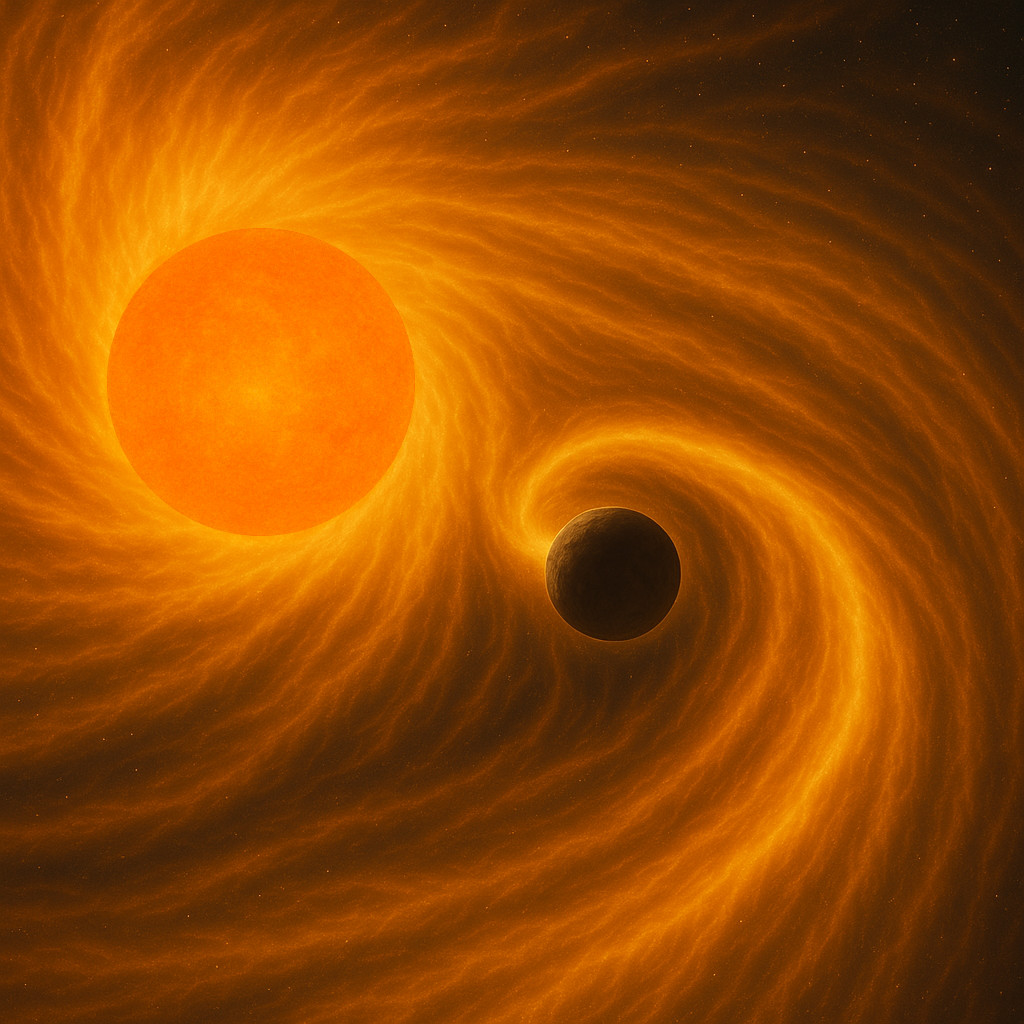
At the end of their life cycle, stars like our Sun turn into pulsating red giants that expel vast amounts of gas and dust. In doing so, they contribute to the creation and distribution of new chemical elements in the Universe, thereby being the driving force behind the so-called cosmic cycle. This final stage of stellar evolution is still only partially understood. One key open question is how a nearby companion influences the mass loss and the evolution of the giant star. Hidden by the dense, dusty environment, these companions have long escaped detection. Using new observations, researchers have now discovered one of these companions and revealed how it moves around the giant star.
The focus of the study is π¹ Gruis, an ageing giant star more than 7,000 times brighter than our Sun. This star ejects large quantities of gas and dust into space through a powerful stellar wind. There have been indirect indications of a close companion for a long time, but it remained hidden in the dusty environment and by the strong turbulence surrounding the giant star.
‘Giant stars are difficult to observe. Their environment is so turbulent and dusty that even nearby companions become practically invisible,’ says Mats Esseldeurs, PhD student jointly supervised by KU Leuven and CEA-Paris Saclay. ‘With the help of new techniques, we were able to track their motion directly for the first time.’
ALMA telescope peers through the dust
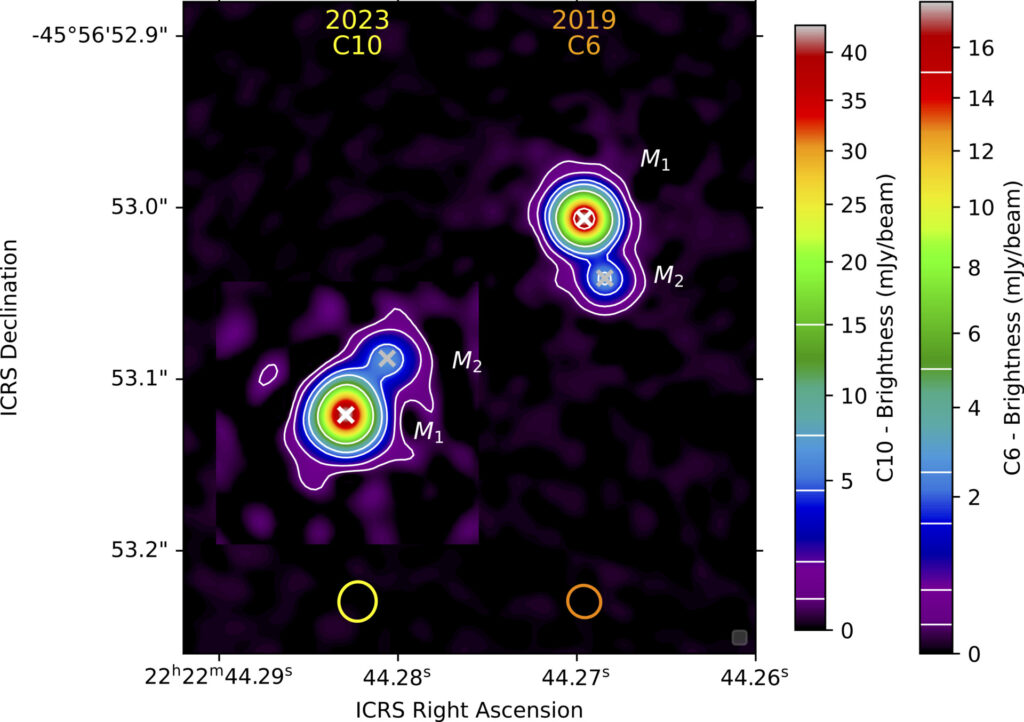
The team used the ALMA telescope in Chile, a network of 66 radio telescopes ideally suited for imaging gas and dust structures in detail. π¹ Gruis was observed in 2019 and again in 2023. These repeated measurements allowed the scientists to confirm, for the first time, that there is a companion star moving in an almost perfectly circular orbit around the giant star.
‘It is like we were able to watch the dance of two stars live,’ says Professor Leen Decin, astronomer at KU Leuven. ‘This direct observation changes everything. Until now, we could only suspect there was a companion star; now we actually see it orbiting the giant star.’
New insights into dying stars
The outcome is surprising: theory predicted an elliptical orbit for the companion star, but we observe an almost perfectly round orbit. This suggests the orbit evolves faster than previously thought. The result calls for adjustments to existing models of the final life stage of giant stars with companions. ‘Our Sun will one day go through such a stage as well,’ adds Mats Esseldeurs. ‘Understanding how close companions behave under these conditions helps us better predict what will happen to the planets around the Sun, and how the companion influences the evolution of the giant star itself.’
More information
The study ‘Evidence for the Keplerian orbit of a close companion around a giant star’ by Esseldeurs et al. (DOI 10.1038/s41550-025-02697-2) was published in Nature Astronomy. The study was primarily funded by a FWO grant.
This project was a collaboration between KU Leuven, Monash University, CEA Paris-Saclay, and other international partners.
Contacts
- Stéphane Mathis, Astrophysics division, UMR AIM/IRFU
- Mats Esseldeurs, Department of Physics and Astronomy, KU Leuven
- Professeure Leen Decin, Department of Physics and Astronomy, KU Leuven