

Each year in France, 35 young female researchers are awarded the “France Young Talents Award” by the L’Oréal Foundation as part of the L’Oréal-UNESCO For Women in Science program. On the occasion of this 20th edition, two astrophysicists from CEA-IRFU have been honored: Camille MOISSET and Marie-Anne CARPINE, both PhD candidates. Camille Moisset [on the left] studies the evolutionary dynamics of stars. Marie-Anne Carpine [on the right] is interested in the physical properties of interstellar dust.
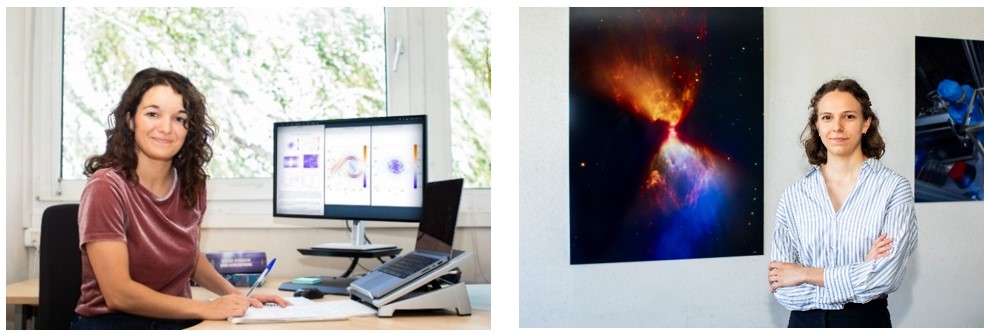
A double win for IRFU. This Wednesday, October 7, two PhD candidates from the astrophysics department received the France Young Talents Award, granted annually by the L’Oréal Foundation. They are among the 35 scientists selected from more than 800 applications. This distinction supports the excellence of their scientific work. It also highlights the role of women in research.
For the two young researchers, this prize represents both scientific recognition and an opportunity to share their work. Camille Moisset, a PhD candidate at the LDE3 laboratory (Stellar, Exoplanet and Environment Dynamics), hopes thus to develop her science “in a more independent way” and “inspire the youngest, especially girls.” She studies the evolution of stars, particularly the link with their internal dynamics. Marie-Anne Carpine, a member of LFEMI laboratory (Star Formation and Interstellar Medium), sees in it “a major potential to create bridges between researchers and the public.” She works on the physical properties of interstellar dust.
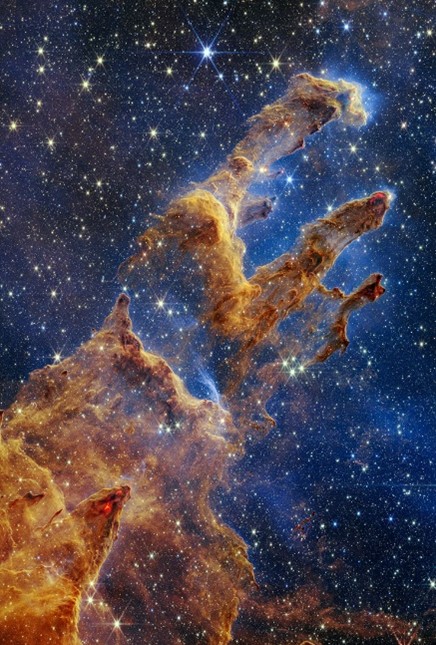
Marie-Anne Carpine: from interstellar dust to planetary seeds
Interstellar dust is a tiny component of the gaseous matter found between the stars of our galaxy for example. Yet, it plays a primordial role in the formation of stars and planets. Marie-Anne Carpine studies the optical properties of this dust: “My work aims to create the very first fully realistic model of protostellar dust.” The objective is to shed light on the very first stages of the evolution of this dust toward planetesimals, the elementary building blocks from which planets form. To do this, she develops numerical models capable of reproducing the complex structure of dust grains. Ultimately, these models will be integrated into simulations of observations of young stars.
Camille Moisset: understanding and modeling the silent architects of stars
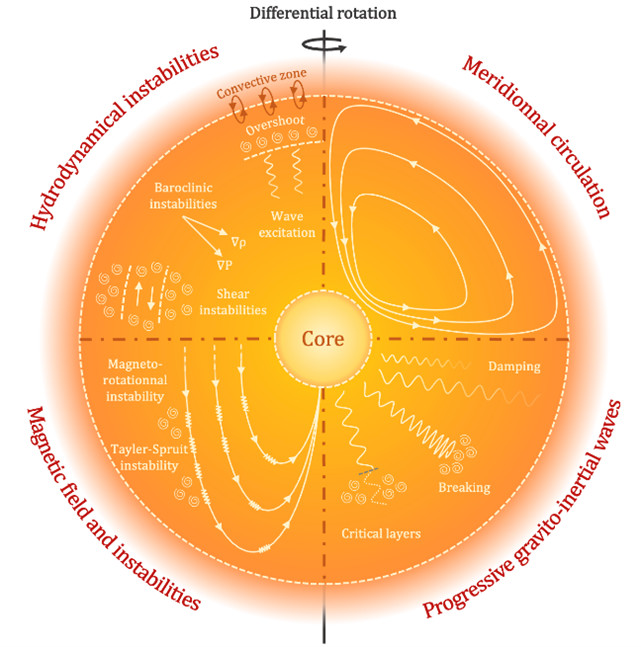
Stars are the fundamental celestial bodies of our Universe. But understanding precisely how they evolve and die remains difficult. In particular, our current models struggle to reproduce the observations from space telescopes. Camille Moisset has set herself the mission of understanding how processes occurring on small scales inside stars influence their structure and evolution. Waves, instabilities, turbulence… her work consists of deciphering the complex dynamics of these “silent architects.” The ultimate goal is to build “robust theoretical models that reproduce the effects of these processes on stellar evolution”, she explains. The researcher relies on high-performance numerical simulations to study these phenomena under different conditions. She then derives simplified models, called “parameterizations.” These models summarize the complex effects of small-scale processes. They then serve as a basis for the codes that simulate stellar evolution.
Contacts : Camille Moisset, Marie-Anne Carpine
Ressources :
- Le communiqué de presse (FR) : CP FWIS France 2026 DEF.docx
- Le dossier de presse (FR) : DPFWISFrance2026.pdf