





Drawing on technical and observational advances, an international team led by researchers from the Astrophysics Department of the IRFU (CEA Paris-Saclay) has unravelled the mystery of the formation of spheroids, found in the bulges of spiral galaxies and in giant elliptical galaxies. These structures, long considered to be mainly the product of galactic mergers late in cosmic history, could also have formed directly in the distant Universe. Their spherical shape is thought to be the result of intense star formation induced by a dynamic process combining the accretion of cold gas and galactic interactions.
These discoveries represent a major advance in our understanding of the evolution of galaxies, and will have an impact on current models, which will also benefit from high-resolution observations thanks to the latest-generation telescopes (JWST, Euclid, etc.).
This research was presented in an article entitled “In situ spheroid formation in distant submillimetre-bright Galaxies“, published in the prestigious journal Nature.
Technical and observational limits finally lifted

Galaxies in the Universe fall into two main morphological categories. On the one hand, there are the disk-shaped spiral galaxies, like our own Milky Way. They are young, rich in gas and still forming stars. On the other hand, there are spheroidal galaxies, which include elliptical galaxies and the bulges of spiral galaxies. These galaxies have no gas, are made up of very old stars and hardly form any more stars; they are as good as “dead”. While the formation of spiral galaxies is perhaps better understood, that of spheroidal galaxies has remained a mystery until now, despite the existence of several theories, which were limited by our previous observational resources and techniques.
To understand the formation of these spheroids, we need to go back to the birth of the stars that make them up, to the era of the “cosmic noon”, when the Universe was between 1.6 and 4.3 billion years old. At that time, many galaxies were actively forming stars and were rich in dust and gas, making them opaque in the visible spectrum, but extremely luminous in millimetre and submillimetre wavelengths. The arrival of the Atacama Large Millimeter/submillimeter Array (ALMA), capable of observing in this part of the spectrum, opened up the possibility of studying galactic bulges. These observations are complemented by the infrared vision of the powerful James Webb Space Telescope (JWST), which provides a global view of galaxies (see Figure 1).
This research was also made possible by an important technical advance. In a previous publication (Tan et al. 2024, A&A), the researchers developed a new method for fitting surface brightness profiles to interferometric observations, such as those produced by ALMA. Before this innovation, extracting information from these data was complex, and the existing methods introduced too many biases, making it difficult to carry out an in-depth analysis of spheroidal systems.
New perspectives on the formation of giant elliptical galaxies in the early Universe

This study is based on ALMA observations collected over the years by various projects. Thanks to the A3COSMOS and A3GOODS archival projects, researchers have been able to compile a sample of more than a hundred galaxies with intense star formation, very bright in the submillimetre range, with a high signal-to-noise ratio (S/N > 50). These galaxies come from the early Universe, which was only 1.6 to 4.3 billion years old at the time (redshift between z = 1.5 and 4). Such a wealth of data would have been impossible to obtain with a conventional request for observation time, underlining the importance of exploiting archives for studies of this scale.
The first discovery concerns the morphology of the submillimetre components at the centres of these galaxies, which correspond to the sites of star formation. The study shows that most of the centres of these galaxies are intrinsically spherical, and not disc-shaped as previously thought. In fact, the researchers found that the submillimetre emission from these galaxies is very compact, with surface brightness profiles that differ significantly from those typical of discs. This conclusion is reinforced by detailed modelling of their 3D geometry, which shows that the ratio between the shortest and longest axes is on average half, increasing with spatial compactness (see Figure 2).
The second revelation in this study concerns the mechanism by which spheroidal galaxies are formed. It has long been thought that spheroids formed late in the history of the Universe, mainly through coalescence, i.e. the merging of two galaxies after a collision. However, this study provides a new perspective: spheroids have been observed to form directly from outbreaks of stars, probably due to the simultaneous action of cold gas accretion and interactions between galaxies, without the need for fusion. These processes lead to intense star formation concentrated in the three-dimensional cores of these galaxies from the earliest epochs of cosmic history.
Possible access to the birthplaces of large elliptical galaxies
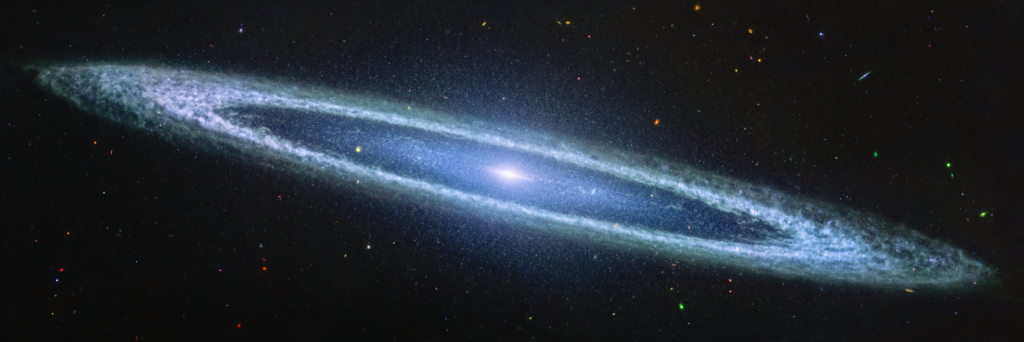
This study has provided the first solid observational evidence that spheroids can form directly as a result of intense star formation, fuelled by the accretion of cold gas and simultaneous galactic interactions in the cores of galaxies. This process, apparently widespread in the distant Universe, represents a turning point in our understanding of the formation and evolution of the bulges of spiral galaxies, and perhaps also of giant elliptical galaxies, such as M87 in the constellation Virgo, whose birth sites have been sought for decades.
New ALMA observations, benefiting from increased resolution and sensitivity, combined with archival data, will make it possible to explore in detail the distribution and kinematics of cold gas – the raw material for star formation – within these galaxies by means of statistical studies. In addition, the capabilities of the JWST, Euclid and Chinese Space Station (CSST) telescopes to map the stellar components of galaxies will complement this approach, offering a more complete view of their evolution (see Figure 3). Together, these tools promise to revolutionise our understanding of galaxy formation in the early Universe.
CEA/IRFU contacts: Emanuele Daddi, Benjamin Magnelli, Camila A. Correa, David Elbaz, Frédéric Bournaud, Carlos Gomez Guijarro