





For this ESA/Hubble Image of the Month, the Hubble Space Telescope joins forces with ESA’s Euclid to provide a new view of the most visually complex remnants of a dying star, known as the Cat’s Eye Nebula. Discovered for the first time in 1864, it is located about 4,300 light-years from Earth.
Although Euclid is primarily designed to map the distant universe, it observed the Cat’s Eye Nebula as part of its deep imaging surveys.
In the wide-field image obtained by the Euclid space telescope, observing in visible and near-infrared light, the Cat’s Eye Nebula appears surrounded by an extended halo of gas ejected by the central star during successive phases of mass loss. These structures correspond to layers of material expelled during the final stages of stellar evolution. Observing such a wide field also reveals many very distant galaxies in the background: their presence reminds us that modern astronomical surveys allow the study of both stellar evolution processes in our galaxy and the distribution of galaxies on a cosmic scale.
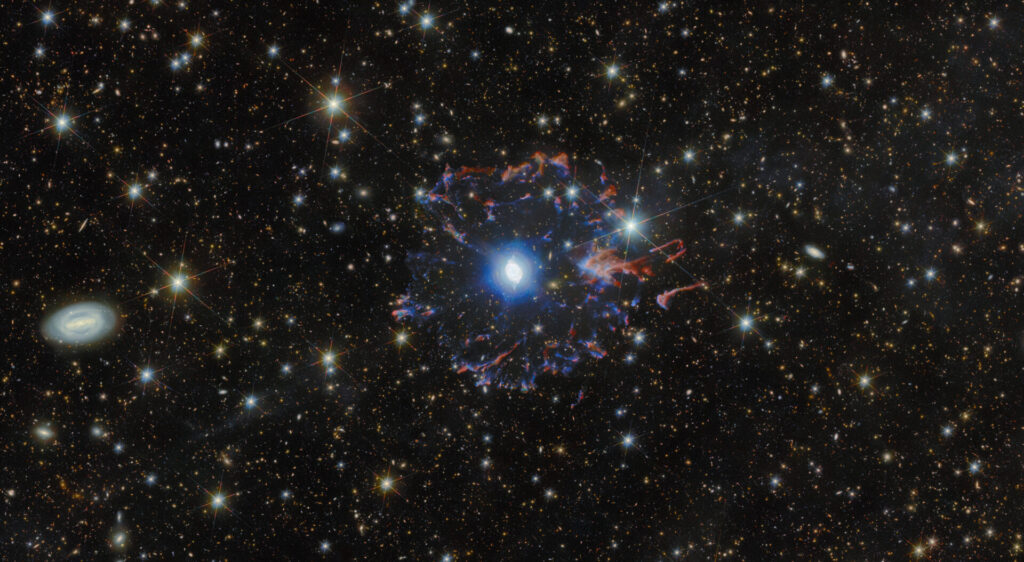
Two image processing specialists, Jean-Charles Cuillandre and Emmanuel Bertin, both astronomers at the Paris-Saclay Observatoire des Sciences de l’Univers and members of the Astrophysics Department at CEA IRFU, created this image. Its production is part of the scientific communication efforts led by ESA and the Euclid Consortium to accompany key milestones in the Euclid mission and its large sky survey.
Jean-Charles highlights the complementarity of the two observations:
“Hubble offers an angular resolution about twice that of Euclid in the visible spectrum, allowing for better resolution of shells, jets, and structures in the heart of NGC 6543.
Euclid, with a field of view nearly 200 times wider and an optical design optimized for detecting faint surface brightness, also reveals the extended diffuse halos and the large-scale environment. Their combination illustrates remarkable scientific complementarity.”
The nebula is highlighted by the combined perspectives of the Hubble Space Telescope (NASA/ESA) and Euclid (ESA), revealing the remarkable complexity of stellar death.
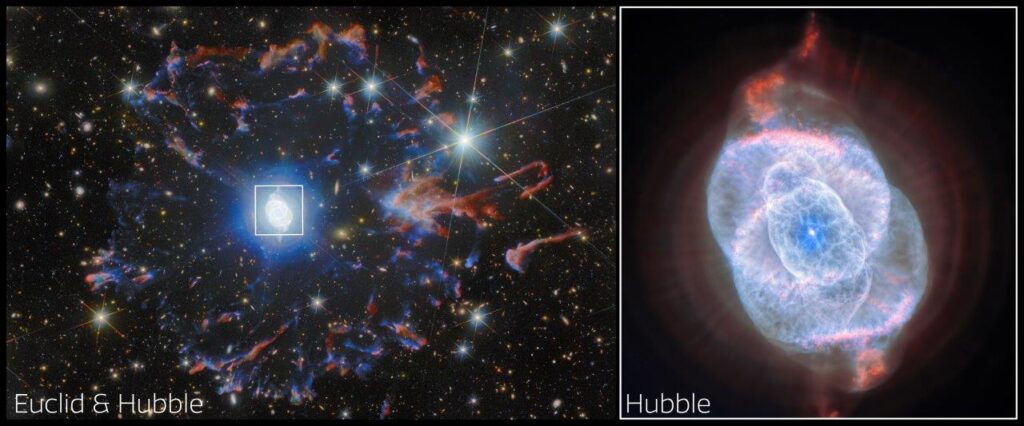
The left image, from combined observations by the Euclid and Hubble Space Telescopes, shows the Cat’s Eye Nebula and its vast surrounding envelope of gas. This material comes from the outer layers of a Sun-like star, ejected when it entered the final phase of its evolution. During this stage, the star gradually sheds its envelope in the form of stellar winds, forming an extended halo of gas around it. The white frame indicates the central region of the nebula, shown in detail in the right image obtained by Hubble. Here, several nested shells and bubbles of gas can be seen, shaped when fast stellar winds collided with previously ejected layers of material. The intense radiation from the central star heats and ionizes this gas, causing it to glow and revealing the complex structure of this planetary nebula, a brief stage in the evolution of a star before it becomes a white dwarf.
Credits: ESA/Hubble & NASA, ESA Euclid/Euclid Consortium/NASA/Q1-2025, J.-C. Cuillandre & E. Bertin (CEA Paris-Saclay), Z. Tsvetanov Licence : CC BY-SA 3.0 IG
Contacts IRFU/DAp: Jean-Charles Cuillandre, Emmanuel Bertin
ESA website: ESA – Hubble & Euclid zoom into cosmic eye