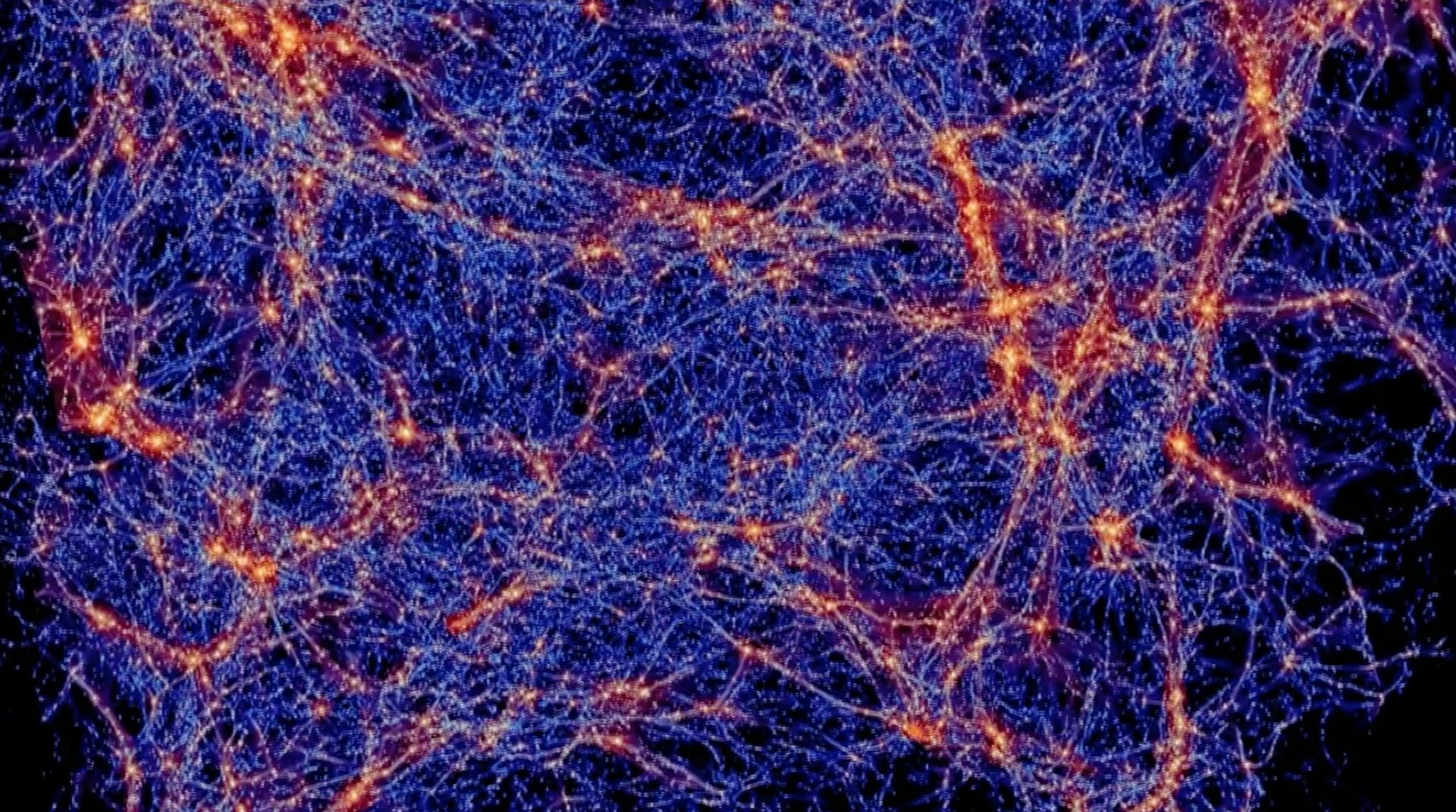





Our research in cosmology spans observational cosmology, notably with the Euclid and NewAthena space telescopes, theoretical modeling of large-scale structures using stochastic approaches, and numerical simulations.
Observational Cosmology
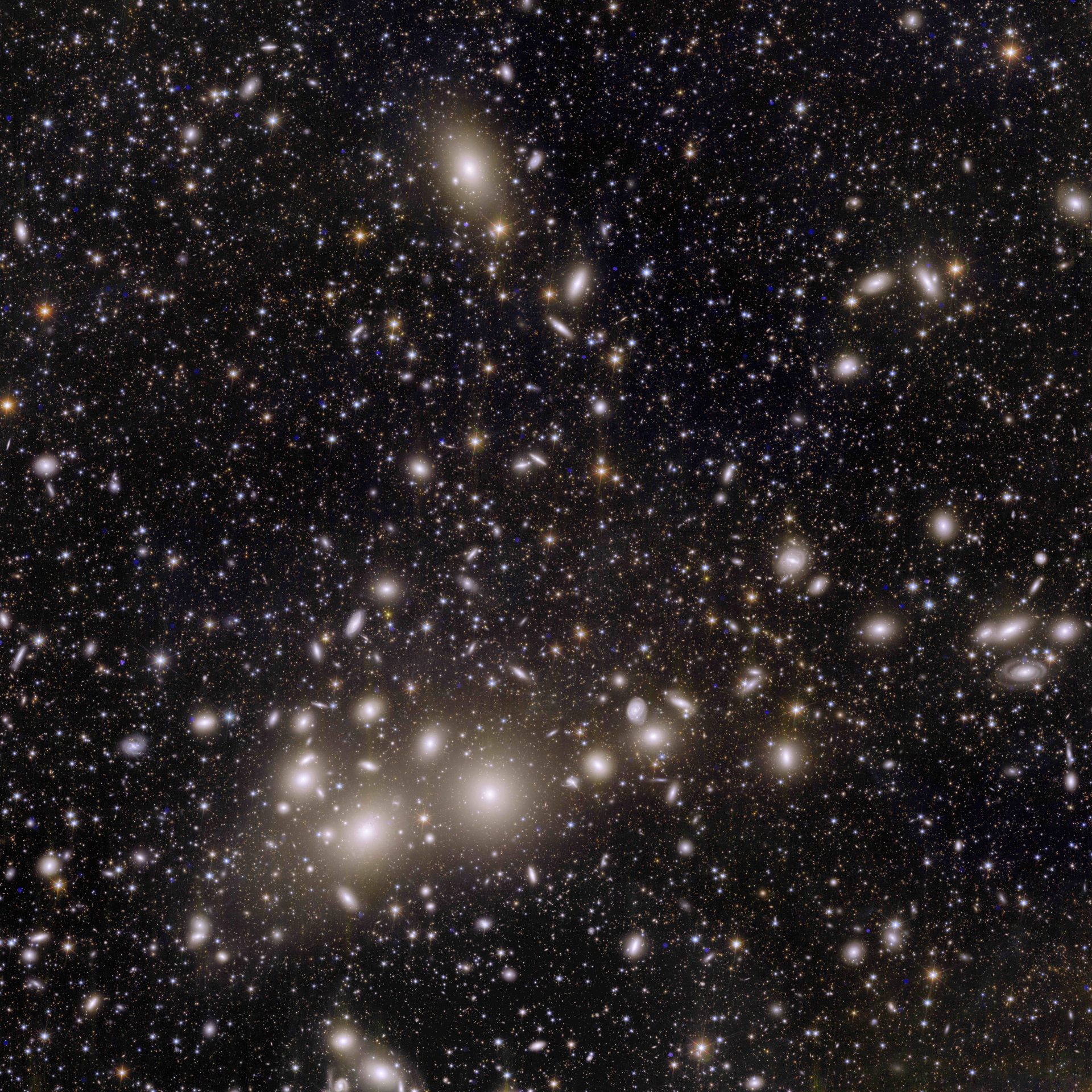
Euclid : The LCEG is heavily involved in the Euclid mission, from the ground segment to scientific exploitation. Our interests include gravitational shear measurements and what they reveal about the cosmological model, as well as studies of the connection between the cosmic web and galaxies. In preparation for Euclid, our team was deeply involved in the UNIONS survey, particularly through the MegaCam instrument on the Canada-France-Hawaii Telescope. Low surface-brightness studies of galaxies enabled us to characterize their morphology and orientation within nearby large-scale structures such as the Pisces–Perseus supercluster. This galaxy–cosmic web connection is important not only for improving our understanding of how galaxies form and evolve, but also for cosmology itself. Indeed, cosmic shear measurements are contaminated by large-scale galaxy alignments in the Universe, making detailed studies of these alignments essential.
NewAthena : Our laboratory is also involved in preparing ESA’s NewAthena mission. This flagship X-ray observatory, scheduled for launch in the late 2030s, will provide a sensitivity an order of magnitude greater than that of today’s most sensitive observatories. It will feature both a wide-field imager and a high-resolution X-ray integral field unit. NewAthena will revolutionize our understanding of hot gas in cosmic structures by enabling measurements of gas velocity fields in nearby systems, determining the thermodynamic properties of galaxy cluster outskirts, and detecting hot gas in high-redshift proto-cluster candidates. Since the growth and evolution of the galaxy cluster population over cosmic time depend sensitively on several fundamental cosmological parameters, these observations can provide independent cosmological constraints complementary to those obtained through other methods. We already successfully apply this approach using galaxy cluster catalogs identified both by current X-ray observatories and in the millimeter domain through the Sunyaev–Zel’dovich effect, notably thanks to our involvement in the XMM-Newton and Planck missions.
Numerical Simulations
Our laboratory develops cosmological simulations aimed at improving our understanding of structure formation (including galaxy clusters, the cosmic web, and galaxies) within their cosmological context. Through the ERC COLIBRI project, we perform zoom-in simulations in a variety of cosmic environments (for example, cosmic voids versus superclusters) in order to understand how these environments affect the evolutionary histories of the galaxies they host. Such environmental effects are crucial to model accurately for interpreting observations in the era of large surveys such as Euclid and LSST. However, these simulations are extremely computationally demanding and require dedicated numerical developments, which constitute an important part of our work.
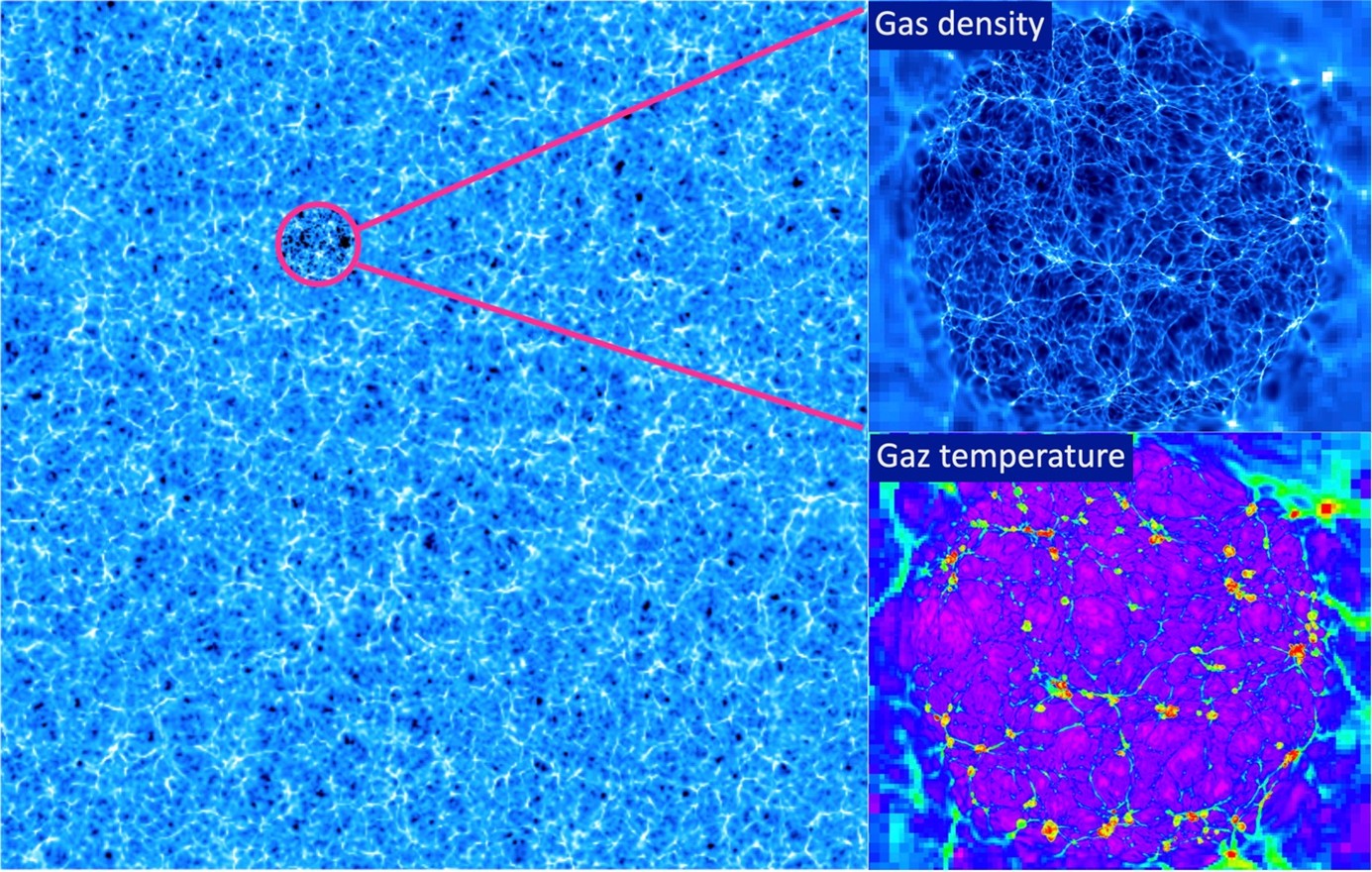
Credit © Sandrine Codis / 2023
Theory of Large-Scale Structures
We develop theoretical models aimed at understanding the evolution of matter on large scales in the Universe. In recent years, our research has focused particularly on (i) modeling the cosmic web through predictions of the abundances of peaks, filaments, walls, and voids in the Universe; (ii) modeling the weak gravitational lensing signal generated by large-scale cosmic structures. These studies rely on large deviation theory, which is also widely used in statistical physics, meteorology, and economics to understand the occurrence of rare events. They also make use of other probabilistic methods such as constrained random fields. These theoretical developments help us understand the physical processes governing the large-scale Universe and how observations of large-scale structures can improve our knowledge of the cosmological model and of fundamental physics more generally, including dark matter, dark energy, and possible modifications of gravity.