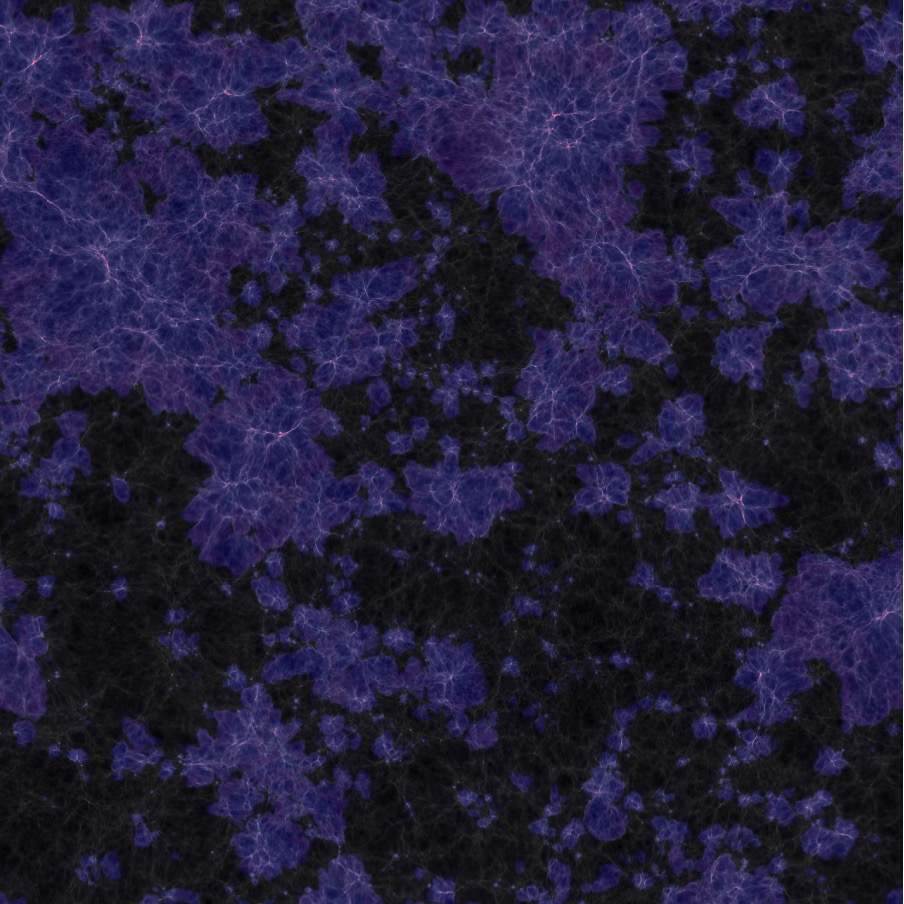





Numerical simulations play an essential role within the LCEG in supporting and enhancing the laboratory’s various research themes. This includes both the interpretation of current observations and the preparation of future surveys and instruments. To this end, several simulation-related projects and developments are being carried out at the LCEG:
- Galaxy simulations aimed at understanding the emergence and evolution of galaxies in a broad sense (the rise of the main sequence, morphological transformations, quenching, etc.). These are complemented by simulations of the first galaxies, designed to investigate the surprising nature and diversity revealed by the James Webb Space Telescope, as well as their role in the Reionization of the Universe.
- Large-volume simulations, together with advances in modeling large-scale structure formation, intended to support the scientific exploitation of new cosmological surveys such as Euclid (with strong involvement from both the DAp and the LCEG) and the Vera Rubin Observatory.
- Synthetic observations are also being developed to enable more accurate comparisons between galaxy observations and simulations, notably through work on synthetic photometry and dust attenuation.s entre observations de galaxies et simulations, notamment grâce à un travail sur la photométrie synthétique et l’atténuation par la poussière.