





The Sun’s active regions are the site of powerful radiation emissions, known as flares, which are among the most energetic phenomena in our solar system. One sub-category is distinguished by the fact that a flare located in the Sun’s atmosphere triggers another elsewhere, at a different longitude and latitude. These are called sympathetic flares. However, no statistically robust proof of their existence has yet been established.
A team of researchers affiliated to the Astrophysics Department of CEA Paris-Saclay and the Physics Department of the University of Montreal, Canada, has demonstrated for the first time that sympathetic flares are triggered within a 30-minute interval, involving active regions separated by around 30°. This distance corresponds to the typical gap between the two anchor points of magnetic loops, suggesting that these flares are caused by magnetic connectivity between these active regions. This phenomenon occurs in around 5% of solar flares located in the same hemisphere. However, when the active regions are separated by the solar equator, the phenomenon is reversed: the magnetic field would inhibit flares rather than promoting them. This phenomenon, known as unsympathetic flares, is reported for the first time in this article.
This study has been published in the journal Astronomy & Astrophysics: “Flaring together: A preferred angular separation between sympathetic flares on the Sun“. In addition, one of the figures from the study will illustrate the cover of a monthly issue of the journal A&A.
Solar flares: a phenomenon observed for a long time but still poorly understood
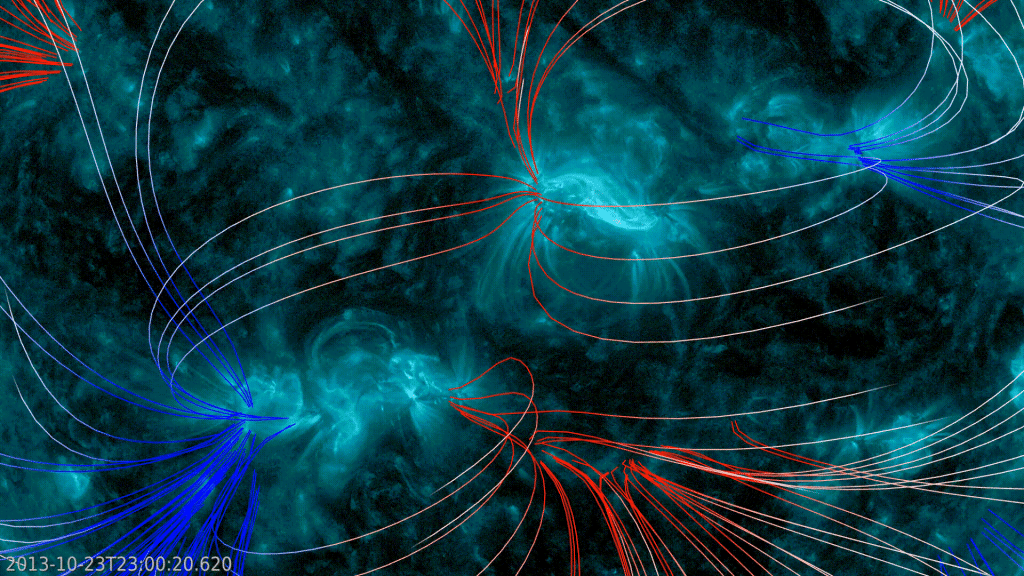
First mentioned by Chinese astronomers around 25 BC, sunspots are active regions where the Sun’s magnetic field pierces the surface of our star, freezing the plasma in the process. This stops the renewal of plasma by convection, causing these areas to cool and appear dark in contrast to the rest of the warmer surface.
The number and size of sunspots are linked to the Sun’s magnetic cycle, which has an average period of around 11 years between two maxima. During phases of maximum activity, as is currently the case, solar activity can be particularly intense, with a large number of sunspots that can be several times the size of the Earth’s diameter, making them visible to the naked eye with suitable equipment.
In 1951, scientist Richardson and his team discovered that a flare emitted by one active region could almost simultaneously trigger another in a nearby active region (see Video). However, this phenomenon, known as the sympathetic flare, had not yet been established with any statistical certainty on the Sun, and the underlying mechanisms were still poorly understood.
Sympathetic flares under the microscope
In order to assess this phenomenon statistically, the researchers analysed a large set of solar flares that had occurred over the last two solar cycles. These observations were carried out by three space missions: the Solar Dynamics Observatory (SDO), RHESSI and Solar Orbiter, using the STIX instrument whose Caliste detectors were developed at CEA-IRFU.
The researchers first found that sympathetic flares account for around 5% of solar flares, statistically demonstrating that active regions can interact with each other, increasing the rate of solar flares.
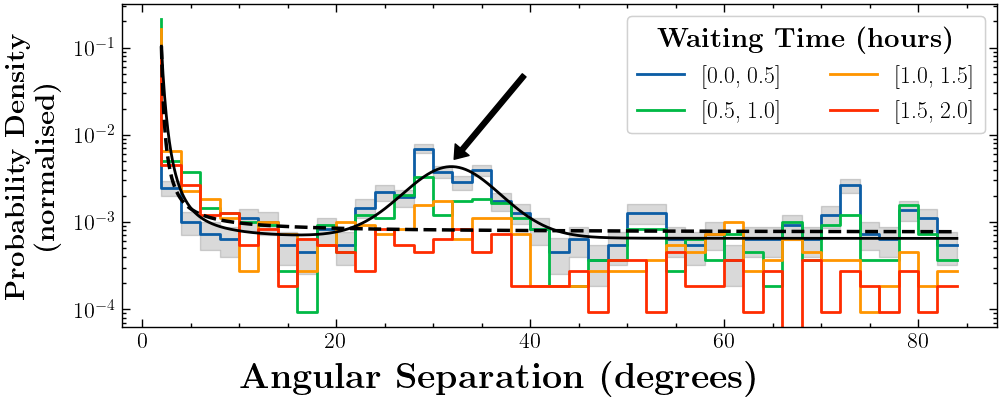
They then measured, for the first time, that the typical distance between two active regions at the origin of these sympathetic eruptions is around 30 degrees. They also determined that the time interval between two successive eruptions is less than 30 minutes (see Figure 2).
Finally, to understand the origin of this phenomenon, they measured the average distance between the anchor points of the magnetic loops, i.e. the zones where the magnetic field emerges and re-enters the surface, over the entire solar disc. Surprisingly, this distance, estimated at 30 degrees, corresponds to the distance between the active regions that cause sympathetic flares. This correlation made it possible to attribute the cause of this phenomenon to magnetic connectivity between two active regions.
Flares that aren’t always sympathetic
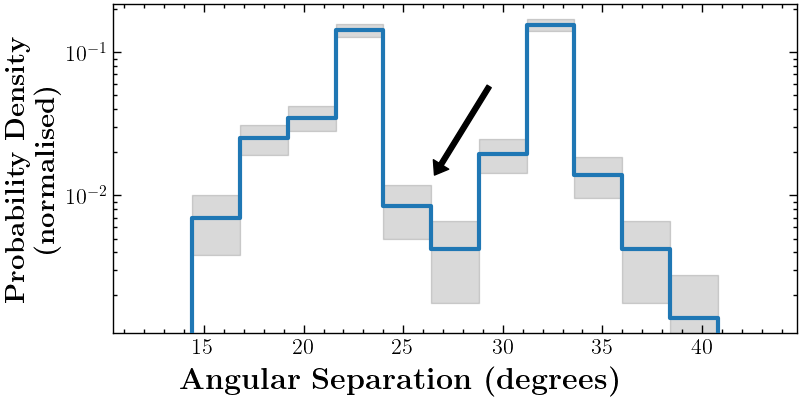
While sympathetic flares cause an excess of flares when active regions are separated by 30°, the researchers were surprised to find that when these active regions were separated by the equator, the amount of flares decreased significantly (see Figure 3). This inhibition of flares can be explained by the difference in magnetic field configuration between the two hemispheres. This phenomenon, identified for the first time in this study, has been dubbed unsympathetic flares.
This ground-breaking discovery raises fascinating questions about the physical mechanisms behind sympathetic and unsympathetic solar flares, opening up new perspectives for future research.
CEA/IRFU contacts: Antoine STRUGAREK and Louis-Simon GUITE