
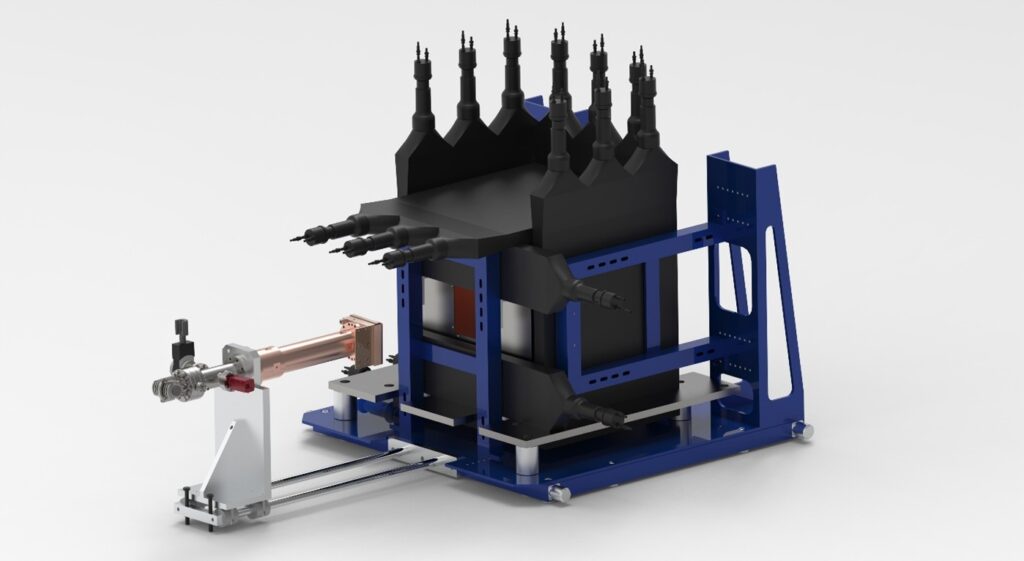
BabyIAXO marks the first step towards the ambitious IAXO (International Axion Observatory)[1], which aims to detect axions originating from the core of the Sun. Axions are hypothetical, neutral, and extremely light particles, proposed in the 1970s to solve a fundamental problem related to the strong interaction in the Standard Model of particle physics. Their extremely weak interaction with matter also makes them good candidates for explaining dark matter. Detecting them is a true challenge: it requires detectors of very high sensitivity, capable of identifying a potential axion signal amidst substantial background noise produced by cosmic rays and natural radioactivity. A Micromegas detector, specially designed for BabyIAXO, was recently installed at DESY (Deutsches Elektronen-Synchrotron, German electron synchrotron) in Hamburg for initial tests, which confirmed the excellent performance of the detection system while validating the effectiveness of the shielding. It represents one of the first tangible components of the BabyIAXO experiment.
A Hypothetical Particle to Explain Dark Matter
Axions are hypothetical particles introduced in the 1970s to solve a theoretical inconsistency in the Standard Model of particle physics, linked to the asymmetry between matter and antimatter. These very light, neutral particles, interacting only very weakly with matter, are also a serious candidate for dark matter, which makes up a large fraction of the Universe. Theoretical and astrophysical constraints estimate their mass between a few µeV/c² and a few eV/c².
The IAXO experiment, a fourth-generation helioscope, is based on a simple but ambitious idea: to use the Sun as a source of axions. These particles, if they exist, could be converted into X-ray photons when passing through a strong magnetic field, a rare but detectable process. The planned IAXO infrastructure will include a 20-meter-long toroidal magnet accompanied by eight lines of sight equipped with X-ray telescopes and ultra-low-background detectors (electronic and/or radiative).
BabyIAXO: A Reduced-Scale Demonstrator Already Under Construction
While awaiting the construction of IAXO, a first reduced-scale version called BabyIAXO [2] is being set up at DESY (Hamburg). Its purpose is to validate the technological choices of the final project.
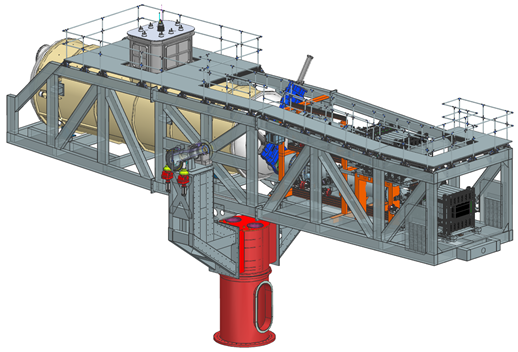
The setup is based on a 10-meter-long dipole magnet, capable of generating a 2.5 T magnetic field. Installed on a steerable platform (Figure 1), it allows tracking of the Sun for about 8 hours per day. In this intense magnetic field, solar axions could be converted into X-ray photons of about 4 keV, which would then be detected by two highly sensitive X-ray detectors placed at each end of the vacuum tubes.
The detectors used are Micromegas [3], specifically optimized for axion searches within the CAST experiment [4–7] at CERN. Their design is based on Microbulk technology [8], made from copper and kapton, two materials well known for their excellent radiopurity. This approach is complemented by optimized passive and active shielding, as well as advanced analysis techniques enabling effective topological discrimination of the signal. Topological analysis consists of comparing the “shape” of events in the detector to distinguish those resembling the expected signal from those due to background noise. An expected signal event (a photon from a converted axion) produces a simple, localized trace: a small spot or compact cluster in the readout plane, while a background event (natural radioactivity, cosmic muons, multiple interactions, etc.) generally leaves a different signature: an elongated track, multiple energy deposits, or a more complex topology.
New-Generation Micromegas Detectors for BabyIAXO
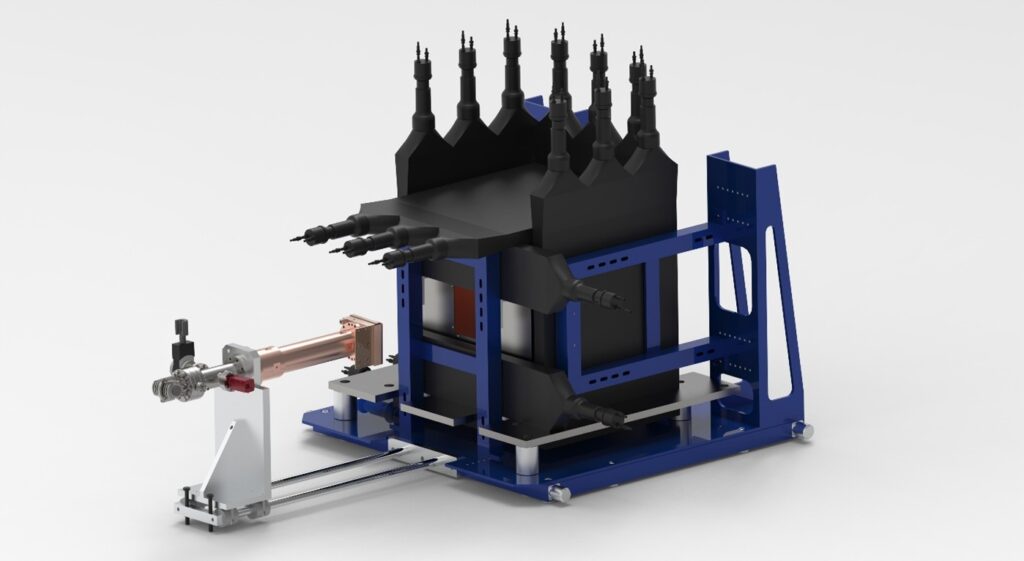
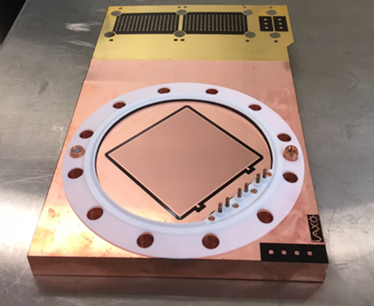
A new Micromegas detector was developed for BabyIAXO, with improved radiopurity (Figure 2). Several prototypes were built and tested with different shielding configurations. The shielding is designed to block or attenuate unwanted particles and radiation from the environment that contribute to background noise.
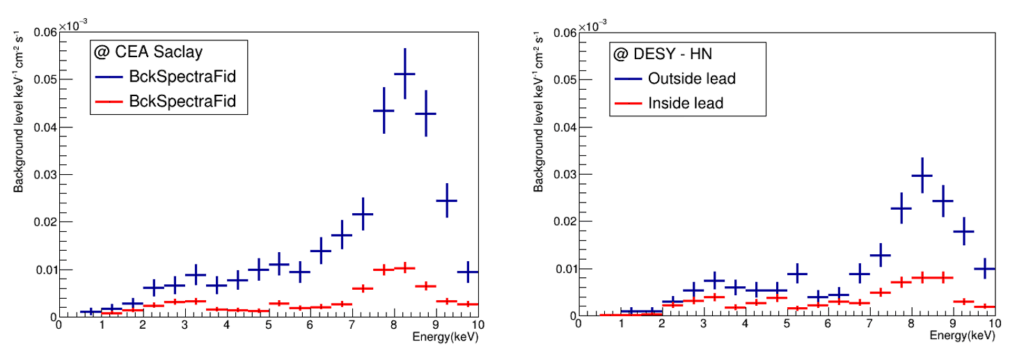
A monoblock 20 cm thick lead shield, made from low-radioactivity lead (~5 Bq/kg), was custom designed and built at Irfu. A prototype tested in this shield reached a background level of 2.6×10⁻⁶ ± 2.6×10⁻⁷ c/keV/cm²/s after selection cuts. This result illustrates the remarkable performance of the system: a detector both extremely “sensitive” and “quiet,” leaving only about eight events in one month of data after selection.
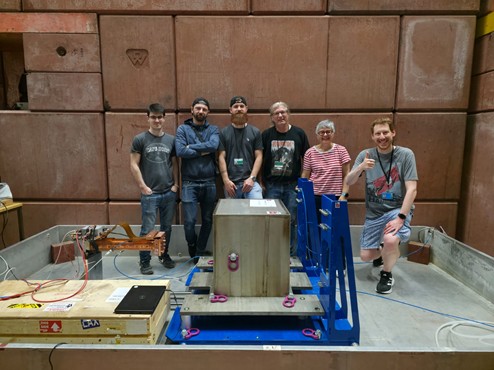
To reject cosmic muons, a 4π veto system was developed, consisting of scintillators coupled to photomultipliers (Figure 3). The entire setup was transported to DESY in June 2025 and installed in the HERA North hall, the former site of the H1 experiment, located about six stories underground.
The first background measurements carried out on site, outside the shielding, reveal an even lower level than that observed at Saclay (Figure 5, right, blue points). This improvement is mainly due to the detector’s underground location, which provides significant attenuation of the cosmic-ray flux. Results with the detector inserted in the shielding are consistent. These results confirm the excellent performance of the detection system and validate the effectiveness of the shielding. The next step will be to fully integrate the muon veto for even more sensitive detection.
While awaiting the construction of the magnet, the various BabyIAXO subsystems — vacuum tubes, X-ray telescopes, detectors — continue to be developed. A full test of the instrument’s detection lines is planned within three years, marking a crucial step towards the realization of BabyIAXO and IAXO
Contact : Esther Ferrer-Ribbas
References
[1] IAXO Collaboration, Physics potential of the International Axion Observatory (IAXO), JCAP 1906 (2019) no.06, 047
[2] BabyIAXO Collaboration, Conceptual Design of BabyIAXO, the intermediate stage towards the International Axion Observatory, Journal of High Energy Physics, volume 2021, Article number: 137 (2021)
[3] D. Attié et al., Current Status and Future Developments of Micromegas Detectors for Physics and Applications Appl.Sciences 11 (2021) 12, 5362
[4] CAST Collaboration et al, Nature Phys. 13 (2017) 584-590
[5] CAST Collaboration New Upper Limit on the Axion-Photon Coupling with an Extended CAST Run with a Xe-Based Micromegas Detector, Phys.Rev.Lett. 133 (2024) 22, 221005 e-Print: 2406.16840 [hep-ex]
[6] FM CAST 2017: https://irfu-i.cea.fr/Phocea/Vie_des_labos/Ast/ast.php?t=fait_marquant&id_ast=4027
[7] FM CAST 2009: https://irfu-i.cea.fr/Phocea/Vie_des_labos/Ast/ast.php?t=fait_marquant&id_ast=2580
[8] S. Andriamonje et al. Development and performance of Microbulk Micromegas detectors, JINST 5 (2010) P0200