
Researchers from the international DESI collaboration, which includes a team from IRFU, have just completed—ahead of schedule—the large galaxy survey originally planned for a 5-year period. Preliminary results suggest that the acceleration of the Universe’s expansion may not be governed by a cosmological constant but rather by a time-dependent “dark energy.” These findings have had a major impact on the scientific community, and DESI will continue its observations until the end of 2028 to confirm this potential groundbreaking discovery.
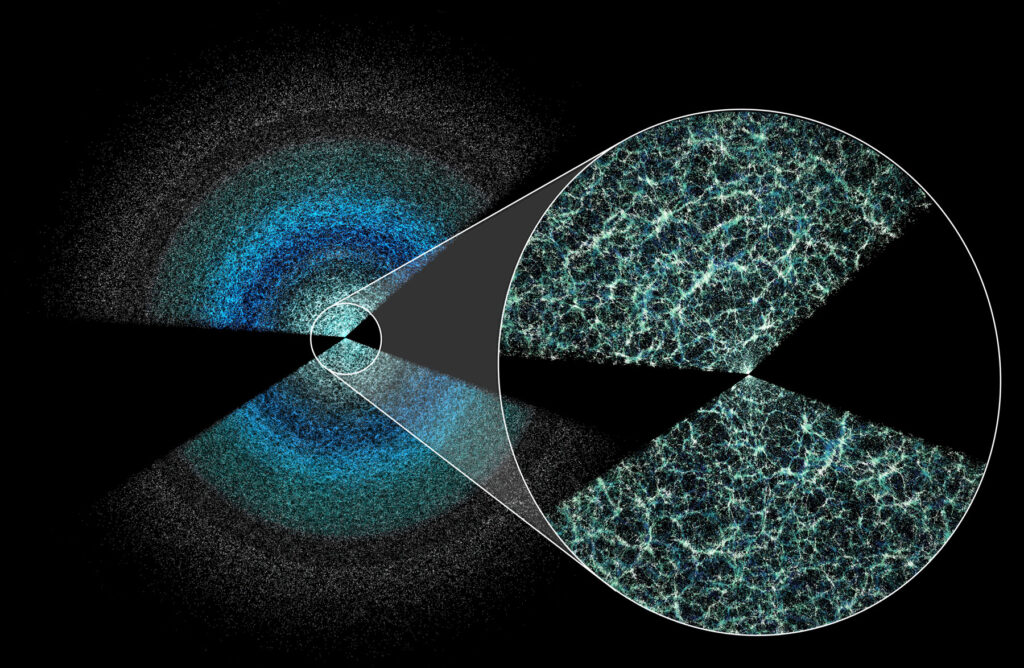
The image above shows a thin slice of the 5-year Universe map produced by DESI. It displays galaxies and quasars, with Earth at the center of the sections. The black zone indicates where our own galaxy obscures distant objects. The light from the farthest galaxies shown took 11 billion years to reach Earth.
On the night of April 14–15, 2026, the DESI collaboration observed the final “tile” of the originally planned survey (a tile corresponds to a telescope pointing at a region of the sky covering about 8 square degrees, or 16 times the area of the full Moon). Over the past 5 years, every 20 minutes, the DESI instrument has switched tiles and measured the spectra of 5,000 new galaxies, covering more than a third of the sky.
DESI’s original goal was to capture light from 34 million galaxies and quasars (extremely distant but bright objects with black holes at their centers) over five years. In reality, DESI has observed over 47 million galaxies and quasars, as well as 20 million stars.
Thanks to this instrumental success, the DESI survey will continue for an additional two and a half years until the end of 2028.
This time-lapse video shows how the DESI spectroscopic instrument built its observation map over five years. Each “tile” represents a telescope pointing, where DESI records the spectra of thousands of objects simultaneously. The tiles overlap to densify the map, with most areas observed multiple times. The observations shown here were collected during the “Dark-Time Survey”, a campaign targeting the faintest and most distant objects DESI can observe, located billions of light-years away.
Credit: DESI data: Anand Raichoor/DESI Collaboration; Sky map: Axel Mellinger, “A Color All-Sky Panorama Image of the Milky Way,” Publ. Astron. Soc. Pacific 121, 1180–1187 (2009)
The spectrum of each galaxy and quasar measured by DESI is analyzed to determine their positions in the largest and densest 3D map of the Universe to date. Researchers use this map to explore dark energy, a fundamental component that makes up about 70% of our Universe and is responsible for its accelerated expansion.
By observing the distribution of galaxies in the Universe, researchers have traced the influence of dark energy over 11 billion years of cosmic history, which began approximately 13.8 billion years ago. The surprising results from the first three years of DESI observations suggest that dark energy, long considered a cosmological constant, may actually evolve over time. These findings, whose scientific papers were the most cited in 2025, have had a profound impact beyond the cosmological community.
With the complete five-year dataset, researchers will have much more information to verify whether this hypothesis holds. If confirmed, it would mark a major shift in our understanding of the Universe and its fate, which depends on the balance between matter and dark energy. Should we modify the theory of general relativity, or invoke a fifth force?
DESI has now measured cosmological data for six times more galaxies and quasars than all previous surveys combined. The collaboration has already begun processing the full dataset, with the next results on dark energy from the complete 5-year DESI mapping expected in 2027
What’s next? Teams are working to define a scientific program and technical improvements to continue the incredible scientific harvest already underway. The scientific program for the so-called “DESI-2” phase would be based on four pillars.
A survey with ten times the density of DESI for the last 8 billion years of the Universe’s evolution (redshift <1) to study the nature of dark energy and test the theory of general relativity.
A survey of the Universe when it was 2 to 4 billion years old, a time when the Universe was still a faithful reflection of primordial initial conditions. This era is highly sensitive to the cosmic inflation model and the sum of neutrino masses.
The third part of the survey aims to measure the spectra of tens of millions of stars in the Milky Way and the “Local Group,” including the first extensive survey of the Andromeda galaxy, to better understand local dynamics and dark matter.
A strong synergy with the Rubin-LSST Observatory is planned. The DESI-2 program would begin in 2029 for a duration of 6 years and pave the way for future large surveys, such as the Widefield Spectroscopic Telescope, with first light expected in 2040.
Contacts: Etienne Burtin, Christophe YECHE