A DES-DRF collaboration at the crossroads of expertise
Molecular dynamics simulations have just quantified the effect of crystalline defect formation on the re-sponse of ultra-sensitive cryogenic detectors used for neutrino and dark matter detection. Researchers hunt these ghostly particles through their interactions in a crystal. The challenge lies in determining the relationship between the energy transferred to the atom struck by the incoming particle and the signal that will be recorded in the crystal. Such calibration is difficult because the energies involved are extreme-ly low. This study quantified both the creation of crystalline defects by the recoiling atom and the fraction of the initial energy stored in these defects. The work, published in Phys. Rev. D, results from a collabora-tion between the Nuclear Physics Department (DPhN) and the Materials Corrosion and Behavior Research Division (DES-S2CM). It offers a deep dive into atomic-scale interactions that will help exploit the full sen-sitivity of the detectors.
Imagine an atom neatly aligned among many others in the crystal lattice of a cryogenic detector. Suddenly struck by a particle unseen both in its arrival and departure, it is ejected from its site with an energy of about 100 eV, collides with a few neighbors, and finally comes to rest. The lattice “gong” vibrates for a few milliseconds in response to this tiny perturbation, then everything freezes again in the detector’s cryostat. This lilliputian event seems, at first glance, inaccessible—forever lost in the hidden bustle of matter. And yet, this is the very portrait of the signal physicists are now chasing in their detectors in the search for dark matter or coherent neutrino scattering. These two elusive candidates can indeed make an atom recoil without leaving any other trace in the detector. A broad experimental program is underway, including the NUCLEUS project at IRFU, which studies coherent neutrino scattering in calcium tungstate (CaWO4) crystals near the Chooz nuclear power plant. In fact, the technology already exists to “hear” this micro-bong of a crystal, which physicists call the phonon signal. But linking this signal to the initial recoil energy remains a daunting task. Understanding the detector response in this ultra-low energy regime is still largely uncharted territory.
The effect studied is the formation of crystalline defects at the end of the cascade of atomic displace-ments triggered by the initially struck atom. These defects are residual deformations of the atomic lattice, or even vacancies left by atoms ejected from their original sites and trapped in interstitial positions (so-called Frenkel pairs). The energy stored in these deformations is “invisible” in the sense that it does not contribute to the detector signal. But what fraction of the initial recoil energy does it represent? In her PhD carried out between DPhN and S2CM, Gabrielle Soum-Sidikov addressed this question for CaWO4 detectors used in the NUCLEUS experiment. This work has just been published in Physical Review D [1].
The simulations were performed using molecular dynamics with the LAMMPS code (Large-scale Atom-ic/Molecular Massively Parallel Simulator). This method tracks step by step the evolution of atomic posi-tions and velocities over time. At each timestep, the forces on each atom are computed based on their relative positions, and Newton’s equations of motion are applied to update positions and velocities. The accuracy of such simulations relies on modeling the interatomic potential from which forces are derived. No suitable potential existed for CaWO4. We therefore developed a machine-learning potential trained on a database of point defects in the CaWO4 crystal. This approach is computationally expensive but more accurate than conventional empirical potentials.
The database was designed to include as many configurations as possible (ideal lattice, Frenkel pairs of tungsten, calcium, or oxygen, local cell deformations, thermal agitation, etc.). For each configuration, the system’s total quantum energy and the corresponding atomic forces were calculated using density func-tional theory. These high-precision but heavy calculations were performed with the VASP code (Vienna Ab initio Simulation Package). While VASP cannot directly describe the time evolution of atomic cascades, it provides enough information to build, via the machine-learning code Milady (Machine Learning DYnamics), the interatomic potential needed for the molecular dynamics simulations.
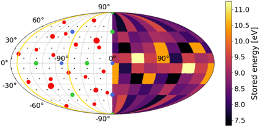
The results are shown in Figure 1. The energy stored in defect formation for a tungsten atom recoiling with 112 eV is plotted as a function of recoil direction. The average is 8.9 eV, i.e. a non-negligible 8% of the initial energy. Moreover, varying the initial kinetic energy shows that the average stored energy is not proportional to it. Indeed, there exists a “displacement threshold” below which no defects are created. Above this threshold, the predicted distribution of stored energies is rather broad. This shows that for a tungsten recoil in CaWO4, in addition to one or two vacancy–interstitial pairs, there also appear local dis-tortions, broken bonds, etc., leading to a complex relationship between the initial recoil energy and the fraction stored in defects.
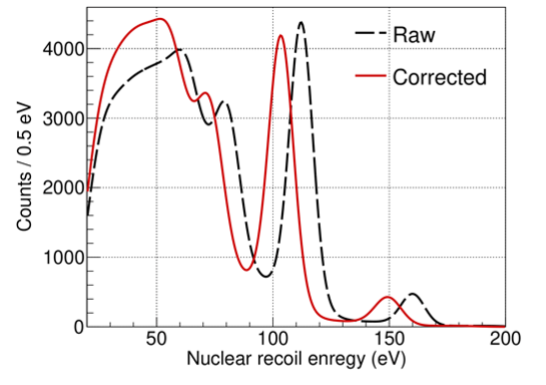
The CRAB collaboration (Calibrated Recoils for Accurate Bolometry) has recently proposed using neutron capture in cryogenic detectors to precisely characterize their response by generating nuclear recoils of known energy in the relevant range. This method is validated by preliminary measurements, and a high-precision phase is under development. Figure 2 illustrates the expected CRAB spectrum in CaWO4, with three main recoil peaks at 81, 112, and 160 eV. After including defect formation, these peaks are visibly shifted to lower energies (nonlinearly) and their relative intensities are altered. Comparing predicted and measured spectra will thus provide a unique test of our understanding of defect creation in a threshold-sensitive regime. The study of atomic recoils with the CRAB method will also complement existing calibra-tions, which mainly produce electron recoils without atomic displacements.
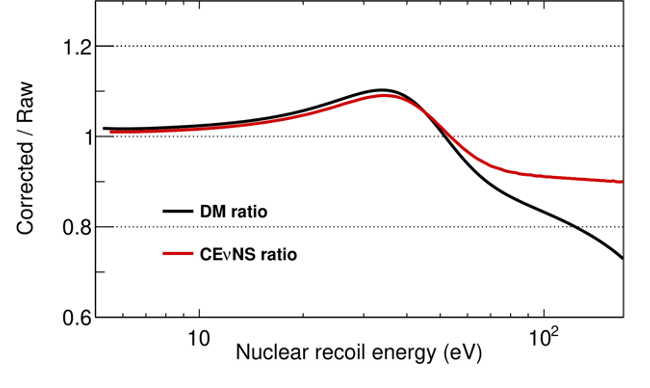
Like the CRAB spectrum, the recoil energy spectra from elastic scattering of dark matter particles or neu-trinos are also affected by defect formation. Figure 3 shows predicted distortions of about ±10%, depend-ing on recoil energy. Such deviations must be taken into account in comparing future results with theoret-ical predictions in order to fully exploit the sensitivity of these experiments.
This fruitful collaboration between DES and DRF addresses a strong need for solid-state expertise within the low-threshold cryogenic detector community. It will continue, extending calculations to germanium crystals, a material used in many projects.
References :
[1] Calculation of crystal defects induced in CaWO4 cryogenic detector by 100 eV displacement cascades using a data driven force field, G. Soum-Sidikov, J. P. Crocombette, M. C. Marinica, C. Doutre, D. Lhuillier, and L. Thulliez, Phys. Rev. D 111 (2025) 8, 085021