

Non-destructive elemental analysis using negative muons is a new method to study the composition of material samples without any damage.
An analysis of one-dimensional depth profile was demonstrated with Ge semiconductor detectors by changing momenta of muons at MUon Science Establishment (MUSE) at Japan Proton Accelerator Research Complex (J-PARC). However, in order to study the real distribution of elements in samples, two-dimensional spatial information, in conjunction with spectra, is indispensable.
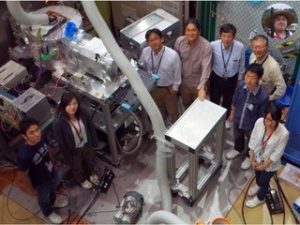
Dr. Katsuragawa and her team have developed a prototype compact imager with the CdTe double-sided strip detector (CdTe- DSD) which has a large effective area (32 mm × 32 mm). The CdTe detector has a high energy resolution of 1–2 keV at 60 keV and a high position resolution of 250 μm. Since, the counting rate of the experiment is so high that pinhole optics can be used. With a conic pinhole collimator, the team was able to reconstruct images with a simple back projection method.
Dr. Katsuragawa and her team have performed several experiments on non-destructive analysis using negative muons at the MUSE/J-PARC. They prepared various samples which consist of light elements (Li, B N, F, Al) and have succeeded to derive spatial distributions of these light elements by using muonic X-rays ranging from 17 keV (Li) to 52.3 keV (B).
Kavli Institute for the Physics and Mathematics of the Universe (Kavli IPMU) The University of Tokyo