

An international research team, led by Irfu, GSI/FAIR in Darmstadt and the MPI for Nuclear Physics in Heidelberg, both in Germany, has succeeded in observing a two-photon decay on a so-called bare atomic nucleus from which, for the first time, the entire electron shell has been removed. The measurements on germanium-72 nuclei were carried out as part of the FAIR Phase 0 experimental program at the experimental storage ring ESR at GSI/FAIR, improving the applicability of similar experiments by two orders of magnitude. The results have been published in the journal Physical Review Letters [1].
The nuclear two-photon or double-gamma decay is a second-order electromagnetic process, whereby a nucleus in an excited state emits two gamma rays simultaneously. This new type of radioactivity was first discovered in the 1980s at the MPI, but further investigations were impossible until now due to its rare nature. Using bare nuclei allowed to extend these studies to low-energy excited states (below 1 MeV), where the branching ratio is far too small to allow a direct observation of the gamma rays. Studying this process gives insight into fundamental properties of the nucleus, such as the difference in electric polarisability and magnetic susceptibility of the nucleus in different states of excitation, which currently cannot be described by state-of-the-art nuclear models.
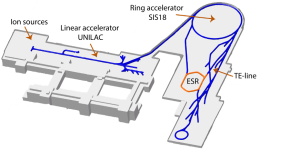
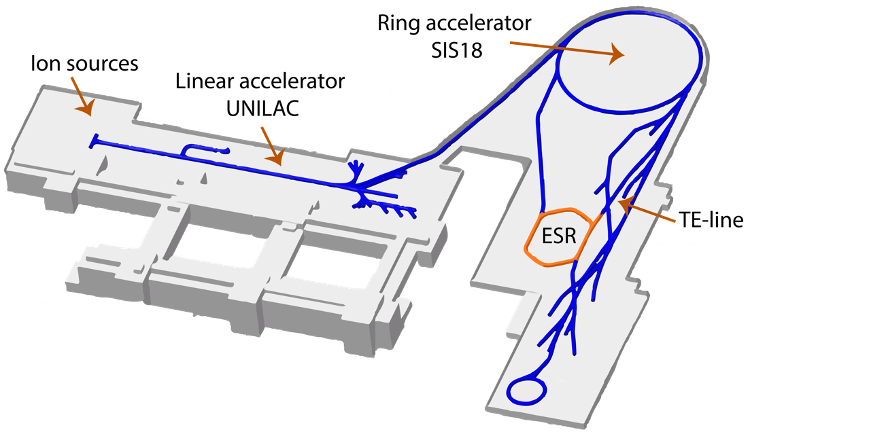
In the recent experiments, this rare phenomenon was studied in a specific isotope of Germanium, with mass number A=72, which was stripped of its entire electron shell. For this purpose, a beam of krypton ions was accelerated to about 70% of the speed of light with the GSI/FAIR accelerator facility (see Fig. 1) and subsequently passed through a beryllium plate with a thickness of ~1 centimetre. In the collision, these germanium ions are (in a few percent of all cases) produced in a specific excited state, which has the same spin-parity quantum number 0+ as the ground state. In this situation the usually dominating decay by the emission of a single gamma-ray is forbidden due to angular momentum conservation, since the gamma-ray must take away an intrinsic spin of one unit. Other competing decay modes, such as the transfer of the energy to an electron of the atomic shell, are also not possible for fully-stripped nuclei. The double-gamma decay becomes the lowest-order, and thus the dominant decay mode. The scientists utilized this situation to directly measure the partial half-life for the double-gamma emission.
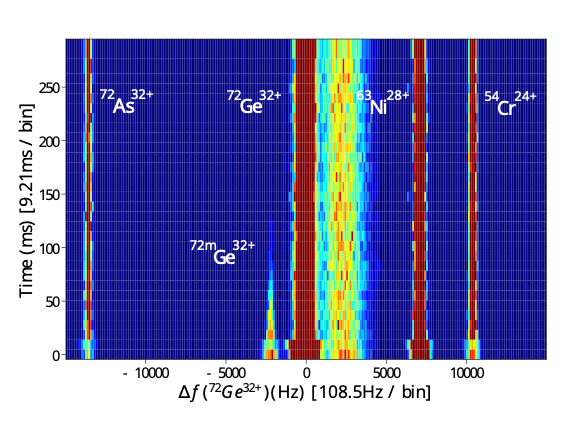
However, this measurement relied upon another technical innovation using the experimental storage ring ESR at GSI/FAIR in a specific “isochronous” operation mode, in which all particles with the same mass-to-charge ratio and within a finite momentum range circulate at constant frequency. In this way the ground and the isomeric states of the 72Ge ions can be reliably resolved by non-destructively measuring the revolution frequencies of all particles trapped in the storage ring (see Fig. 2), despite their very small relative mass difference of the order of 10-6. From the decay rate of the ions in the isomeric state the half-life for the 2γdecay of the first-excited 0+ state in bare 72Ge ions was determined to be 23.9(6) ms, which strongly deviates from expectations based on the earlier measurements and is about fifty thousand times longer than in the atom. With this ratio it should be possible to directly observe the g rays in a dedicated experiment and shed light on the origin of the unexpected short half life.
More generally, the newly developed technique made it possible to measure a half-life that is at least two orders of magnitude shorter than the shortest lifetime directly measured previously for stored highly-charged ions. This promising technique will be applied to search for new isomers with excitation energies down to ∼100 keV and half-lives as short as a few ms, allowing the discovery of hitherto unknown low-lying isomers over the whole nuclear chart.
[1] D. Freire-Fernandez et al. Phys. Rev. Lett. 133, 022502 (2024).