

Axions are particles that resolve the strong CP fine-tuning problem in quantum chromodynamics, which, in general, should not respect CP symmetry. Produced nonthermally in the early universe, they are excellent candidates for cold dark matter (DM), despite expected masses on the order of µeV. Axions couple to the classical electromagnetic field via an effective two-photon vertex. In the presence of a magnetic field, an axion-photon mixture is therefore expected.
In direct detection experiments, the strategy involves inducing the conversion of dark matter present in the form of axions in the laboratory by applying an intense magnetic field. In 2020, the DPhP group secured ERC funding for the G-LEAD project. As part of this project, two experiments are currently under construction at CEA Saclay, which share a common cryostat and detection system. The detection system is a radiometer operating between 10 GHz and 40 GHz, designed to detect an increase in power due to a signal emitted by the magnetized region located opposite it. The cryostat is a cylindrical chamber 5 m long and 2 m in diameter, designed to cool the experiment to around 4 K to minimize thermal background noise.
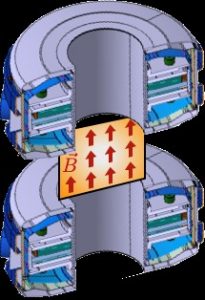
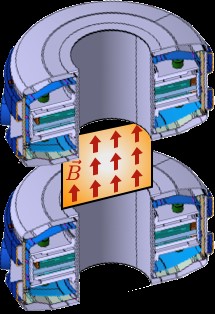
The first experiment, DAWA (Dark Axion Wideband Approach), uses a set of permanent magnets in a specific, patented spatial configuration. The second experiment, Super-DAWA, will employ high-critical-temperature superconducting coils. The originality of the approach lies in its wideband design, whereas most competing experiments use resonant systems. The use of modular magnetic emitters, as opposed to a single, large magnet, is another distinctive feature of the project.
The group includes teams from DPhP, DEDIP, DACM, and DIS, supervises two doctoral students, and hosts several undergraduate (L3) and graduate (M1, M2) interns each year.
Contact: Pierre Brun