

The DPhP’s High-Energy Gamma-Ray Astronomy group studies the most extreme phenomena in the Universe. These sources can be the vicinity of compact objects such as black holes and neutron stars, or dense cosmic structures where dark matter particles could annihilate. The group uses ground-based Cherenkov telescopes to analyze atmospheric sprays produced by high-energy gamma-ray photons, notably within the H.E.S.S. network, while participating in the construction of NectarCAM cameras and mirrors for the future CTAO observatory.
Within H.E.S.S., the DPhP works on several major themes, including fundamental physics, surveys (galactic and extragalactic), temporal variability, and the search for high-energy counterparts to gamma-ray bursts (see multimessenger astrophysics). The group contributes to the search for massive dark matter particles (WIMPs), by analyzing the central source and its environment, but also satellite or irregular dwarf galaxies and galaxy clusters. Other candidates for explaining dark matter, primordial black holes, were sought by the burst that would signal the end of their evaporation.
The group has played an important role in the survey of galaxies, extragalaxies and the galactic center (GC). The GC is a complex region, rich in cosmic gas pedals (Sagittarius A*, supernovae, pulsars) and unexplained phenomena such as Fermi bubbles. The group’s expertise in the indirect detection of dark matter has enabled it to make a major contribution to CTAO’s scientific program, notably in the drafting of the Dark Matter Program.
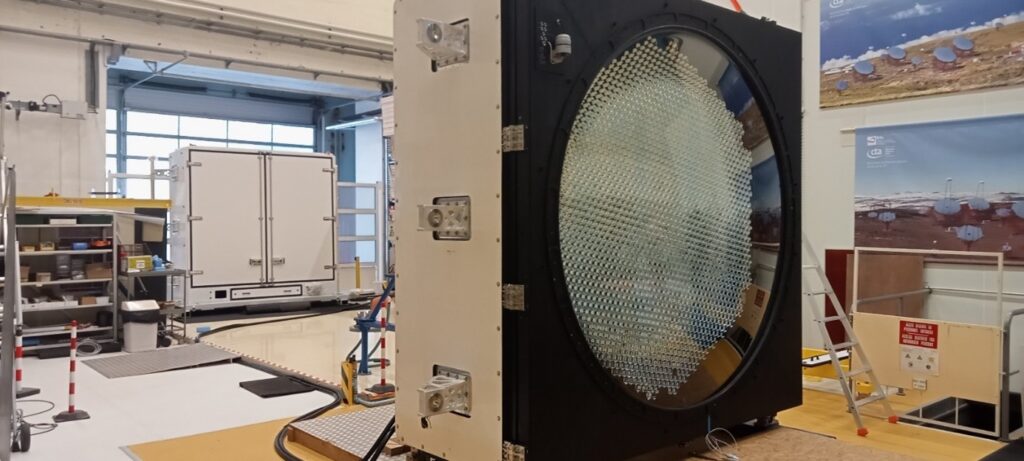
CTAO, a future network of telescopes covering 20 GeV to 300 TeV, will be deployed in the Canary Islands and Chile. The IRFU is responsible for the scientific and technical aspects of the NectarCAM cameras for the medium telescopes (12 m reflector) and for the development of the mirrors for these same telescopes. NectarCAM cameras, comprising 265 photomultiplier modules with a wide field of view, are assembled and tested at Saclay. The segmented mirrors, also designed at the IRFU, are individually characterized to guarantee their optical performance before installation.
Contact: Jean-François Glicenstein