
Astrophysical Image Processing
The observation of astrophysical objects, whether from the ground or from space, yields an ever-increasing amount of data, which is affected by atmospheric turbulence or the imaging capabilities of the telescope. Furthermore, the images suffer from intrinsic limitations due to the instrument’s aperture (the size of the telescope’s primary mirror) and the presence of potential optical aberrations. Optimally utilizing existing and future instruments therefore requires the development of specific analysis tools.
In this context, the Multiresolution program—the result of a collaboration between research engineers at Dedip and DAp—is developing methods and algorithms that make the best use of knowledge regarding image formation mechanisms. The technique, based on the “wavelet transform,” makes it possible to separate details corresponding to different spatial scales within an image, hence the term “multiresolution.” Its applications span a wide range of areas, including filtering, deconvolution, shape detection, and data compression. Research topics employing these techniques include, among others, the detection of dark matter via weak gravitational lensing or the Sunyaev-Zel’dovich effect, the characterization of the internal structure and dynamics of stars (asteroseismology), and the characterization of the cosmic microwave background.
Parallel Computing, Visualization, and Software Engineering for the Numerical Simulation of Astrophysical Plasmas
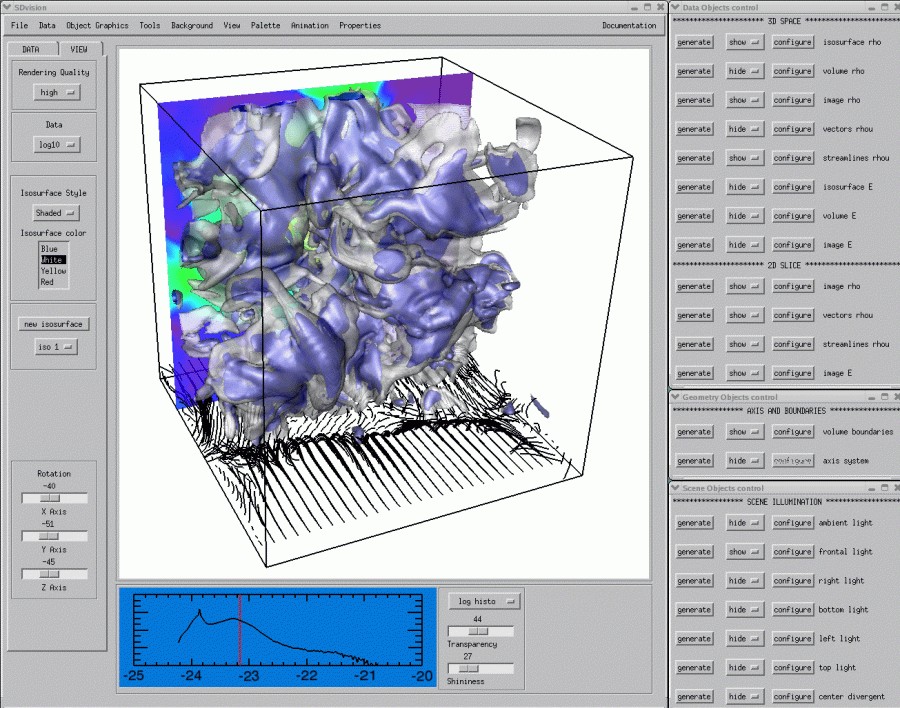
The Coast (COmputational ASTrophysics) program was launched in 2005 at IRFU to establish an ambitious software engineering initiative applied to numerical simulations in astrophysics. The goal is to optimize, parallelize, and manage computer programs using specialized tools. Coast has thus enabled the development of the SDvision visualization software, capable of analyzing the results of hydrodynamic simulations conducted at Irfu; it has also facilitated the creation of the Odalisc opacity database for modeling laser and astrophysical plasmas, as well as the implementation of common tools for managing program versions. Expertise in various fields (cosmology, the interstellar medium, protoplanetary disks, stellar physics, and the physics of dense, hot plasmas generated by lasers), along with the skills acquired in numerical analysis and software development, give Irfu a leading role in several international collaborations, such as the Horizon, Odalisc, Magnet, and Sinerghy projects. Participation in these projects will require significant involvement from IRFU in the coming years to develop and disseminate these computational tools and methods intended for international communities of researchers in astrophysics, geophysics, and plasma physics.