Neutrinos are quite remarkable elementary particles which are produced in great abundance in the sun, in the atmosphere and at the core of nuclear power reactors. DAPNIA has been interested in them for a very long time. It has now been established that although they are very light, neutrinos do not have zero mass. It remains to be determined how these masses are distributed among the three known varieties of neutrino: ne, nμ and nτ
last update : 10-18 00:00:00-2005 (529)
![]() |
04-03-2011
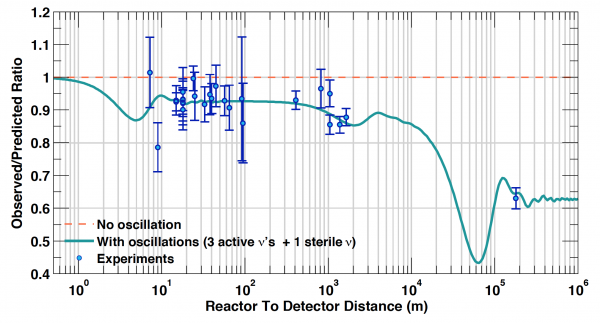
IRFU's Double Chooz group has just published some surprising results regarding the flux of antineutrinos generated by uranium and plutonium fission products in nuclear power reactors. A more precise estimate of this flux has revealed a +3% shift with respect to the predictions considered as the benchmark for the past 25 years. The re-analysis of the most important past reactor neutrino experimental results, in the light of this new flux prediction, lead to the so called 'reactor antineutrino anomaly'. Including other effects such as the evolution of the neutron lifetime and the presence of long-lived fission isotopes, the averaged shortfall in the number of antineutrinos detected at short ... More » |
![]() |
02-06-2009
The second phase of the Double Chooz international experiment officially began on Wednesday 20 May. The Declaration of Intent signed by the four partners (CEA, CNRS, EDF, Champagne-Ardenne Region) is the first step in the plan to build a second detector devoted to neutrino research next to the Chooz nuclear power plant.
Prior to signing the DOI, the participants visited the site of the first detector, currently under construction. By the end of the year, the detector should pick up the first neutrinos emitted by the plant and attempt to measure the disappearance of primary flux neutrinos. The second detector, which will be operational two years from now, will provide precise ... More » |
![]() |
16-02-2010
In Japan at the end of January 2010, the detectors of the Tokai to Superkamiokande (T2K, [ti:tu:kei]), developed at Saclay, observed their first neutrinos. These detectors consist of two large chambers where the tracks of charged particles are able to be reconstructed and the neutrino beam can be characterized. In this experiment, neutrinos are created by a proton beam coming from the Tokai accelerator. These same neutrinos are then measured 300 km away, at Kamioka, in a large water vessel 40 m in diameter and 40 m high, which was previously used to study neutrinos coming from cosmic ray interactions in the atmosphere and to definitively prove the phenomena of neutrino oscillation ... More » |
![]() |
14-09-2009
Engineers and physicists from IRFU have successfully assembled and commissioned three large chambers designed to reconstruct charged particle tracks. The chambers will characterize the neutrino beam used in the T2K (Tokai to Kamiokande) experiment. They are the first large Time Projection Chambers (TPCs) to be equipped with micromesh gas detectors (Micromegas). The chambers have a very large sensitive area (nearly 9m²) and a correspondingly high number of electronic channels (124,000). IRFU built the entire detection system of the three TPCs, comprising 72 Micromegas detectors and all the front-end electronics. Engineers from SEDI, a department specialised in ... More » |