

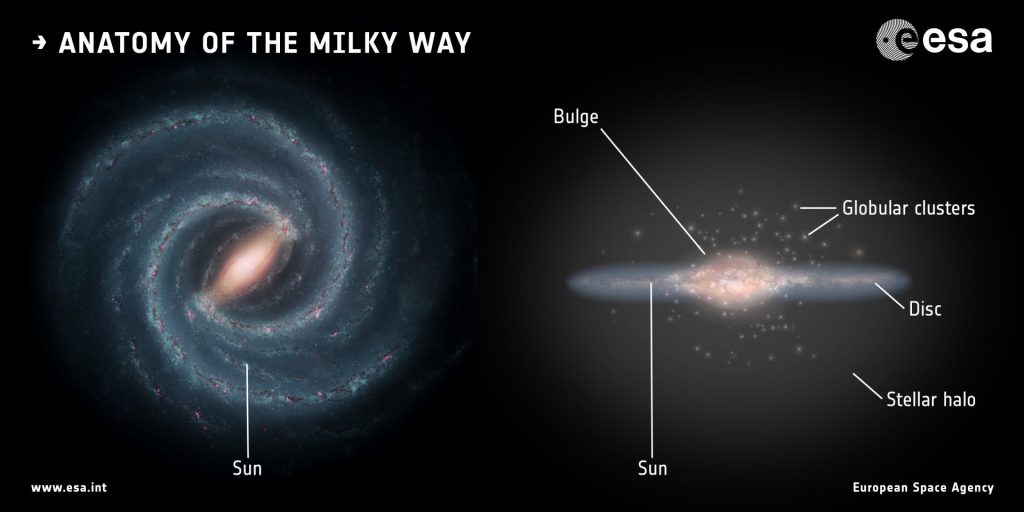
Artist’s impression of our Milky Way, a “barred spiral galaxy” around 13 billion years old, with an omplex, interlocking structure: thin, thick discs of stars surrounded by an extended halo, with a bulge of old stars at the centre. A bar of stars runs through the centre of our galaxy and globular clusters – ancient collections of thousands or millions of stars – dot the galactic bulge and halo.
Our spiral galaxy, the Milky Way, has a complex structure, characterised in particular by its star-studded centre surrounded by globular clusters – ancient collections of thousands to millions of stars (see Figure). These structures did not always exist, and one of the major objectives of galactic research is to understand when and how these components formed.
Using chemical and dynamical data from the star SOS1, which stands out clearly from its neighbours, stellar researchers, including members of the CEA-IRFU Astrophysics Department, have traced its probable origin within one of the galaxy’s most massive globular clusters, Terzan 5, dating back 353 million years. The study suggests that SOS1 could have been ejected from its natal cluster by gravitational interaction or captured by the tidal forces of the Milky Way. These findings support the idea that many stars in the central bar of the galaxy were transported by gravitational forces, playing a key role in the assembly of the Milky Way’s ancient structures.
The results were published in The Astrophysical Journal Letters and made the front page of The American Astronomical Society (AAS)
Contacts CEA/IRFU: Rafael Garcia
Reference: “Tracing Back a Second-Generation Star Stripped from Terzan 5 by the Galactic Bar,” Stefano O. Souza et al 2024 ApJL 977 L33. doi:10.3847/2041-8213/ad91af