





Our research on galaxy evolution ranges from the study of the formation, evolution and physical properties of galaxies and their internal structure, right down to the scales of star formation and up to the scales of their environment and in particular galaxy clusters. These structures are studied across cosmic time, from the birth of the first galaxies to the nearest present-day objects. These studies are conducted both with multi- wavelength observations using state-of-the-art observatories (ALMA, JWST, VLT, IRAM, Euclid, XMM and Chandra) complemented by state-of-the art cosmological and galaxy evolution simulations using the largest supercomputers in Europe. A continuous interplay between observations and simulations is sought in order to maximize the interpretation of the data and provide the best constraints for structure formation models.
How and when did galaxies come to be what they are today?
One of the central questions driving research at the LCEG is understanding the full lifecycle of galaxies, how they assembled their stellar mass, developed their characteristic shapes, and gradually transformed from the turbulent, gas-rich systems that dominated the young Universe into the diverse population we observe around us today. By combining deep multi-wavelength surveys with spectroscopic analyses, the team traces the physical properties of galaxies, their morphologies, star-formation rates, and stellar mass distributions, across several billion years of cosmic history.
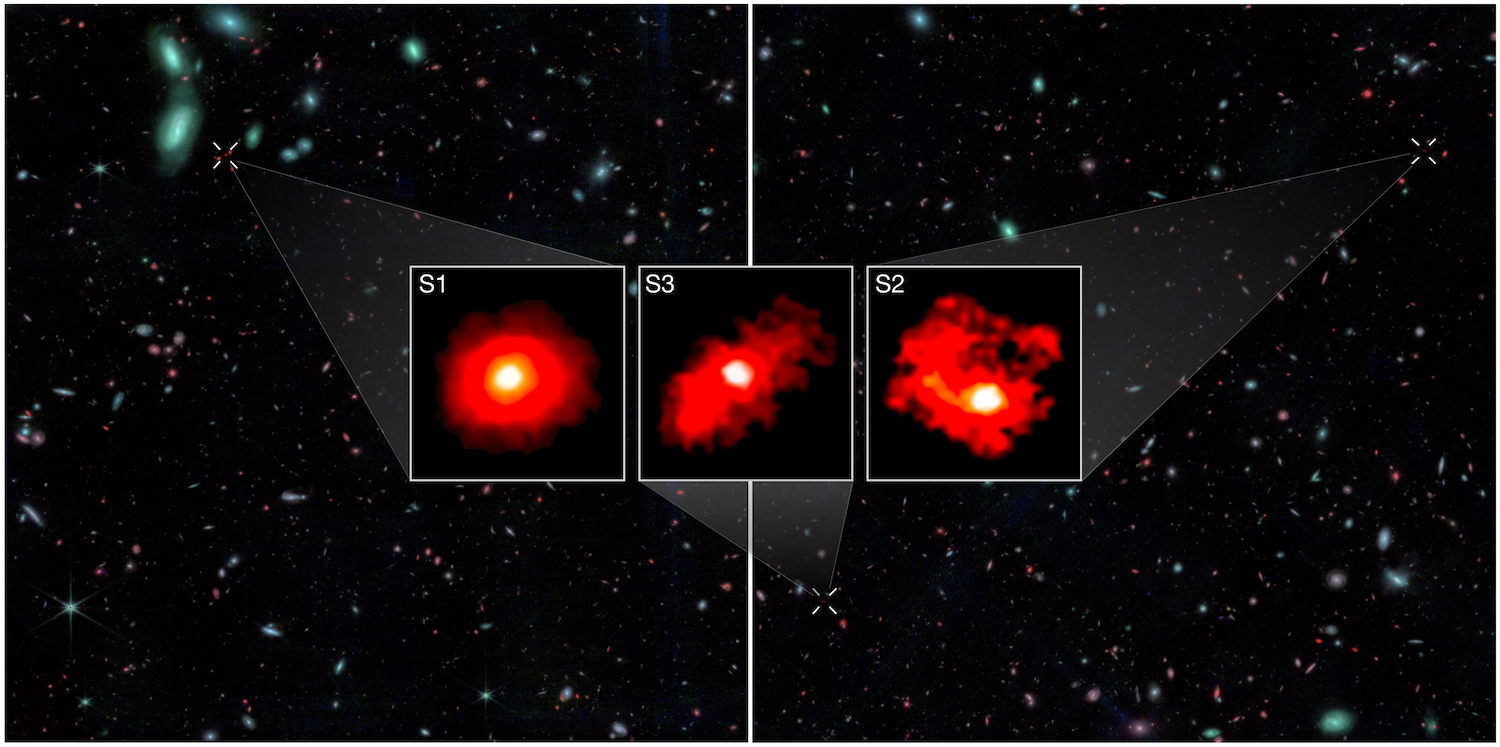
A major focus of the LCEG activities lies on the high-redshift Universe, where instruments such as JWST and ALMA have recently opened a new window onto the earliest galaxies, just a few hundred million years after the Big Bang. Here, we investigate how the very first massive galaxies were able to grow so rapidly, challenging previous assumptions about the early cosmos. At lower redshifts, we also study the structural evolution of galaxies, investigating how they build up their bulges and discs through a complex combination of internal dynamics and environmental interactions. Crucially, we explore the phenomenon of galactic quenching, the intricate processes by which galaxies progressively, and sometimes abruptly, shut down their star formation to become dormant, “red-and-dead” systems. All along, these observations are compared with predictions from numerical simulations to test and refine models of galaxy evolution.
What regulates star formation across cosmic time?
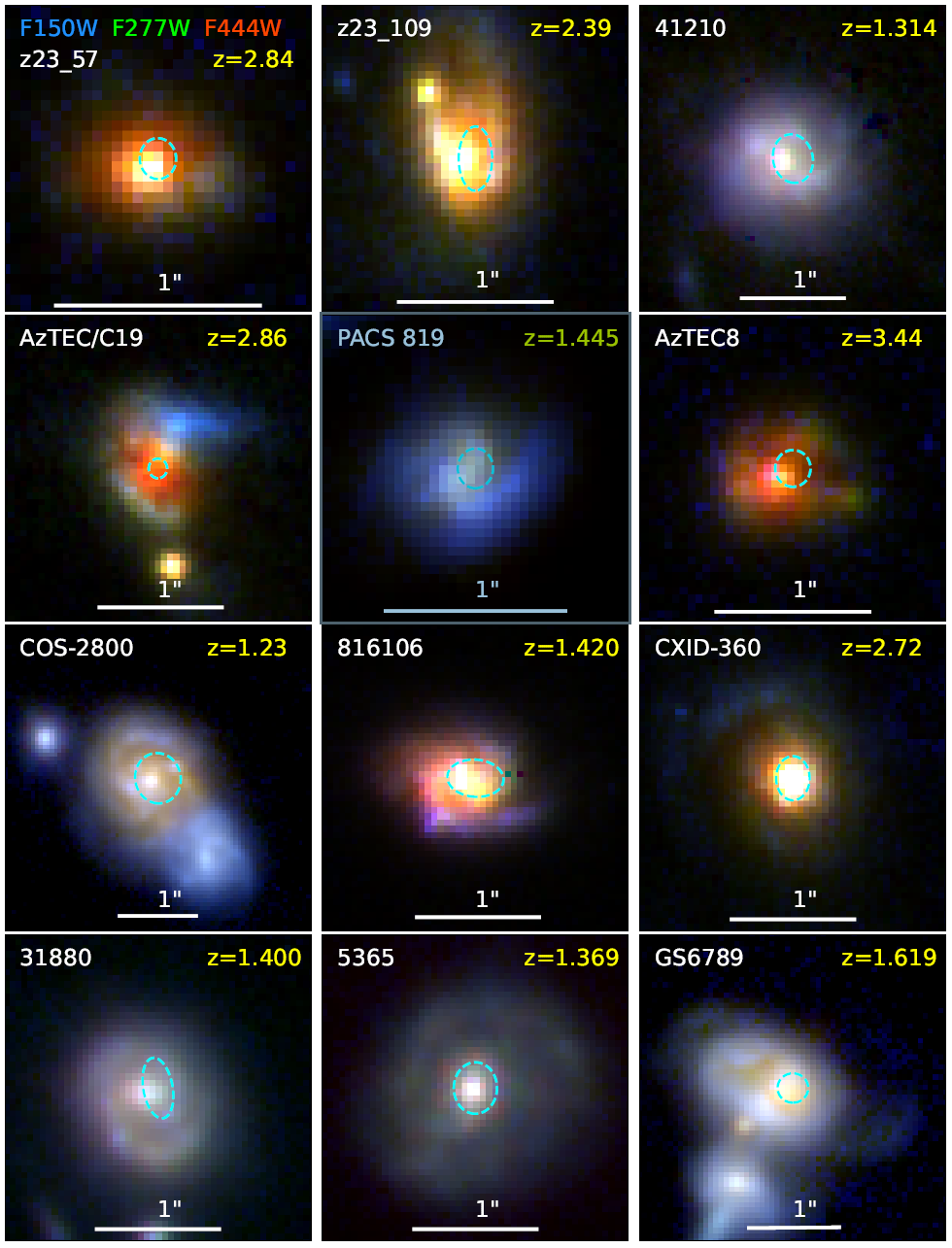
Understanding what controls star formation remains one of the deepest open questions in extragalactic astrophysics. Most galaxies evolve calmly along a well-defined “main sequence”, converting their gas into stars at a steady pace dictated by their mass. A small fraction, however, undergo violent episodes of accelerated star formation, starburst galaxies, while the most massive systems eventually cease forming stars altogether and join the so-called red-and-dead population.
The LCEG investigates the physical mechanisms that underlie these different regimes, with particular attention to the balance between fueling and feedback. On one hand, we study how galaxies are continuously fed by vast reservoirs of molecular gas, the raw fuel for new stars, from cold accretion from the cosmic web and/or the circumgalactic medium. On the other hand, we examine the powerful feedback processes that regulate, and sometimes entirely suppress, star formation: feedback from stars themselves, through supernova explosions and radiation pressure, or from active galactic nuclei (AGN) through powerful outflows. Infrared and sub-millimetre observations are central to this work, since most star-forming activity is shrouded in dust and only visible at these wavelengths. In a complementary approach, observations of galaxies hosting gamma-ray bursts offer a unique window onto the interstellar medium conditions of faint, otherwise inaccessible galaxies, tracing their star formation history and internal constitution in absorption.
Credit: Tan et al. 2024
Galaxy Clusters and the impact of large-scale structure on galaxy evolution
Moving beyond individual galaxies, we study the largest gravitationally bound structures in the Universe: galaxy clusters and their high-redshift progenitors, proto-clusters. Galaxy clusters, together with their high-redshift ancestors, proto-clusters, serve as cosmic laboratories for understanding how large-scale structures grow and evolve, and how this process dictates galaxy evolution.
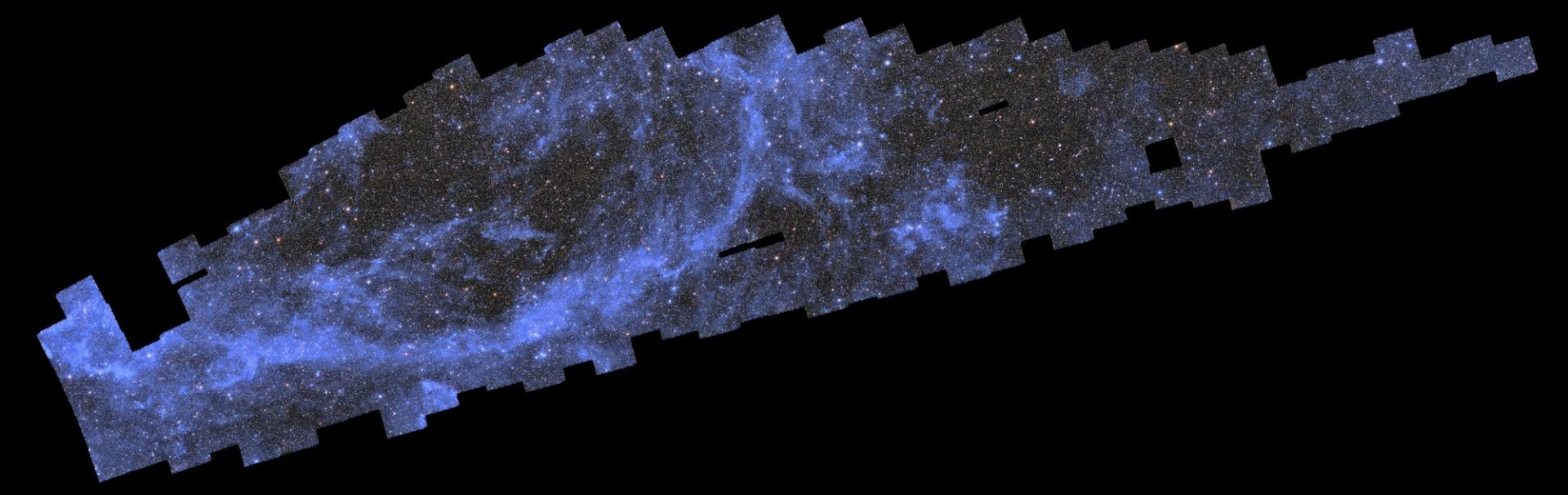
At the LCEG, we actively detect and characterize these (proto-)clusters in the nearby and distant Universe. By leveraging rich, multi-wavelength datasets, including optical, infrared, submm and deep X-ray observations, we map from the lowest surface-brightness member galaxies to the vast intergalactic reservoirs of gas that surround them.
Our research probes the complex physics of the intra-cluster medium, including turbulence, dissipation, and feedback processes. We investigate how this gas influences galaxy evolution, using in particular low surface-brightness galaxies as particularly sensitive tracers. We examine the transition from galaxies fueled by cold, pristine filamentary inflows to those embedded in the hot accretion environments of massive halos. Through this work, we aim to uncover exactly how the environments of clusters shape the lifecycle, gas fueling, and eventual quenching of the galaxies trapped within them.
Credits: ESA/Euclid/Euclid Consortium/NASA, CEA Paris-Saclay, image processing by J.-C. Cuillandre, E. Bertin, G. Anselmi