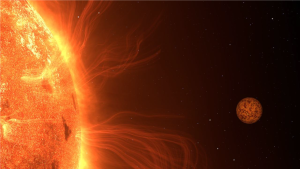





The AIM “Dynamics of Stars, Exoplanets and their Environment” team aims to develop cutting-edge research to understand the internal and external structure, dynamics, and evolution of the Sun, stars, and planets, as well as the atmospheres of exoplanets. Additionally, the research teams study gravitational, magnetic, and radiative interactions at different scales between these celestial bodies and their environment, as well as the orbital architecture of planetary systems. This research is based on innovative and synergistic theoretical predictions, nonlinear 3D HPC simulations, observational data analysis that constrains the models, and the development of instruments for dedicated space missions (SOHO, Solar Orbiter, JWST, PLATO, and ARIEL).
Main activities
The Dynamics of Stars, Exoplanets and their Environment team is structured around three interconnected pillars:
- Sun and heliosphere: Understanding the Sun and heliosphere, and the dynamics and evolution of stars. The teams seek to understand and characterise the interior of the Sun and stars, their rotation, the origin of their magnetism and their variability, and how these affect their evolution.
- Dynamics and evolution of stars: In parallel, researchers are carrying out research to understand how the winds of the Sun and stars, as well as star-planet interactions, shape and structure the environment and architecture of their planetary systems, with the emphasis on space weather in the case of our Sun.
- Exoplanets: Finally, they aim to build a coherent understanding of the internal and atmospheric structure, dynamics and chemical composition of exoplanets throughout their lifetime as a function of their overall composition and the stellar energy environment (radiation, particles and magnetism), and how these factors affect the conditions for the emergence of life.
Permanent members
BRUN Allan-Sacha, DUCROT Elsa, GARCIA BUSTINDUY Rafael, GARCIA MUNOZ Antonio, LAGAGE Pierre-Olivier, MATHIS Stephane, PERRI Barbara, STRUGAREK Antoine