Instrumental electronics laboratory (LEI)

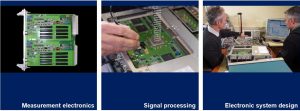
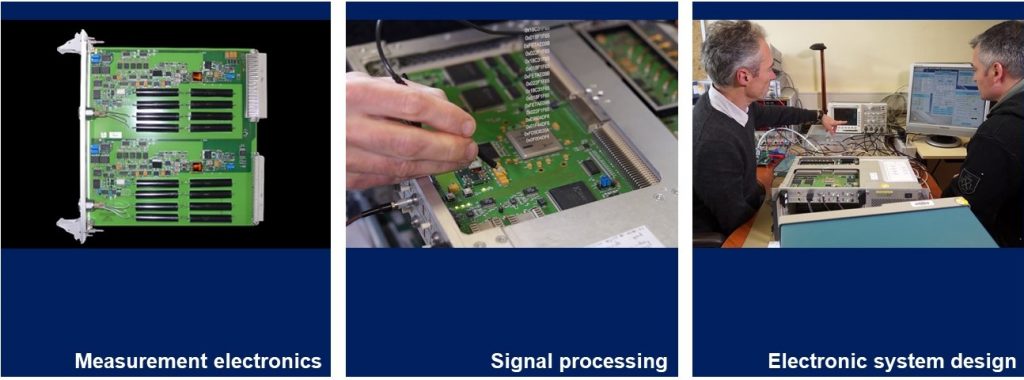
The instrumental electronics laboratory is in charge of developing electronic systems to measure, control or secure equipment for research in physics.

LEI is structured to respond to the different stages of an electronic project, within the framework of international research work:

  • Pre-project phase with feasibility and cost studies to assess the viability of future devices.
  • Specifications and architectures to define the assemblies to be developed
  • Design of electronic devices.
  • Subcontracting of realizations, integration, tests and recipes.
  • Installation and development on site in France or abroad.
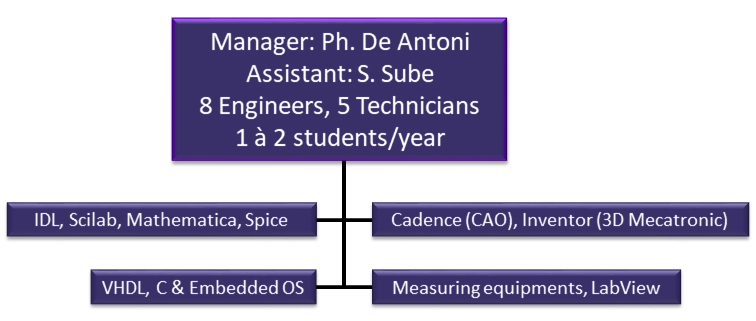
LEI’s resources.

Main activities :

  • Design of analog and digital electronic devices and boards composed by:
    • Specific equipments developed according to scientific needs.
    • Commercial equipment for parts meeting industrial standards.
  • Design of digital systems based on FPGA (Field Programmable Gate Array) mixing:
    • Logic.
    • Microprocessors with or without operating systems.
    • Signal processing functions.
    • Programming is done in VHDL and C or LabView languages (RT and FPGA)
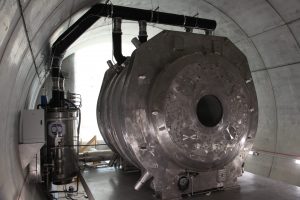
  • Study and realization of systems for the protection of superconducting magnets (Magnetic Safety System – MSS) for magnet test stations or physics experiments.
    • An R&D program is underway to use FPGA components.
  • Mechanical design applied to the packaging of electronic assemblies, 3D placement/routing study.

Examples of achievements

Magnet Safety System (MSS)

LEI is a laboratory specialized in the design of MSS for the protection of superconducting magnets.

Here is a brief history of the most recent designs:

  • 1999: Realization of a 1st generation MSS for the W7X coil testing station.
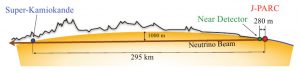
  • 200x: Development of the 2nd generation of MSS for the test stations of the ISEULT project, the T2K accelerator arc of the J-PARC project installed on the KEK accelerator in Japan and the R3B magnet of the FAIR experiment (DESY-Germany).

Today, the developments of the latest generation MSS are characterized by specifications whose requirements are increasing. The MSS for the ISEULT medical MRI magnet requires 4 kV insulation and a high level of reliability to ensure operational safety. The MSS for the JT60SA test station is also isolated at several kV, and is a generic system that can be used for different types of magnets, such as the LNCMI high field magnet. It integrates the Muscade remote supervision tools also deployed on the installations.

Tomorrow, the MSS will be digital and will integrate FPGA-based equipment. For example, future projects such as the STAARQ test station or the MadMax magnet will use:

  • An MSS consisting of an analog front end isolated at several kV to digitize the signals
  • a CompactRIO chassis from National Instruments for the digital processing detecting the quench.
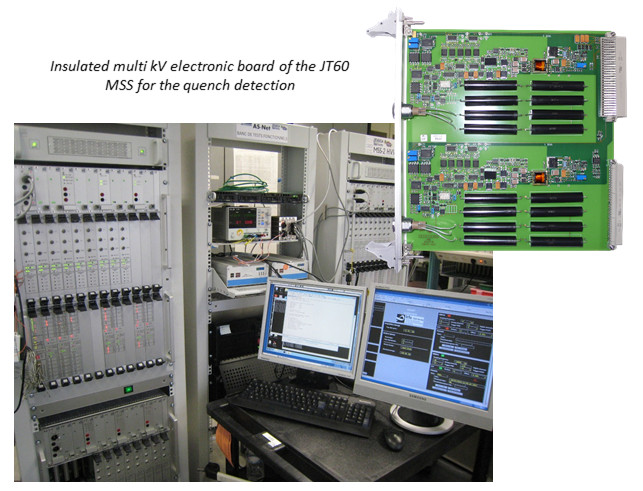
JT60-SA CTF magnet test station. MSS protection system and ASnet acquisition.

Spiral 2 LLRF

LEI carried out the Low level RF (LLRF) of the 33 cavities of Linac Spiral 2 located in Ganil in Caen. The machine frequency is 88.0525 MHz. The main objective is to regulate the amplitude and phase of accelerator fields in cavities with an accuracy of ± 1% and ± 0.5°.

For each cavity, the core of the system is based on two VME64x format cards:

  • A digital board including a Virtex 5 FPGA for intensive calculations such as the field regulation in a cavity
  • An analog card performing analog RF processing such as the analog/digital conversions with a jitter of less than 1 pS.
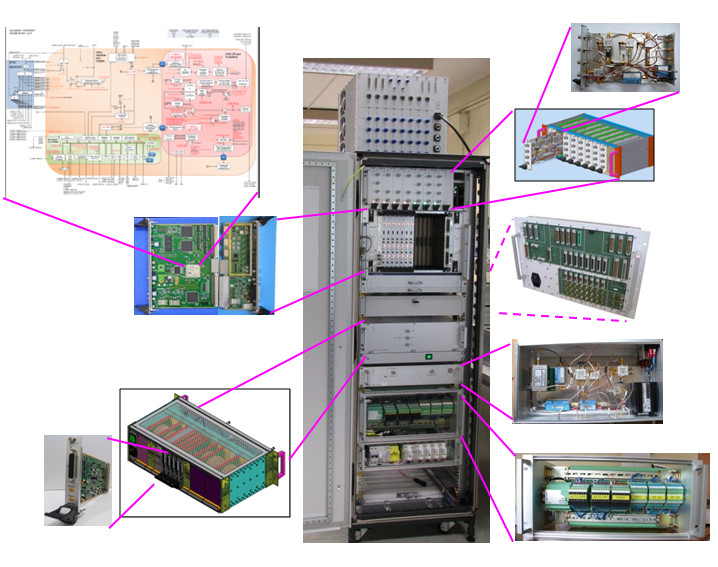
View of a Low level RF bay of the project and the main hardware and software subsystems. A total of 5 bays are deployed along the LINAC

Cold Electronics

In collaboration with DEDIP and DAP, DIS studies and manufactures cooled amplification chains based on HEMT transistors (CNRS – LPN), for reading photodiode, Ge detectors or applications requiring very low noise measurement at very low temperatures (~1K).
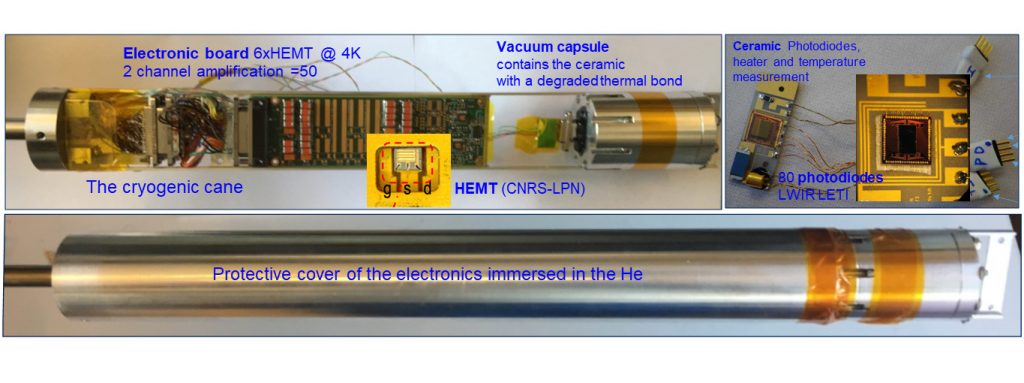
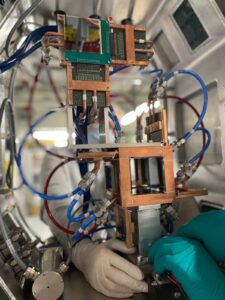
ESA-LWIR & ESA-ALFA project – Design of a cold preamplifier operating at 4K for reading calibrated photodiodes.

Projects

  • AGATA

    AGATA

    AGATA (Advanced Gamma-ray Tracking Array)is a new generation high-resolution γ-ray spectrometer providing unprecedented Doppler-correction capabilities thanks to a combination of fine detector…

  • ALICE

    ALICE

    The ALICE experiment is devoted to the study of nuclear matter under extreme conditions of temperature and density. It is specially designed to test the fundamental theory of the strong interaction,…

  • Antares, a high energy neutrino telescope

    Antares, a high energy neutrino telescope

    Overview Most of our current knowledge of the Universe comes from the observation of photons. Photons have many advantages as cosmic information carriers: they are copiously produced, they are…

  • ArTeMiS bolometer array

    ArTeMiS bolometer array

    Latest news : Artemis installed on APEX (25 sept. 2013) The Artemis camera has been successfully installed on APEX telescope during the summer 2013. The new camera has already delivered a…

  • ATLAS

    ATLAS

    Atlas is one of the general purpose detectors which started operation in 2008 at the the CERN proton collider, to study the Higgs boson. Goals: Unifying the elementary constituants of matter and…

  • BABAR

    BABAR

    Goal The main goal of theexperiment was toperforma complete study of CP violation (CP is the symmetry linking particulesand antiparticules) in the systemof Bmesons. Moregenerally the experiment…

  • CLAS12

    CLAS12

    Deeply Virtual Compton Scattering experiment at Jefferson Lab Hall B , with CLAS12, large acceptance spectrometer. Goals: Theoretical concepts asGeneralized Parton Distributions (GPD), enable to…

  • CLIC: CTF3-CALIFES

    Objectives The scientific exploitation of the LHC (Large Hadron Collider), planned to start operation in 2008 will be the higher priorityin high energy physics for the next coming years. In the…

  • CMS

    CMS

    CMS is the detector of one of the 2 multi-purpose experiments out of the 4 experiments located at the LHC at CERN near Geneva. CMS is installed at point 5 in Cessy. Main goals : During the last…

  • ISEULT

    ISEULT

    The technique of magnetic resonance imaging (MRI) is a diagnostic tool for research and neuroscience. Its evolution led to instruments for whole body operating at very high field from 0.5 to 1.5…

  • ITER

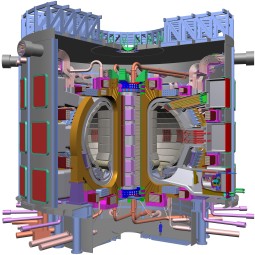
    ITER

    Objective The objective of the ITER («way » in latine) project is to go through the steps still necessary to enable the construction of a prototype producing electricity through nuclear fusion in…

  • JWST

    JWST

    The James Webb Space Telescope (JWST) launched on 25 December 2021 isthe successor of the Hubble Space Telescope. This is a NASA led mission with the participation of Europe, under the…

  • LISA

    LISA (Laser Interferometer Space Antenna) is the large-class mission of the European Space Agency’s (ESA) long-term Cosmic Vision programme for the observation of gravitational waves. It will be the…

  • MEGACAM

    MEGACAM

    Megacam MegaCam A major instrument at the CFHT observatory (Canada-France-Hawaii Telescope) The MegaCam camera was developed for the prime focus of the 3.6m diameter Canada-France-Hawaii Telescope…

  • MEGACAM

    MEGACAM

    Caméra installée au foyer du télescope de 3,6m de diamètre du CFHT. Camera installed on the 3,6m diameter telescope of the CFHT.

  • Mini Inca

    Mini Inca

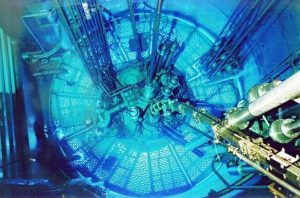
    Objectives: The objective of the Mini-INCA project is to study minor-actinide transmutation processes in high intensity thermal neutron fluxes, in view of proposing solutions to reduce the…

  • SPALADIN

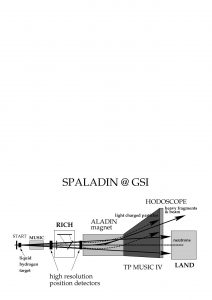
    SPALADIN

    Presentationof theproject Physics& programmes Spallation reaction study, physics data for nuclear energy Goals of the experiment The measurement in coincidence and in inverse kinematics of the…

  • SPIRAL2

    Presentation: SPIRAL2 [SPIRAL: Système de Production d’Ions Radioactifs Accélérés en Ligne, production system of on-line accelerated radioactive ions] is the project of a facility intended for the…

  • T2K

    T2K

    T2K (Tokai to Kamioka) is the world leading experiment dedicated to the study of neutrino oscillations over a long distance using µ-neutrino and µ-anti-neutrino beams. Neutrinos exist in three…

PhD thesis

Actuellement aucune thèse disponible pour : dis