Real-time systems, acquisition electronics and microelectronics laboratory (STREAM)

Real-time systems, acquisition electronics and microelectronics laboratory (STREAM)

The Real-time systems, acquisition electronics and microelectronics laboratory (STREAM) designs and manufactures analogue, digital and programmable electronic components for detection instruments used in experiments conducted by the Institute in various fields.

The laboratory brings together 14 permanent and 6 non-permanent staff in the following fields: analog and mixed analog/digital microelectronics, associated support for characterization, chip bonding and production testing of special-purpose integrated circuits (ASICs), data acquisition system architecture, analog and/or digital electronic board design, firmware programming of field-programmable logic circuits (FPGAs) and embedded real-time system computing.

The STREAM laboratory works in synergy with the Institute’s physics departments and other Sédi laboratories to make significant contributions to leading scientific experiments.

The trajectograph acquisition system for the Clas12 nuclear physics experiment is an example of this combination of skills: the DREAM chip, designed in the STREAM laboratory and based on know-how in low-noise analog microelectronics and analog memories, is the basic building block of the FEU front-end boards, co-developed with Liseta. These cards read cylindrical Micromegas detectors developed at SEDI. This reading system, which will ultimately comprise 20,000 channels, is currently being delivered and installed at Jefferson Lab (USA). On the Franco-Chinese SVOM space mission, STREAM and Lilas laboratories are sharing development of the firmware and on-board software for the satellite’s Scientific and Technical Management Unit (UGTS). The STREAM laboratory also designed and produced the flight ASICs for the ECLAIRs wide-field telescope, a key element of SVOM’s payload. Still for space applications, the STREAM laboratory’s expertise in low-noise radiation-hardened microelectronics enabled it to develop and produce, in collaboration with the astrophysics department, the “Caliste” hybrid micro-gamma camera for the Solar Orbiter satellite.
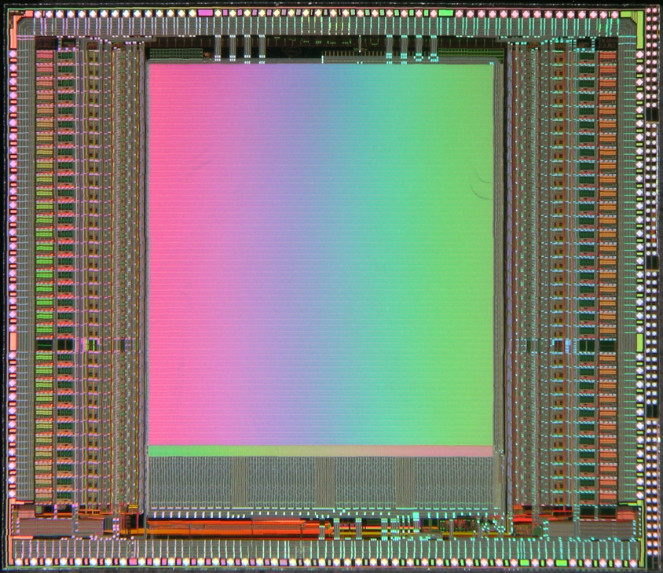
The DREAM ASIC: 700,000 transistors, 1/2 cm2. Each of the 64 channels converts the detector signal, filters it and stores its shape in 512 analog memory points.

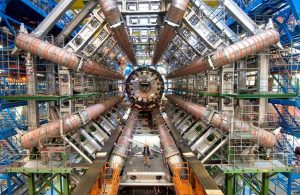
The laboratory’s other main current projects concern Phase 1 of the Large Hadron Collider (LHC) experimental enhancement program at CERN, with a microelectronics contribution to the monolithic pixelated silicon detectors of the ALICE Muon Forward Tracker, and responsibility for the design and production of the 600 or so SOLAR front-end boards for the Bras-Dimuon. In the ATLAS experiment, the STREAM and LISETA laboratories share responsibility with American partners for the design and production of the ~150 high-performance, radiation-hardened “LTDB” digitizing cards.

One of the laboratory’s R&D activities concerns cryogenic microelectronics and the design of superconducting filaments for reading infrared or X-ray bolometer arrays for astrophysics applications.

The laboratory is also anticipating the ramp-up to Phase 2 of the LHC experimental enhancement program by developing high-voltage CMOS pixel detectors for the ATLAS internal trajectograph. Similarly, the future front-end ASIC for the central part of the CMS electromagnetic calorimeter is currently being designed in the laboratory.
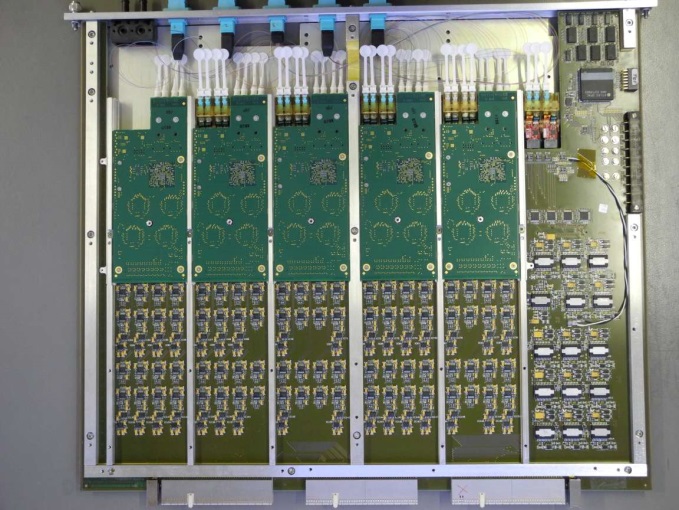
Prototype of the Liquid argon calorimeter Trigger Digitizer Board (LTDB). This radiation-hardened board is a 320-channel, 12-bit, 40 MHz amplifier-digitizer with optical outputs (192 Gbit/s total gross data rate). The final model will integrate over 10,000 components on a 24-layer printed circuit board measuring 41 cm x 50 cm. One hundred and fifty units will be used in the ATLAS experiment.

Membres

Projets

  • AGATA

    AGATA

    AGATA (Advanced Gamma-ray Tracking Array)is a new generation high-resolution γ-ray spectrometer providing unprecedented Doppler-correction capabilities thanks to a combination of fine detector…

  • ALICE

    ALICE

    The ALICE experiment is devoted to the study of nuclear matter under extreme conditions of temperature and density. It is specially designed to test the fundamental theory of the strong interaction,…

  • Antares, a high energy neutrino telescope

    Antares, a high energy neutrino telescope

    Overview Most of our current knowledge of the Universe comes from the observation of photons. Photons have many advantages as cosmic information carriers: they are copiously produced, they are…

  • ATHENA

    ATHENA

    Un satellite pour l’étude del’univers chaud et énergétique. Lancement prévu pour 2031. A satellite to study hot and energetic universe to be launched in 2031.

  • ATLAS

    ATLAS

    Atlas is one of the general purpose detectors which started operation in 2008 at the the CERN proton collider, to study the Higgs boson. Goals: Unifying the elementary constituants of matter and…

  • BABAR

    BABAR

    Goal The main goal of theexperiment was toperforma complete study of CP violation (CP is the symmetry linking particulesand antiparticules) in the systemof Bmesons. Moregenerally the experiment…

  • BAO

    BAO

    Most of the content of the Universe, about 70%, is dominated by an energetic component that is neither matter nor radiation: dark energy. This mysterious component, first observed in 1998 with…

  • CLAS12

    CLAS12

    Deeply Virtual Compton Scattering experiment at Jefferson Lab Hall B , with CLAS12, large acceptance spectrometer. Goals: Theoretical concepts asGeneralized Parton Distributions (GPD), enable to…

  • CLIC: CTF3-CALIFES

    Objectives The scientific exploitation of the LHC (Large Hadron Collider), planned to start operation in 2008 will be the higher priorityin high energy physics for the next coming years. In the…

  • CMS

    CMS

    CMS is the detector of one of the 2 multi-purpose experiments out of the 4 experiments located at the LHC at CERN near Geneva. CMS is installed at point 5 in Cessy. Main goals : During the last…

  • COAST  COmputational ASTrophysics

    COAST COmputational ASTrophysics

    Simulation numérique en astrophysique spécialisé dans l’activité de “calcul de haute performance”. Astrophysics digital simulation for “high performance computing”.

  • COAST  COmputational ASTrophysics

    COAST COmputational ASTrophysics

    Web site of the COASTproject Presentation The COAST project is a DAPNIA program of high performances computing in astrophysics. It includes developments of codes, numerical methods, visualization…

  • CTA (Cherenkov Telescope Array)

    CTA (Cherenkov Telescope Array)

    A new generation observatory to explore the high energy Universe. Une nouvelle génération d’observatoire pour explorer l’Univers à haute énergie.

  • D0

    D0

    Presentation The D0 experiment was located at the proton-antiproton Tevatron collider at the Fermilab laboratory (Chicago, USA). There was two data taking periods: Run I from 1992 to 1996 with a…

  • Detectors for linear collider

    Detectors for linear collider

    FELICE (acronym for “Future Electron LInear Collider Experiment”) is a group of physicists and engineers working for the physics and detectors at the ILC (International Linear Collider). An…

  • Edelweiss

    Edelweiss

    Objectives The goal of Edelweiss is to detect the dark matter of our Galaxy through its interactions in detectors operated in underground laboratory. The EROS experiment, searching for massive…
  • ESS: The European Spallation Source

    ESS: The European Spallation Source

    The linear accelerator includes a low-energy section (E≤ 90MeV) with a Radio Frequency Quadrupole (RFQ), a Drift Tube Linac (DTL), and a high-energy section made up of superconducting cavities that…

  • Fulis rotating Target

    Fulis rotating Target

    Objectives While the heaviest element on earth is 238-uranium (with traces of Pu and Np in natural nuclear reactors) whose lifetime is 5 billion years, the last 60 years have seen the synthesis of…

  • GBAR

    GBAR

    Aims: One of the fundamental questions of today’s physics concerns the action of gravity upon antimatter. No experimental direct measurement has ever been successfully performed with antimatter…

  • HESS

    HESS

    H.E.S.S. Exploring the High Energy gamma ray sky H.E.S.S stands for “High Energy Stereoscopic System”. This telescope system been designed and built by a large international collaboration which…

  • JWST

    JWST

    The James Webb Space Telescope (JWST) launched on 25 December 2021 isthe successor of the Hubble Space Telescope. This is a NASA led mission with the participation of Europe, under the…

  • LISA

    LISA (Laser Interferometer Space Antenna) is the large-class mission of the European Space Agency’s (ESA) long-term Cosmic Vision programme for the observation of gravitational waves. It will be the…

Thèses

Publications