CEA    Saclay    SACM    SAp    SPhN    SPP       drapeau

The Accelerators, Cryogeny and Magnetism Division

The Sacm

images_icon.jpg Gallery [+]
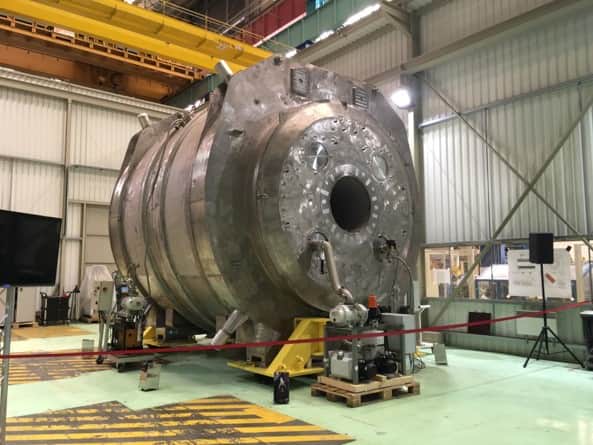
SAM et son compagnon: « Sam et son compagnon » : Prototype d’antenne IRM développée au SACM et fantôme SAM permettant de valider la sécurité de l’antenne avant l’acquisition  d’images in-vivo. Avant une acquisition IRM sur SAM, un lendemain de pluie. SAM et son compagnon: « Sam et son compagnon » : Prototype d’antenne IRM développée au SACM et fantôme SAM permettant de valider la sécurité de l’antenne avant l’acquisition d’images in-vivo. Avant une acquisition IRM sur SAM, un lendemain de pluie.
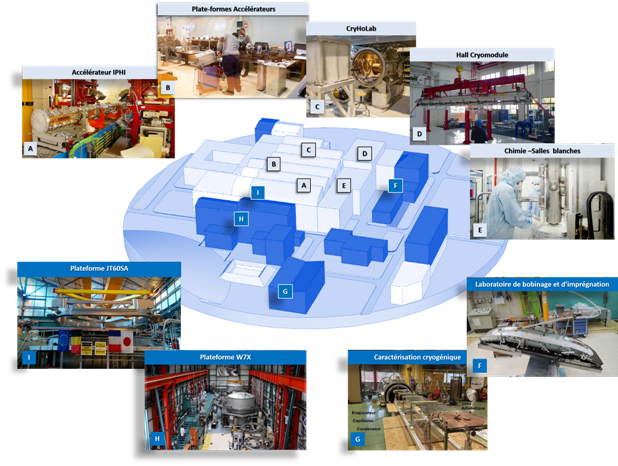
Accelerators, Cryogenics and Magnetism Department (SACM) Accelerators, Cryogenics and Magnetism Department (SACM) : SACM develops and builds particle accelerators, cryogenic systems, and superconducting magnets for IRFU's scientific programs and for those of the CEA in general. It is organized to manage large-scale projects. These are conducted within the IRFU project organizational structure, in close collaboration with the Institute's other physics and technology departments, and in particular with the Systems Engineering Department (SIS).   In 2009, 67 engineers and 50 technicians worked for SACM, together with five doctorate students, several visiting researchers, and more than fifteen students. The workforce is divided among four laboratories: Ø  the Accelerator Research and ... More »


vide_exp_icon.gif Projects

R3B  Physics and programmes   -         Study of nuclear matter in its extreme states / exotic nuclei -         Physics for nuclear energy / nuclear data and modelling   Goals of the ...
CLAS/DVCSObjectives Study of deeply virtual Compton scattering (DVCS) at Jefferson Lab, at 6 GeV, as part of the general program to determine generalized parton distributions (GPD) in the nucleon. Recent theoretical advances resulted in the definition of these new ...
Super Heavy Element StudiesObjectives While the heaviest element on earth is 238-uranium (with traces of Pu and Np in natural nuclear reactors) whose lifetime is 5 billion years, the last 60 years have seen the synthesis of dozens of new elements in laboratory, with shorter lifetimes. In 2007, The heaviest elements which ...