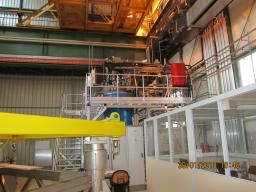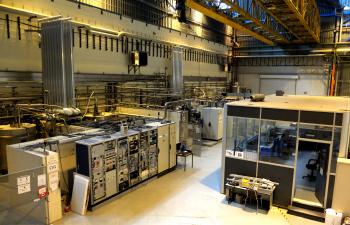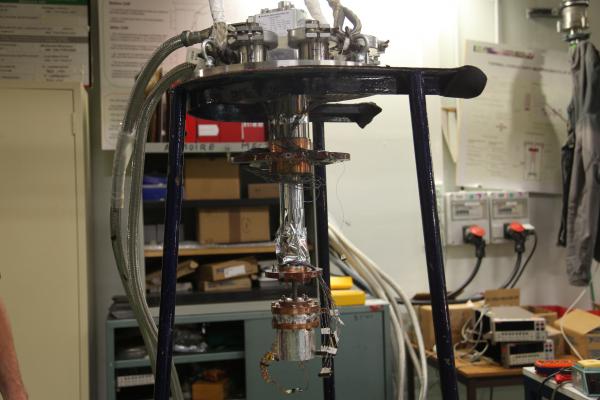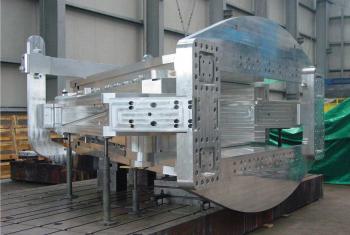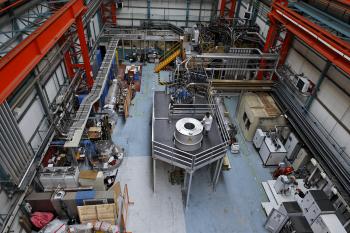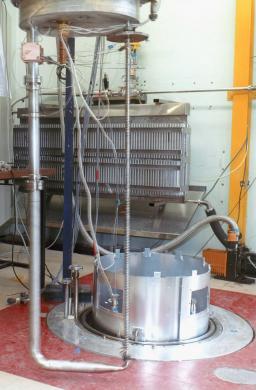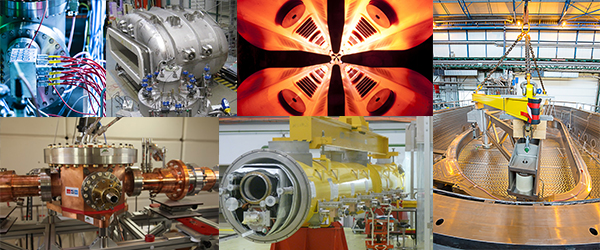
SACM develops and builds particle accelerators, cryogenic systems, and superconducting magnets for IRFU's scientific programs and for those of the CEA in general. It is organized to manage large-scale projects. These are conducted within the IRFU project organizational structure, in close collaboration with the Institute's other physics and technology departments, and in particular with the Systems Engineering Department (SIS).
In 2009, 67 engineers and 50 technicians worked for SACM, together with five doctorate students, several visiting researchers, and more than fifteen students. The workforce is divided among four laboratories:
Ø the Accelerator Research and Development Laboratory (LEDA),
Ø the Laboratory for the Study of Accelerating and Radiofrequency Structures (LESAR),
Ø the Laboratory for Superconducting Magnet Research (LEAS),
Ø the Cryogenics Laboratory and Test Stations (LCSE).
A Scientific and Technical Committee, the CSTS, made up of 16 members, including 5 international experts from outside the organization, meets on a yearly basis to take stock of ongoing activities and examine new proposals. The CSTS assists the Head of SACM in defining research and development strategy within the Department. More specifically, it examines the guidelines laid down in European programs, and the files submitted to the French National Research Agency (ANR).
SACM has access to a wide range of technical facilities to help it achieve these objectives, such as:
Ø specially equipped laboratories for performing electrical, cryogenic, mechanical, and radiofrequency tests, characterizing materials, and chemical surface treatments;
Ø 4.2 K and 1.8 K testing stations, designed for testing superconducting elements or electromagnets up to 20,000 A, superconducting accelerating cavities, equipped with their power couplers, and the required acquisition and analysis equipment;
Ø a liquefier to produce liquid helium, and three refrigerators for the test stations.
In the last three years, SACM has scored a number of successes. In October 2007, the Supratech research center, set up as part of the initiative to bring research teams closer together, conducted its first tests on its new site, previously occupied by the Saturne accelerator. In the summer 2008, SACM took part in starting up ATLAS and CMS, the two large detector magnets of the Large Hadron Collider at CERN. This rewarded nearly fifteen years of commitment and effort by Saclay teams. In September 2009, the last W7-X coil left Saclay, following a long test campaign on the 70 coils of the stellarator currently under construction in Greifswald, Germany. In addition, SACM consolidated its expertise in ECR proton sources, routinely injecting continuous 100 mA currents, making significant progress in the construction of the IPHI (high-intensity proton injector) and its RFQ accelerating cavities, and in mastering vital techniques for new accelerators such as FAIR and ESS.
Following on from these achievements, new ambitious projects have emerged. First, was realized the development of accelerator facilities, with the construction of the Spiral 2, IFMIF-injector, and SOPHI bunkers and the large clean room, and the preparation of the assembly hall for the XFEL cryomodules. Second, in the field of cryomagnetism, the Iseult project has gone from success to success in its development plan and the industrial-scale production of the 51 tons of superconductor has now begun. The highly innovative coils of the R3B-GLAD spectrometer have been produced, also on an industrial scale.
Activities over the next three years will focus on completing the IPHI high-intensity proton injector, achieving industrial production of the cryomodules for the XFEL project, building and testing equipment for the IFMIF-EVEDA prototype, and performing and monitoring testing on the Spiral 2 cryomodules.
In the field of cryomagnetism, the JT-60SA coil test station will be completed by 2014, opening up the possibility of technological extensions to the ITER program. The R3B-GLAD spectrometer will be assembled and tested; the coils and cryostats for the Neurospin-Iseult medical imaging magnet will be installed to achieve its ambitious performance levels in terms of magnetic field, homogeneity, and stability. SACM will also be involved in developing the new high-field magnets required for the LHC luminosity upgrade.
Between now and 2014, the Department will forge ahead with its complementary work in the fields of accelerators and cryomagnetism, meeting the CEA's key scientific challenges and looking to the surrounding communities to secure the success of the Saclay Campus.
Antoine Daël, Head of SACM
Inauguration of the large clean room
last update : 04-25 17:49:25-2013 (732)
![]() |
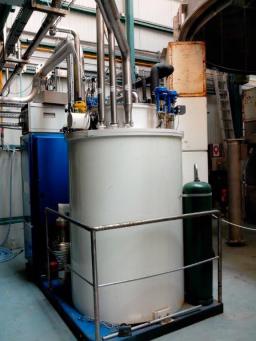
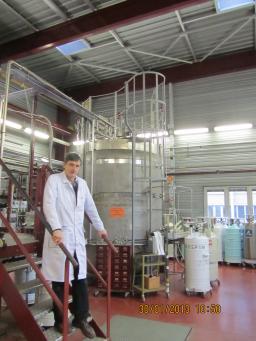
The task of the Cryogenics Laboratory and Test Stations (LCSE) is to master cryogenics technology for superconducting magnets, accelerating cavities, physics detectors (cryogenic target systems, calorimeters), and the production and distribution of liquid helium.
Its expertise is applied to the design, construction, and operation of cryogenic facilities of various types and sizes. The fluids used at these facilities are helium I and II, nitrogen, argon, and hydrogen. Design and construction work focuses mainly on cryostats and the related cryodistribution function, as well as low-temperature refrigeration machines, ranging from cryogenerators to high-power helium ... More » |
![]() |
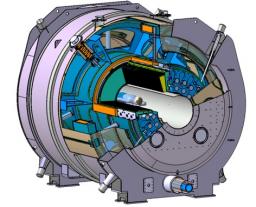
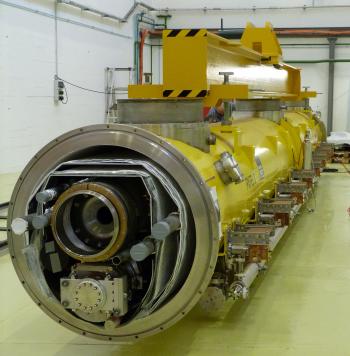
The Laboratory for Superconducting Magnet Research (LEAS) was set up to meet the needs of IRFU physicists for research into magnetic fields. For this purpose, it designs superconducting magnets for experimental facilities, especially large-scale or high-field magnets, and carries out prime contracting activities in this area.
When designing superconducting magnets, LEAS applies its expertise to the optimization of coil geometry, conductor design, mechanical, electromagnetic, and thermal calculations, and magnetic protection in the event of quench. In addition to designing magnets, LEAS has the capacity to manage large projects, to develop magnets and integrate them into cryostats, ... More » |
![]() |
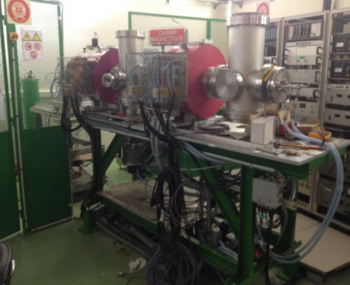
The Accelerator Research and Development Laboratory (LEDA) brings together SACM expertise and skills in the research, construction, and testing of systems used to produce, transport, and accelerate charged particle beams.
LEDA is a team of 14 engineers, 7 technicians and 2 doctorate students as at December 31, 2009, organized as follows:
a team of experts in beam modeling applied to linear and circular accelerators, in the presence of collective effects such as space charge or wake fields, and in electromagnetic calculations applied to electrostatic, magnetostatic and electromagnetic systems;
an experimenter team specialized in R&D, setting up and operating sources ... More » |
![]() |
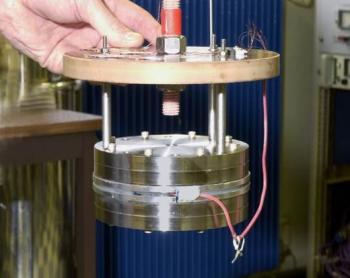
The Laboratory for the Study of Accelerating and Radiofrequency Structures (LESAR) is in charge of developing the radiofrequency systems required for particle accelerator operation.
Albeit the laboratory main activity focuses on accelerating cavities, research is also carried out for other critical components, such as power couplers, cavity mechanical and piezoelectric tuners, and accelerating voltage stabilization systems. These components are designed using simulation codes, some of them are developed in-house. The qualification process makes extensive use of prototyping and testing under realistic operating conditions.
Improving the performance of accelerating cavities ... More » |
![]() |
04-03-2011
IRFU's Double Chooz group has just published some surprising results regarding the flux of antineutrinos generated by uranium and plutonium fission products in nuclear power reactors. A more precise estimate of this flux has revealed a +3% shift with respect to the predictions considered as the benchmark for the past 25 years. The re-analysis of the most important past reactor neutrino experimental results, in the light of this new flux prediction, lead to the so called 'reactor antineutrino anomaly'. Including other effects such as the evolution of the neutron lifetime and the presence of long-lived fission isotopes, the averaged shortfall in the number of antineutrinos detected at short ... More » |
![]() |
23-12-2010
The Double Chooz collaboration recently completed its neutrino detector which will see anti-neutrinos coming from the Chooz nuclear power plant in the French Ardennes. The experiment is now ready to take data in order to measure fundamental neutrino properties with important consequences for particle and astro-particle physics.
contacts:
|
![]() |
07-12-2010
High field magnetic resonance imaging at field strengths at or above 7 tesla appears to be one of the most promising techniques for the early detection of neurological pathologies. Currently beyond the reach of most MRI system manufacturers, this imaging technology is beset with new technological difficulties. The CEA Iseult project team (IRFU and I2BM) has now overcome one of these problems; the homogeneous excitation of atomic nuclei using parallel transmission. This is needed in order to achieve a uniform excitation of the proton spins in living tissue, which in turn enables images of the human brain to be obtained without areas of shadow or loss of contrast. In vivo images recently ... More » |
![]() |
15-02-2010
The CHyMENE project (Cible d'Hydrogène Mince pour l'Etude des Noyaux Exotiques -Thin hydrogen target for the study of exotic nuclei) has the ambitious goal of producing a thin target of pure hydrogen, without using a container, suitable for experiments using the low-energy heavy ion beam planned for SPIRAL2.
A team from IRFU (SPhN and SACM) and from l'Inac/SBT have recently applied cryogenic techniques to successfully produce a ribbon of solid hydrogen 100 μm thick. The target will soon be tested in the beam. This will be a world first.
Below: Interview with Alain GILLIBERT, who is working on the CHyMENE project with Alexandre OBERTELLI and ... More » |
![]() |
17-01-2010
Since 1995, the Accelerators, Cryogenics and Magnetism Division (SACM) has initiated a software development for designing structures and simulating beam transport in accelerators. Since 2000, these codes have been distributed to many laboratories and companies around the world. This professional software suite is now distributed under license from the CEA. |
![]() |
16-11-2009
For more than 20 years, solid niobium has had the monopoly on high-gradient applications of superconducting radio frequency (SRF) cavities for particle accelerators. But it will soon have reached its limits. It was only recently that A. Gurevich, a theoretician from Florida State University, put forward a theory explaining the reasons behind niobium's success and a way of breaking its monopoly. Until now, this theoretical model had never been experimentally demonstrated. This has now changed for a collaborative project between IRFU (Saclay) and INAC (Grenoble) has just made this vital step towards new acceleration technology. |
![]() |
16-11-2009
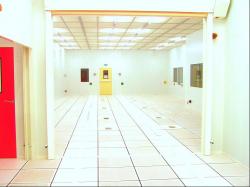
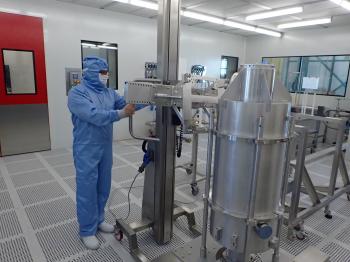
Work on a new clean room, begun in July 2007 at the Saclay accelerator platform, has just been completed. The new clean room will be officially opened on 24 November 2009 and will replace the chemical facilities and clean room of IRFU's Accelerators, Cryogenics and Magnetism Division (SACM) located at L'Orme, which could no longer undergo all the improvements required to keep pace with current development work. A hall in building 124 (previously the Saturne laboratory) has therefore been renovated to accommodate the future facilities and equipment compatible with future accelerator research requirements and collaborative projects with industrial partners interested in the ... More » |
![]() |
30-09-2009
The last coil of the Wendelstein W7X stellarator left CEA-Saclay last week, on Wednesday 9 September 2009 to be precise. The event marks the end of trials on the 70 coils of this fusion reactor and seals the success of a major project that began in 1998 and involved many teams from IRFU (formerly known as DAPNIA). The 70th coil has just been tested and validated at the W7x test station and has now gone to join the other 69 members of the family of superconducting coils currently being assembled on the Wendelstein 7-X stellarator, the research machine for the European programme on magnetic confinement thermonuclear fusion.
The tests, performed under a French-German ... More » |
![]() |
14-09-2009
Engineers and physicists from IRFU have successfully assembled and commissioned three large chambers designed to reconstruct charged particle tracks. The chambers will characterize the neutrino beam used in the T2K (Tokai to Kamiokande) experiment. They are the first large Time Projection Chambers (TPCs) to be equipped with micromesh gas detectors (Micromegas). The chambers have a very large sensitive area (nearly 9m²) and a correspondingly high number of electronic channels (124,000). IRFU built the entire detection system of the three TPCs, comprising 72 Micromegas detectors and all the front-end electronics. Engineers from SEDI, a department specialised in ... More » |
![]() |
15-12-2008
In collaboration with IRFU teams, CMS teams are currently making preparations for the first LHC data acquisition campaign.
On November 14, 2008, the Compact Muon Solenoid (CMS) successfully generated a nominal magnetic field of 4 tesla. This success rewards IRFU efforts for the design and construction of what constitutes the largest superconducting solenoid magnet in the world. Over a period of approximately one month, CMS teams conducted a continuous data acquisition campaign with the detector operating under nominal conditions. Approximately 300 million cosmic events were recorded. This also provided an excellent opportunity to showcase the specific expertise of IRFU teams, particularly in areas such as detection systems, electronics, trace data reconstruction techniques and laser control systems. |
![]() |
10-12-2008
The high energy part of the SPIRAL2 linear accelerator (new GANIL1 accelerator scheduled for implementation in 2012) uses two types of superconducting cavities. IRFU's Accelerator, Cryogenics and Magnetism Department is responsible for the design and development of 12 cryomodules2 of the first type, to be installed at the injector output. On December 8, 2008, the qualification prototype cryomodule was successfully tested at full power. The superconducting cavity attained an accelerating gradient of 10.3 MV/m (million volts per meter), far greater than the specified value of 6.5 MV/m. |
![]() |
03-11-2008
The 11.75 tonne whole body Iseult magnet to be installed in the Neurospin centre in 2012 will push back the boundaries of cerebral imaging. A key step in the success of this Franco-German project is the development of the SEHT test station in which a nominal field strength of 8 teslas was successfully achieved in early October 2008
|
![]() |
24-10-2008
Part of the IFMIF-EVEDA1) project consists of the construction of a prototype deuton2) accelerator at Rokkasho-Mura in Japan. The accelerator is due to enter service in 2013. The purpose of the EVEDA phase is to validate the IFMIF project which aims to investigate the strength of materials subjected to a high neutron flux in order to characterise the materials to be used in the construction of DEMO3). This high-current linear accelerator will produce a 125 mA beam of deutons with energies of around 10 MeV. A number of diagnostic stations need to be installed along the line in order to guide the beam through the various elements of the accelerator. The purpose of these diagnostic stations ... More » |