
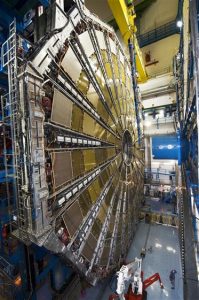
The ATLAS collaboration brings together nearly 6,000 scientists from more than 40 countries to build, operate, and improve one of the two large general-purpose detectors at the LHC. Within this collaboration, the ATLAS group at the DPhP has played a major role, particularly in the design and construction of the liquid argon electromagnetic calorimeter and the muon spectrometer. Its expertise covers instrumentation, data reconstruction, and data analysis. The group has long contributed to essential cross-cutting tasks: data preparation, luminosity determination, detector performance studies, and responsibility for the alignment of the muon spectrometer, which is essential for new physics research.
The group is particularly active in precision electroweak physics. It played a central role in ATLAS’s first measurement of the W boson mass, an important milestone in testing the consistency of the Standard Model. It is now developing methods to reduce the uncertainty of this measurement by a factor of 2 to 3, in particular through detailed studies of W and Z boson production and improvements in calibration. This work also benefits the measurement of the Higgs boson mass in the di-photon channel, as well as analyses of Higgs decays into Z bosons or muons, which have been explored over several runs.
The group is also heavily involved in studying Higgs–top quark coupling, particularly via ttH associated production, as well as in innovative research into new physics, such as axion production in photon-photon collisions in heavy ions. Finally, its long-standing expertise in top quark physics includes research into very rare processes, such as four-top production.
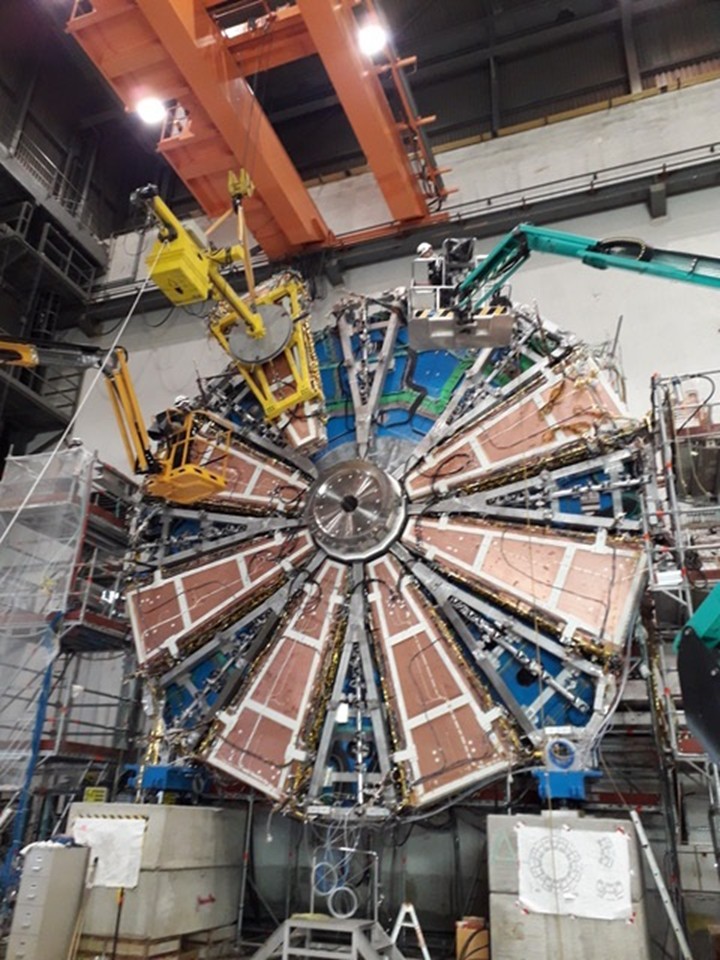
In preparation for the HL-LHC, the group has already contributed to the replacement of the internal wheels of the muon spectrometer and the improvement of the LAr calorimeter electronics. It is fully involved in the current upgrade phase, including the redesign of the calorimeter electronics and the construction of part of the new ITk tracker, with the assembly of more than 2,000 modules.
In 2026, the group has 12 permanent researchers, six PhD students, and three postdoctoral fellows.
Contact: Frédéric Déliot
Highlights
-
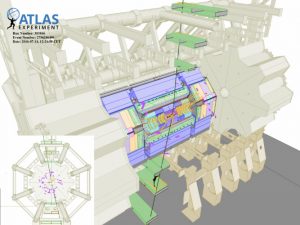
ATLAS muon spectrometer alignment
The muon spectrometer of the ATLAS experiment has been an important contribution of IRFU since the design, and IRFU is still in charge of the alignment today. The spectrometer plays a key role in…
-
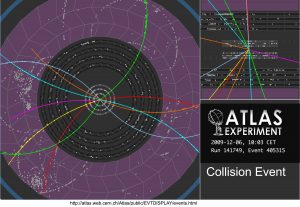
The beautiful awakening of the giant ATLAS
Since the accident which occurred on the LHC accelerator several days after its commissioning in 2008, the ATLAS collaboration has been impatient to observe “true” events produced at the centre of…
Recent publications
See here our researchers’ scientific publications.