
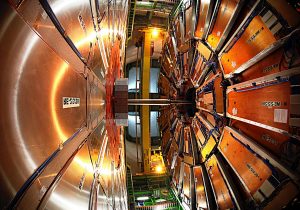
CMS is an international collaboration of 5,500 scientists and engineers from 54 countries. Irfu has been involved since the beginning, particularly in the design of the electromagnetic calorimeter (ECAL) and the implementation of its laser monitoring system. The DPhP group contributes to physics analyses, detector calibration, the development of innovative methods, and upgrade work for the HL-LHC.
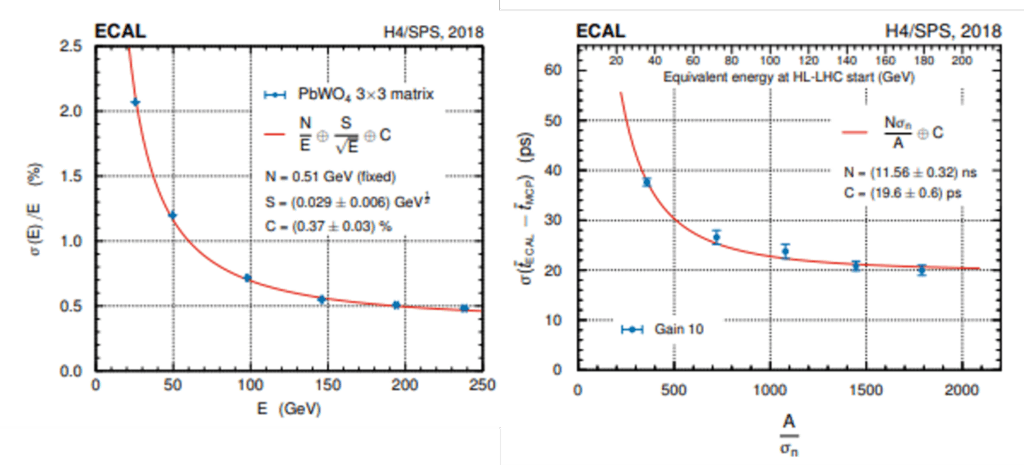
Credit: https://arxiv.org/pdf/2511.17261, accepted by JINST
Since the LHC began operating, the group has played an essential role in calibrating ECAL, which consists of 76,000 lead tungstate crystals. The transparency of these crystals varies depending on irradiation and must be continuously corrected using the laser system, for which the DPhP is responsible. The group also performs relative calibration of the crystals, absolute energy scaling, and resolution modeling. Calibration based on Z→ee decays, implemented in 2012, is crucial for precision measurements, particularly the mass of the Higgs boson in the γγ channel. An additional calibration developed by the group in 2025 and based on Z→mmγ decay also makes it possible to control differences between electrons and photons using data.
In Higgs physics, the group played a major role in the discovery of the Higgs boson in the two-photon channel and in the discovery of ttH production, which allows the study of the Higgs-top coupling and its CP properties. It also contributes to the precise measurement of the Higgs boson mass, differential cross sections, the search for H→ Zγ, and searches for double Higgs production (HH) in the bbγγ and bbττ channels. The group is a pioneer in the use of artificial intelligence for energy deposit reconstruction and background noise simulation.
Irfu is also leading several upgrade projects for CMS at the HL-LHC. These include the redesign of the ECAL electronics to achieve a temporal precision of <30 ps at 50 GeV, thanks to the CATIA circuit, as well as the renewal of laser monitoring via the MONACAL chip. The group also contributes to the readout of the future HGCAL calorimeter (HGCROC) and to the ultra-stable distribution of the LHC clock, thanks to the RAFAEL circuit, which is essential for particle time measurement. The group is also responsible for the data acquisition system in the new charged particle time-of-flight detector (MTD) that will be placed in front of the ECAL. Finally, the group plays a leading role in performance estimates for future or upgraded ECAL, HGCal, and MTD detectors, thanks to its participation in beam tests and the analysis of associated data.
In 2026, the CMS group has 8 permanent researchers, 4 PhD students, and 2 postdoctoral fellows.
Contact: Julie Malclès
Recent publications
See here our researchers’ scientific publications.