
The discovery of neutrino oscillations, which won the 2015 Nobel Prize, established that these particles have a non-zero mass, contradicting the Standard Model (SM). The DPhP group is involved in several neutrino oscillation experiments to search for a difference between neutrino and antineutrino oscillations, a potential sign of a violation of CP symmetry. Such a discovery could explain the matter–antimatter asymmetry in the Universe.
The discovery of neutrino oscillations, which won the 2015 Nobel Prize, established that these particles have a non-zero mass, contradicting the Standard Model (SM). The DPhP group is involved in several neutrino oscillation experiments to search for a difference between neutrino and antineutrino oscillations, a potential sign of a violation of CP symmetry. Such a discovery could explain the matter–antimatter asymmetry in the Universe.
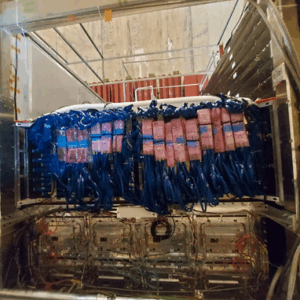
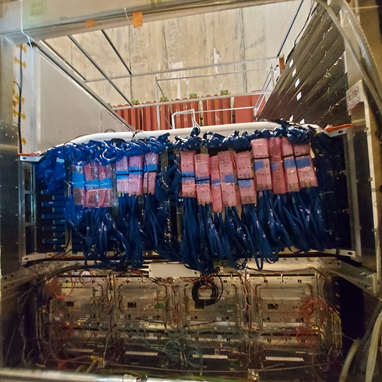
Since 2008, the group has been working on the T2K experiment in Japan, where it plays a key role in measuring oscillations, studying neutrino-nucleus interactions, and searching for new neutral particles. In 2020, T2K published in Nature the first observation of an asymmetry between neutrinos and antineutrinos, suggesting a potentially maximum CP violation. To reinforce these results, T2K has carried out major technical improvements: an upgrade of the accelerator and detectors, including the new ND280, to which the DPhP is contributing with the construction of two new TPCs using resistive Micromegas technology.
A new generation of long-baseline experiments, HyperKamiokande in Japan and DUNE in the United States, are under construction. They will increase the number of detected neutrinos by a factor of >20 and aim to confirm CP violation at 5σ, provide a precise measurement of mass scales, and increase sensitivity to physics beyond the Standard Model. These advances will require exceptional systematic control. In preparation, T2K is developing new detectors and analysis strategies. Since 2019, the DPhP group has been contributing to sensitivity studies and systematic uncertainty models. In addition, together with DEDIP, it is participating in the development of the HyperKamiokande synchronization system, capable of coordinating more than 20,000 channels over 150 m with an accuracy of approximately 100 ps.
In 2026, the group has 7 permanent researchers, 3 PhD students, and one postdoctoral fellow.
Contact: Samira Hassani