
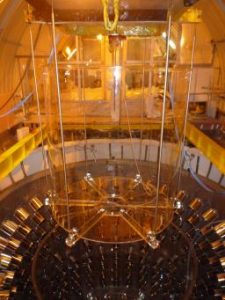
The study of neutrinos produced by beta decay allows us to test the fundamental symmetries of the Standard Model and search for new physics. The Double Chooz experiment, dismantled in 2022, produced results that went beyond the measurement of the mixing angle θ₁₃. The KATRIN experiment, in operation since 2018, established the first direct constraint on the absolute mass of neutrinos below the eV. The search for sterile neutrinos in KATRIN and STEREO did not reveal any signals, but these two experiments provided the best limits worldwide. In addition, a re-evaluation of nuclear models and data in 2022 highlighted biases that could explain the anomalies observed in reactor neutrino fluxes.
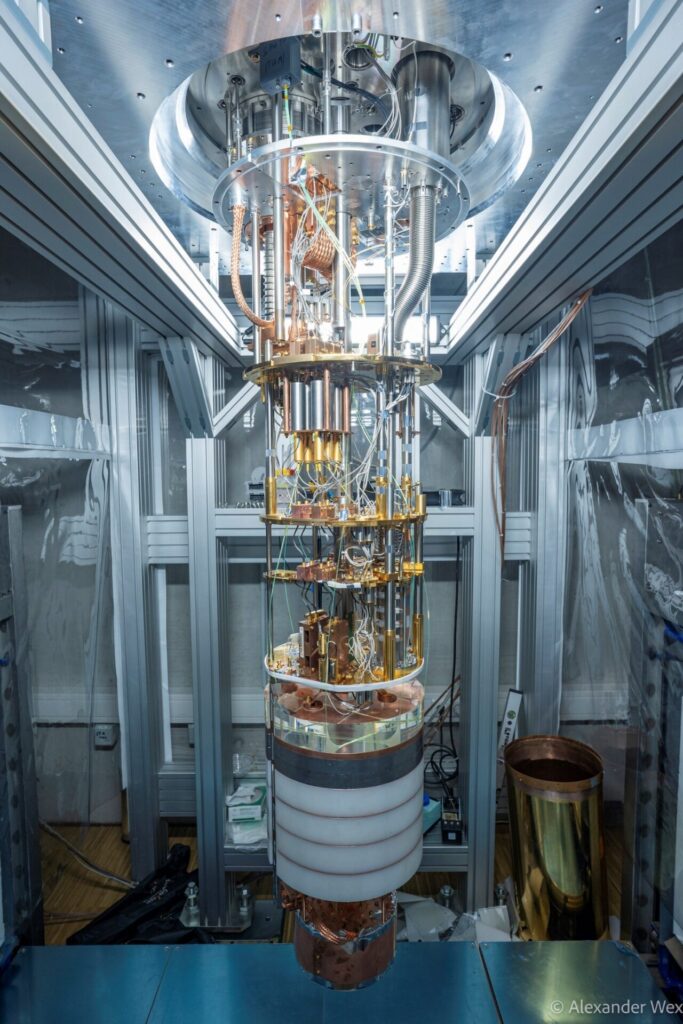
Since 2019, the group has been designing an innovative experiment for detecting reactor antineutrinos: NUCLEUS, based on coherent neutrino-nucleus scattering, a process recently observed at high energy but still unseen in a reactor environment. This interaction, which has a large cross section, could make it possible to greatly miniaturize detectors. The goal is to deploy a first cryogenic device capable of measuring very low nuclear recoils (20–100 eV) in a high background noise environment at the Chooz power plant in 2026.
The group was responsible for preparing the site and designing and deploying all of the noise reduction systems, which have been operational in Munich since 2023. The teams also contributed to the analysis of the initial data, focusing on gaining a detailed understanding of the cryogenic detectors. The DPhN developed an innovative calibration method, CRAB, which enabled the first observation of neutron capture-induced nuclear recoils in the 100 eV range. Initial data collected in the summer of 2022 confirms the effectiveness of this method and the proper functioning of the NUCLEUS device.
Contact: Matthieu Vivier