
Double beta decay without neutrino emission (0νββ) is a hypothetical nuclear process, never observed, that would violate the conservation of lepton number. Its discovery would establish that neutrino and antineutrino are the same particle – a Majorana neutrino – and provide essential information on the absolute scale and order of neutrino masses. Among experimental techniques, bolometric detection is particularly promising thanks to its very high energy resolution, hardware flexibility and low background levels. Since 2012, the group has been developing molybdenum-based scintillating bolometers, capable of simultaneously measuring scintillation heat and light to effectively discriminate background noise.
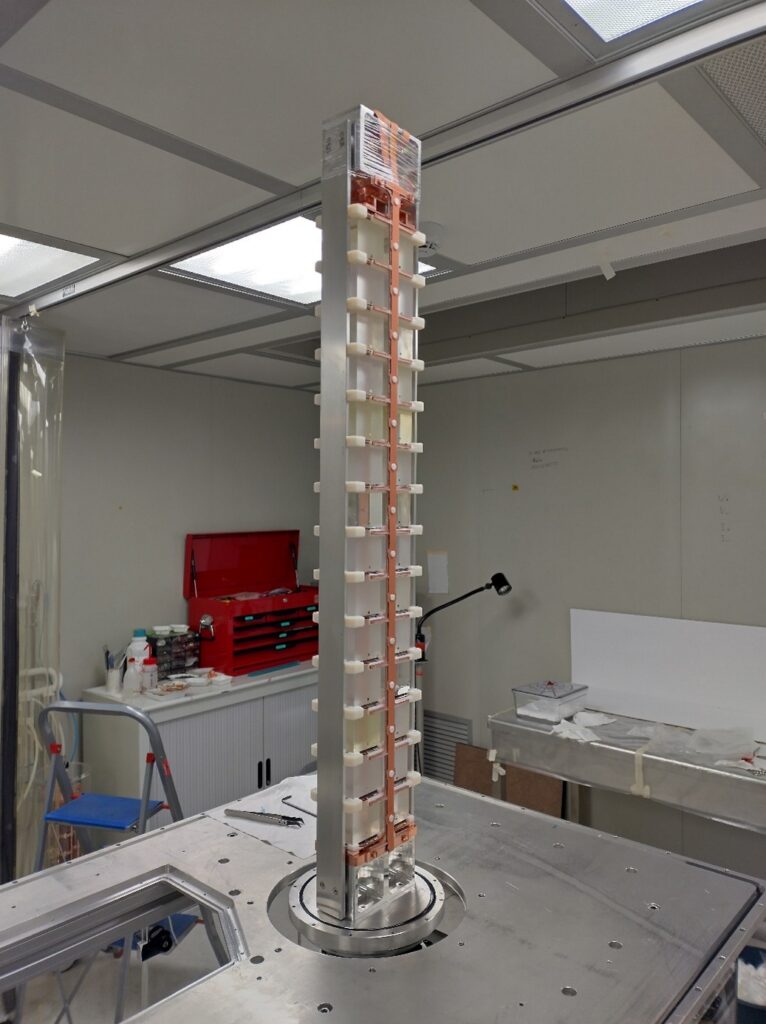
The CUORE experiment, carried out at the Gran Sasso laboratory, represents the state of the art in the search for 0νββ with TeO₂ bolometers. However, its sensitivity is limited by a background noise due to radioactive alpha particles on the surface of the detectors. To remedy this, the next-generation CUPID experiment will reuse the CUORE infrastructure, but with scintillating bolometers enabling background rejection improved by a factor of 100. The results obtained by the group in the LUMINEU and CUPID-Mo projects have led the CUORE/CUPID collaboration to adopt Li₂MoO₄ as the reference technology in 2018 – a major success for the French program.
To prepare for future generations of experiments, the group is also leading the BINGO and TINY ERC projects. BINGO, based at the Modane underground laboratory, aims to further reduce background by a factor of 10 with Li₂MoO₄ and TeO₂ detectors. TINY is exploring two promising isotopes, ⁹⁶Zr and ¹⁵⁰Nd, requiring the development of new high-resolution bolometers with particle identification.
Today, the group is made up of 4 permanent researchers, 2 PhD students, 2 post-docs and 1 part-time student.
Contact: Claudia Nones