
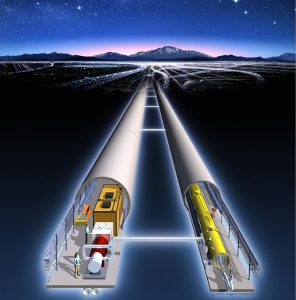
With the discovery of the Higgs boson in 2012, several concepts for future lepton colliders are emerging: linear or circular, electron-positron or muon. DPhP physicists are working on the physics case for the various machines of the future, and on the design of suitable detectors.
For a future linear collider, Irfu teams are working on the design of a TPC, based on a new type of Micromegas detector known as ERAM (Encapsulated Resistive Anode Micromegas), which limits distortion. The Group has also designed reading modules using miniaturized electronic cards. For this technological jewel, two-phase CO2 cooling between 10 and 15°C was chosen. Distribution of the liquid-gas mixture, at 50 bars, is ensured by an aluminum cooling plate produced by metal additive manufacturing.
In physics at a circular e- collider, the group focused on flavour and electroweak physics, helping to determine specifications for calorimetry, trajectography and particle identification. A detailed study of CP symmetry violation in 2021 concluded that high-resolution calorimetry is required. Similarly, gas trajectography is preferable to minimize the amount of material and enable particle identification.
The group is also involved in the MuColl project, funded by Horizon Europe Infra Dev, which will structure activity on muon colliders at the IRFU between 2023 and 2027. The DPhP uses simulation to study some of the physics involved, in particular the simultaneous production of two Higgs bosons, and possible detector concepts.
Contacts: Roy Aleksan, Fabrice Balli, Paul Colas