
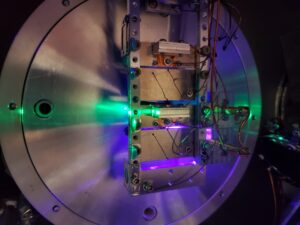
The GBAR experiment, initiated at the IRFU, aims to measure the gravitational acceleration of a free-falling antihydrogen atom, in order to test the behavior of antimatter in the Earth’s gravitational field. The main challenge lies in the extreme cooling of these atoms, initially produced with kinetic energies in the keV range but needing to be slowed down to a few tens of neV. To achieve this, GBAR creates an intermediate state: the positive antihydrogen ion H̅⁺, composed of an antiproton and two positrons. This charged ion can be cooled at speeds of the order of 1 m/s, which is impossible with neutral atoms. Once sufficiently cold, it is photo-detached to produce an ultra-cold antihydrogen atom.
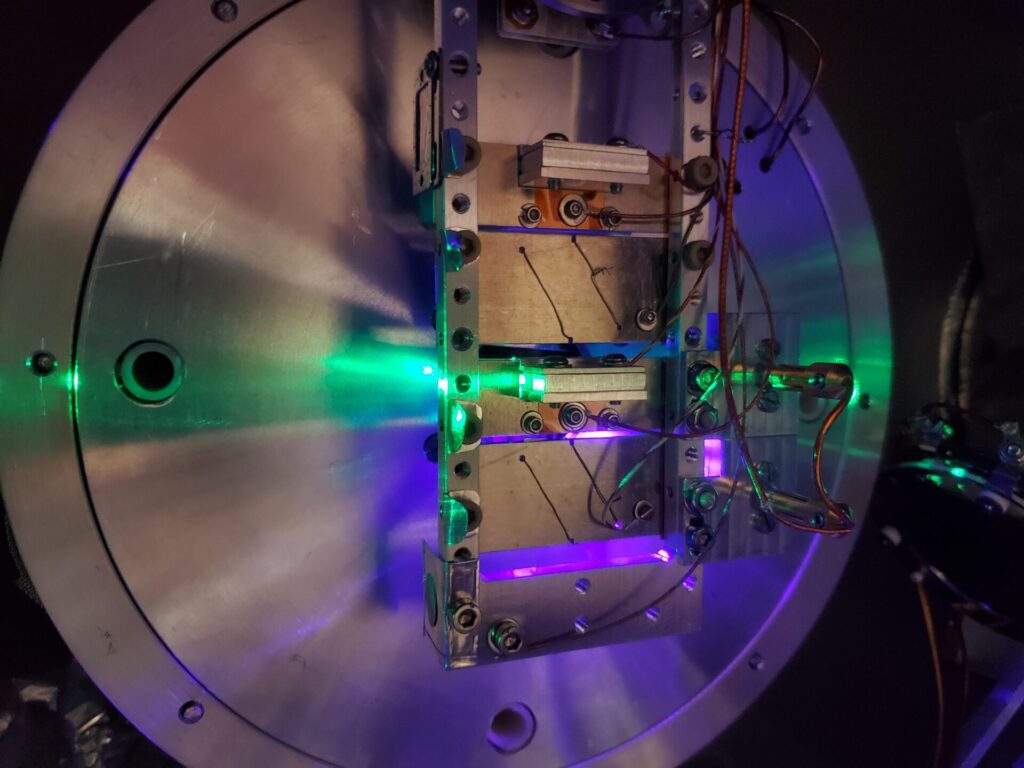
H̅⁺ is produced from a target of positronium (oPs), a short-lived electron-positron bound state (142 ns). The ions are created by two successive reactions involving antiproton and positronium. The antiprotons come from CERN’s AD decelerator, plus the ELENA ring (operational since 2018), which delivers 100 keV bursts every 110 seconds. They are then decelerated to a few keV using GBAR instrumentation before interacting with the positronium target.
Positronium is generated by sending an intense pulse of positrons onto a nanoporous material. These positrons are produced by a beam of 9 MeV electrons striking a tungsten target, then moderated to a few eV and transported to 50 eV. Their accumulation relies on two successive traps: a buffer-gas trap designed at Saclay, then a high-field trap capable of storing up to 10¹⁰ e⁺.
GBAR has already achieved several landmark results: record antimatter trapping, anti-hydrogen production and the first effective cross-section measurements.
Contact: Laszlo Liszkay