
The DPhP has long experience of multi-messenger observations and has stepped up its contributions in recent years. A notable example is its participation in the TAToO alert system for the ANTARES neutrino telescope, which analyzed the data stream in real time, identified significant energetic events and automatically sent alerts to partner observatories. With ANTARES having been dismantled in 2022 after 15 years of operation, the group is now drawing on this expertise to develop new multi-messenger projects.
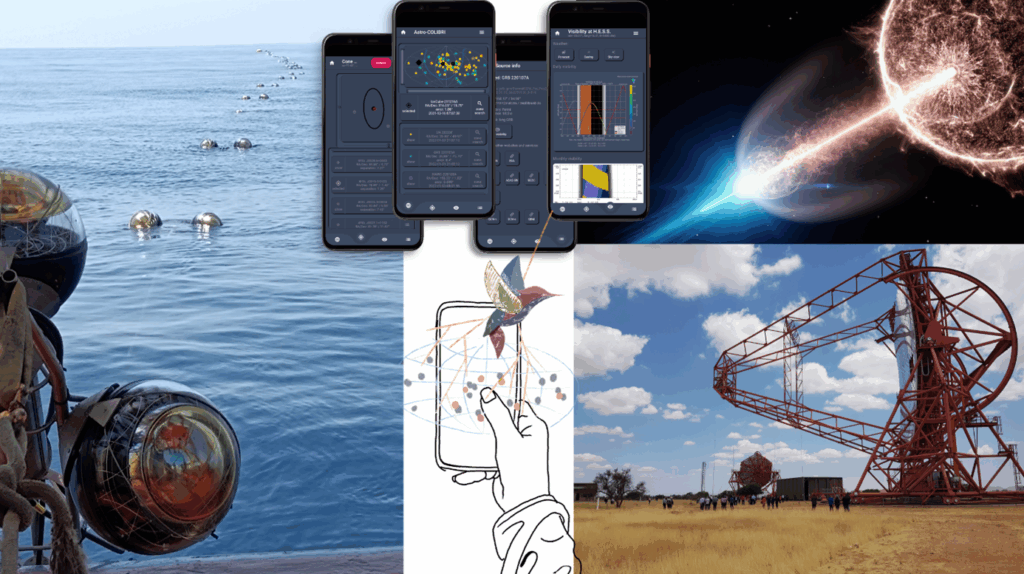
The most important involvement today concerns the leadership of the H.E.S.S. transients working group, as well as the preparation of future observations with CTAO. In recent years, major advances have been made in the study of transient phenomena, thanks to an increase in the time devoted to these observations and improvements in analysis tools. The DPhP has thus contributed to the detection of the first high-energy gamma-ray emissions associated with gamma-ray bursts (GRB 180620B, GRB 190829A) and a galactic nova (RS Ophiuchi). The group is also involved in the search for gamma-ray signals coinciding with high-energy neutrinos, gravitational waves or emerging phenomena such as fast radio bursts.
The rise of the multi-messenger has revealed an unprecedented scientific wealth, but these observations remain difficult because the phenomena studied are very stealthy, with signatures disappearing in a few microseconds to a few days. A rapid, coordinated response from observatories is therefore essential. To meet this challenge, the DPhP group has developed the Astro-COLIBRI platform, in an international partnership. This fully automated cloud infrastructure receives alerts from all over the world, contextualizes them in a multi-wavelength framework and disseminates the information in a matter of seconds via web interfaces and mobile applications. It enables scientists and amateur astronomers alike to quickly assess the relevance of detected events and optimize follow-up strategies.
The group is involved in numerous campaigns to observe transient phenomena in all wavelengths, from radio (ATCA, MeerKAT, SKAO preparation), visible (VLT, OHP, WST preparation), X-ray (Swift, SVOM, THESEUS preparation), gamma-ray (Fermi-LAT, H.E.S.S., LST-1, CTAO preparation) and multi-messenger (Ligo/VIRGO, Einstein Telescope preparation).
Contact: Fabian Schussler