

DPhN is strongly engaged in the study of the partonic structure (in terms of quarks and gluons) of nucleons, protons and neutrons. Nucleons are singular objects as about 90% of their mass originates not from their constituent masses, but rather from the strong interaction they experience. Nucleons are also a benchmark laboratory to study confinement and deconfinement mechanisms which remain an open key point, although QCD is a well established theroy in the standard model. The study of the nucleon structure in terms of quarks and gluons is thus complementary to the investigations of quark-gluon plasma and its associated phase transition.
Gluon contribution to the nucleon spin
One of the approach to the problematic of the nucleon structure has been to study global observables, like the decomposition of the nucleon spin in term of its constituents. DPhN was amongst the pionneers in these measurements held at SLAC, CERN and JLAB. These lead to the so called "spin crisis", showing that the three constituent quarks only carry about a third of the nucleon spin, and solving this puzzle is a key priority of this community now. SPhN Nucleon Structure Laboratory is a co-leader of the COMPASS collaboration setup in 1997 with the goal to measure the different contributions to the nucleon spin. The contribution of the gluons and the strange sea quarks could be measured with unprecedent accuracy. In parallel, measurements confirm that only 25% of the proton spin is carried by the quarks, which is confirmed by the first lattice QCD calculations, the remaining 75% being shared between the gluon spin and the angular momentum of the quarks and the gluons.
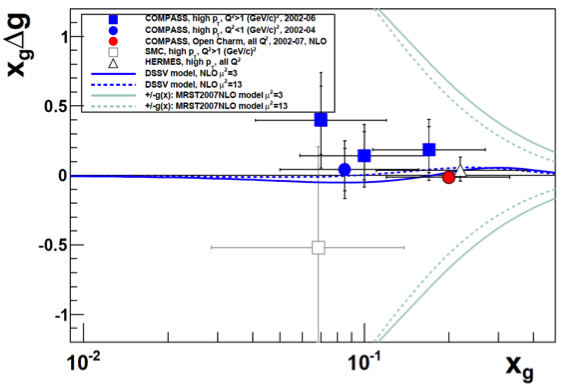
Gluon polarization as a function of x, the momentum fraction of the nucleon carried by the gluon
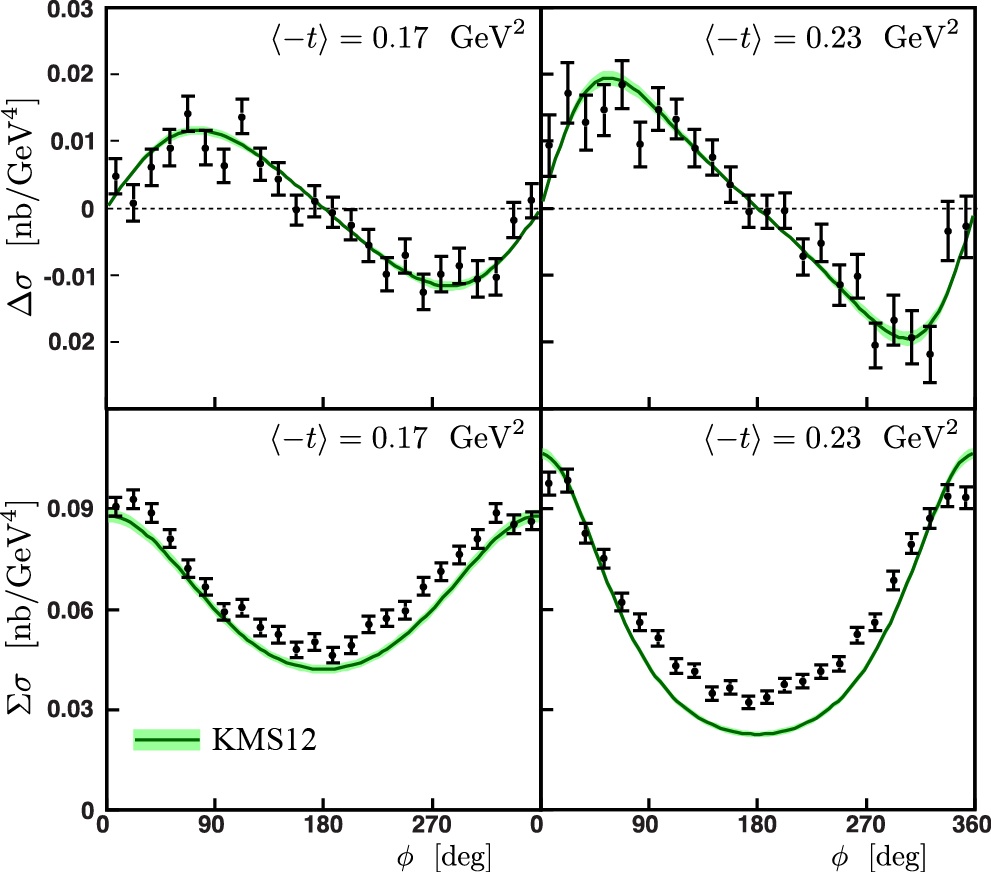
DVCS polarized cross sections measured at JLAB
"3D" imaging of the nucleon
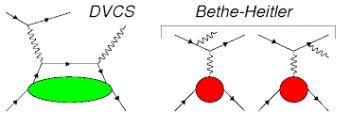
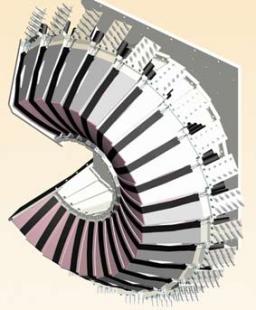
A modern approach to the study of the nucleon structure consists in measuring Generalized Parton Distributions (GPD). They represent correlated distributions of position and momenta of the nucleon constituants. The first experiments dedicated to the study of these GPDs have been setup at Jefferson Lab (2004-2010), and consist in measuring Deep Virtual Compton Scattering (DVCS). The valence quark domain has been explored initially with the CLAS spectrometer at JLAB with a 6 GeV beam. The upgrade to 12 GeV in 2017 will allow a more systematic study of the GPD in this kinematic region. COMPASS at CERN allows to extend these measurements to the sea quarks and gluons, allowing to get a full coverage of the parton position-momentum correlations inside the nucleon. DPhN is co-spokesperson of both of these experiments.
A framework for the theoretical analysis
In addition, the framework PARTONS has been setup to perform a global analysis of all experimental data related to GPDs. This framework consists in a database of experimental measurements and theoretical expectations, and in fast and robust algorithms to compute all observables. This framework, combined with theoretical developments, should allow ultimately to obtain a tomographic 3D view of the nucleon structure.
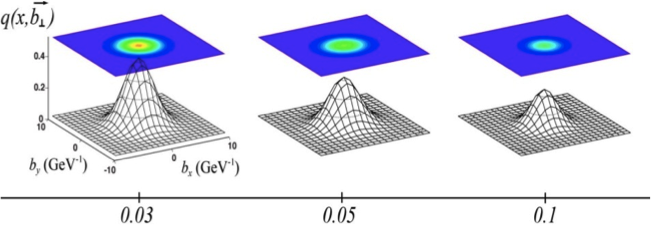
First realistic 3D images of the nucleon obtained from a model adjusted to DVCS world data