
Astrophysicists from the SDSS-III (Sloan Digital Sky Survey) project, composed largely of French researchers, CEA Irfu, CNRS In2p3 and INSU, have made the first measurement of the rate of expansion of the young Universe, only three billion years old out of the 13.7 billion, when gravity was still slowing down its expansion, before its current phase of expansion accelerated by the Dark Energy. They used a new technique to map the distant Universe in three dimensions. This result is online at arXiv.org.
Different phases of the expansion of the Universe
Hubble and Lemaître highlighted the expansion of the Universe in the 1920s by making two types of measurements for the same set of galaxies: the distance between these galaxies and us, and the speed of these galaxies (using the Doppler effect on the lines of their spectra).
Their observations are at the origin of the current “standard” model of cosmology. For most of the history of the Universe, this expansion has continued to slow down under the effect of matter gravitation and radiation. But since five billion years ago, when the Universe was about 7 billion years old, this behavior has been reversed: the expansion started to accelerate, probably due to a mysterious repulsive force produced by what has been called: “dark energy”. Experiments in cosmology have made it possible to observe this period of recent acceleration, but not the primitive deceleration of the Universe. To be able to measure this deceleration requires to go back to the first billions of years of its history, to go far back in time, therefore to observe far in space. For this, galaxies are no longer enough: at such great distances, their luminosity becomes too low.
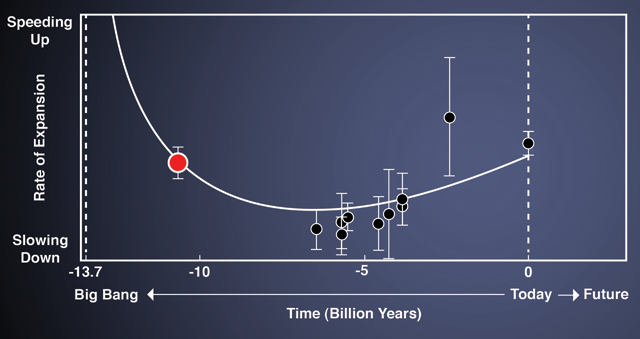
The BOSS experiment was able to trace measurements back to 11 billion years ago using quasar light abosrbed by intergalactic clouds creating “Lyman-alpha forest”.
To get around the problem, the astronomers of the Sloan Digital Sky Survey, composed of French researchers in particular, were interested in quasars, distant and extremely bright stars. When we measure the spectrum of a quasar, we see not only its light but also the residual absorption of the intergalactic gas between the quasar and us. Astronomers have thus been able to study the distribution of intergalactic gas and detect hydrogen clouds. From all the lines of sight of the quasars and the correlation of hydrogen densities, the astronomers were able to extract the relative velocity of these gas clouds, and to reproduce an experiment similar to that of Hubble and Lemaître on the expansion rate of galaxies but with intergalactic gas instead of galaxies.
To effectively apply this innovative SDSS-III measurement technique, known as the “Lyman-alpha forest”, it was still necessary to have a very large number of quasars at one's disposal, and thus to draw a map of the distant universe in three dimensions. It is the French SDSS group, partly financed by the ANR, which has mainly specialized in the research, study and selection of quasars to be observed. The first catalog of the collaboration was published in mid-October and contains 89,000 quasars. The study then focused on 50,000 of these quasars.
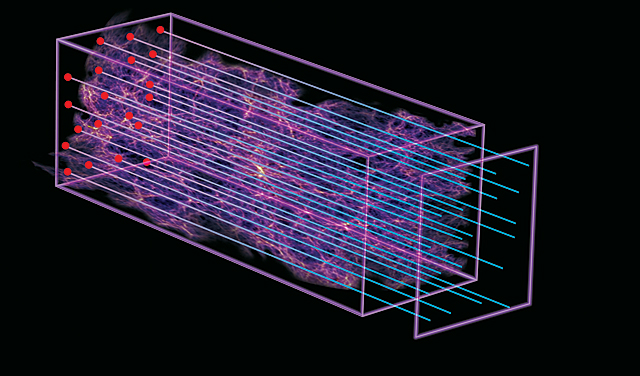
the FPG (French Participation Group) of the BOSS statement of SDSS-III
In 2008, three French laboratories (APC, IAP and Irfu) joined the BOSS survey within the SDSS-III collaboration. These three laboratories have formed the FPG (French Participation Group) which is very active within BOSS, especially in the study of baryonic acoustic oscillations (BAO) with quasars. The FPG participates in all stages of this analysis.
- Irfu (SPP) has developed original methods to select quasar candidates who are then observed by BOSS and has been responsible for the selection of candidates within BOSS.
- IAP has compiled the final quasar catalog from the spectra observed by BOSS. This required, in particular, the visual inspection of more than 160,000 spectra of candidate quasars.
- APC and Irfu (SPP) jointly conducted the analysis of the Ly-a forests of these quasars, to detect for the first time BAOs at a redshift around 2.3 (redshifts z=1 and z=3 correspond to epochs from 2 to 6 billion years after the Big-Bang).
SDSS-III will continue to improve our knowledge of dark energy
By the end of the survey, in 2014, it will have measured more than one and a half million galaxies and more than 160,000 quasars. It will also have demonstrated that the technique of measuring the “Lyman-alpha forest” is no longer a risky gamble, but a standard method for exploring the distant Universe.
Irfu Contact: James Rich