
Zeptometry will carry out the 1st quantitative study of the evolution of the weak mixing angle. The project combines theory and innovative experiments, and will probe the presence of new physics at the length scales of a zeptometer.
Maarten Boonekamp, a physicist in the particle physics department at CEA/Irfu, has been awarded an ERC Advanced fellowship for his Zeptometry project, in partnership with Johannes Gutenberg University in Mainz, Germany. Through a combination of innovative experiments and theoretical developments, the project team will carry out the first quantitative study of the evolution of the weak mixing angle, sin²θW, as a function of energy, over four orders of magnitude. The evolution of this fundamental parameter of the Standard Model of particle physics (SM) is accurately predicted, but this prediction is perturbed in the presence of new particles or interactions. So far, data in this field are too sparse and imprecise to really test the SM and the possible presence of new physics.
The project is divided into 3 parts:
- Design and integration of an innovative detector for precise measurement of sin²θW at low energies with the P2 experiment on the MESA accelerator in Mainz (start of data collection as early as 2026);
- Optimization of sin²θW measurement at Q = mZ and, for the first time, exploration of the Q energy scale at TeV with data from ATLAS at CERN’s LHC;
- Phenomenological developments for a coherent interpretation of the data.
In total, the evolution of sin²θW will be precisely mapped for energies ranging from 100 MeV to 1 TeV. Simultaneous interpretation of these sin²θW determinations will probe the new physics with sensitivity to mass scales of the new particles ranging from 70 MeV to a hundred TeV, corresponding to the length scales of a zeptometer (10-21 m).
The Standard Model (SM) of particle physics describes elementary particles and their interactions. It predicted the existence of many particles subsequently discovered, such as the W and Z bosons at CERN, the top quark and tau neutrino at Fermilab, and the Higgs boson again at CERN. The Standard Model has been complete since its discovery in 2012, but only describes around 15% of the total mass of the Universe. This mystery, among others, suggests the existence of new particles or interactions that would influence the values of the SM parameters. It is therefore essential to measure these parameters with the greatest possible precision, in order to track down the tiniest variations that could lead to new physics.
One of the cornerstones of SM is the weak mixing angle, sin²θW. This parameter relates the masses of the W and Z bosons, but also influences the couplings of the Z boson with fermions. In recent years, scientists have focused on precision measurements of the W and Higgs bosons, and top quarks for example, and results on sin²θW have been relatively scarce. At the Moriond 2024 conference, however, the CMS experiment announced a highly promising measurement of this parameter.
The aim of Zeptometry is to improve the determination of sin²θW at the Z peak, and above all to extend these measurements to energy scales covering four orders of magnitude, by combining information from the LHC with low-energy data from the MESA accelerator, hosted by Johannes Gutenberg University in Mainz, Germany. The combination of all these measurements will test the energy dependence of the weak mixing angle, at low energies, at the Z peak, and for the first time above the Z mass at energies in the TeV range.
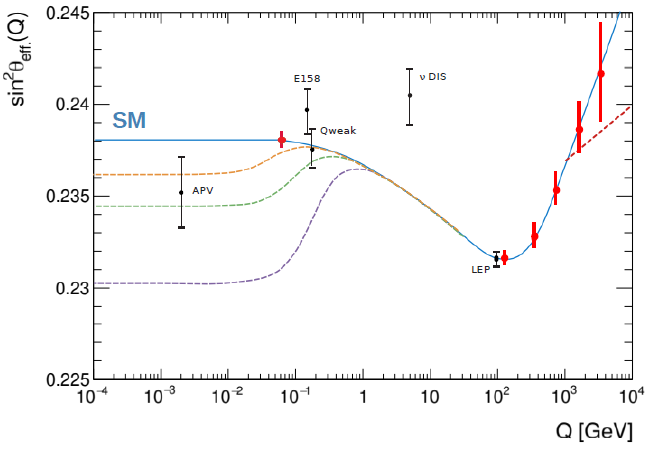
The weak mixing angle is deduced in particular from the asymmetry in the angular distribution of the decay products of the Z bosons. The value of sin²θW is dependent on the energy (Q) at which it is measured, and the SM proposes a theoretical prediction for this dependence. Unfortunately, apart from LEP, which has produced a precise measurement of the weak mixing angle to the Z mass, few experiments have contributed to measuring this parameter, which could be influenced by as yet unknown particles.
Indeed, the values predicted by theory would be modified by any new particle or interaction. For example, a dark matter candidate with a mass of ~100 MeV would generate a deviation of around 1.5%, at energies Q < 10-1 GeV (orange, green and violet dashed curves), while a new interaction involving particles with masses of around 103 GeV would lead to deviations of a few % at high energies (red dashed curve).
The Zeptometry project will provide the international community with precise sin²θW measurements thanks to the complementarity between the two experiments, as well as a global interpretation including the existing data set.
Links
- ERC Website: https://erc.europa.eu/news-events/news/erc-2023-advanced-grants-results
- Partner website: https://www.hi-mainz.de/news-events/detail/erc-advanced-grant-for-the-project-zeptometry
Contact: M. Boonekamp