
On Tuesday, January 7, the European Commission announced that it had granted CTAO (Cherenkov Telescope Array Observatory) the status of European Research Infrastructure Consortium (ERIC), a specific legal form under European Union law facilitating the creation and operation of research infrastructures of European interest. This makes CTAO the 29th ERIC to be created since 2009.
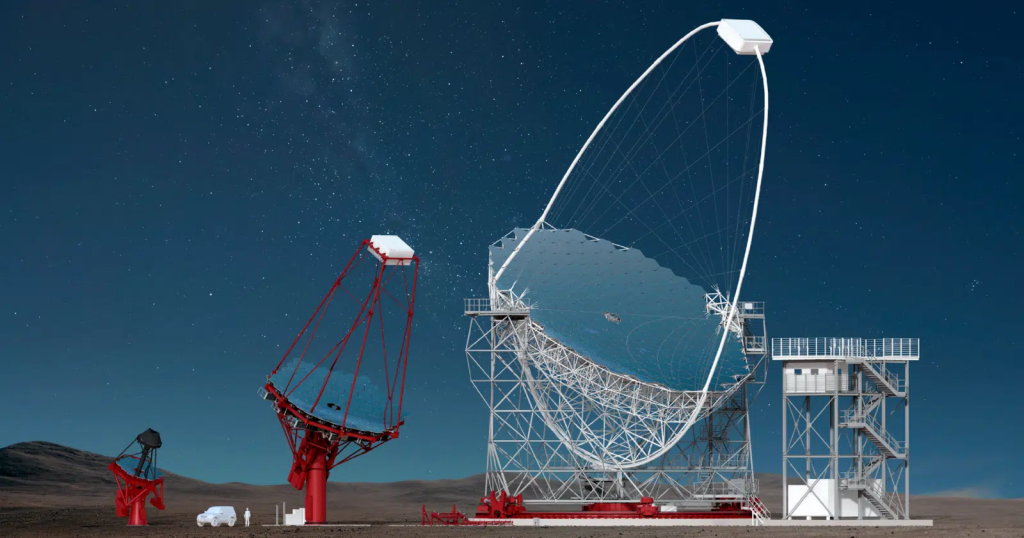
By providing an internationally recognized legal structure, the European Commission’s decision will accelerate the construction of the Observatory and facilitate its operation by ensuring stable infrastructure funding, supporting the recruitment of new personnel, and establishing a framework for the global distribution of the Observatory’s data.
This decision comes at a pivotal moment for CTAO: the first telescopes on its northern site, located in the Canary Islands (Spain), have begun collecting data, and the first telescopes will be installed on its southern site in the Atacama Desert (Chile) next year. Upon its launch, CTAO will become the largest and most sensitive gamma-ray observatory in the world. It will help address major questions in modern physics, such as the origin and acceleration of cosmic rays, the behavior of matter in the extreme environments around black holes, and the nature of dark matter.
The project is led by a scientific collaboration involving 150 laboratories from around 30 countries, in which France has played a crucial role, both in defining the scientific objectives and in developing and now constructing the telescope networks. This involvement earned the project recognition as a French Very Large Research Infrastructure (IR) as early as 2018.
The ERIC status officially establishes CTAO as one of the key infrastructures for European research,” said Thierry Stolarczyk, co-spokesperson of the CTAO Scientific Consortium. “This milestone is the culmination of 20 years of efforts by researchers, engineers, and technicians from the international consortium, who have been engaged in defining the scientific and technical project and are now working on building the telescope networks. Symbolically, it marks the beginning of a new phase toward exploiting the first data, which will soon lead to groundbreaking discoveries in the gamma-ray universe.”
The creation of the CTAO ERIC at the beginning of 2025 is excellent news for the entire European gamma-ray astronomy community. “This development was highly anticipated, particularly by French research institutions, which are among the major contributors to the infrastructure,” noted Guy Perrin, French delegate to the CTAO Board of Governmental Representatives.
About French participation in CTAO
The French scientific and technical staff involved in WATC come from CNRS laboratories (CNRS Nucléaire & Particules and CNRS Terre & Univers) and the IRFU at CEA Paris-Saclay. They contribute to many aspects of setting up the infrastructure and its scientific operation. A major part of the contribution concerns the three types of telescopes (in the photo, from left to right, SST, MST and LST), several dozen of which will equip the Observatory’s two networks, detecting the Cherenkov light produced by the interaction of gamma rays in the atmosphere, between 10 GeV and 100 TeV. More specifically, the French contribution concerns: for the LST, the design of the arches, the camera controllers and the motorisation of the mechanical structure; for the MST, the design, construction and integration of fast electronic cameras (NectarCAM) and the design and supply of mirrors; for the SST, the design and integration of the telescopes. The French teams are also contributing to the monitoring of atmospheric quality through the construction of a LIDAR on the South site. Finally, they are playing a leading role in the deployment of the data analysis chain for the telescope networks and the tools for scientific analysis of the celestial vault for future users of the Observatory.
Irfu Contact: Thierry Stolarczyk, Jean-François Glicenstein and Eric Delagnes