

A major challenge in gamma-ray astronomy lies in separating signals in coordinate space (space, time, energy) where they overlap. A typical example at very high energies (E ≥ 100 GeV) is the problem of residual background noise in observations blending with signals from astrophysical sources of interest.
An innovative approach, recently published in the Journal of Cosmology and Astroparticle Physics, leverages Artificial Intelligence methods based on neural networks to exploit the separability of the spatial and energy components of the signals. This deep-learning–based method estimates the spatial and spectral shapes of both the source and the background, along with their uncertainties, with minimal prior knowledge.
Very-high-energy gamma rays (VHE, E ≥ 100 GeV) are a unique messenger for probing the most violent phenomena in the Universe. They can reveal crucial information about the regions they traverse and the mechanisms that produce them—such as relativistic particle acceleration through plasma shocks and magnetic fields, or processes like dark matter annihilation. Identifying and characterizing such mechanisms requires careful analysis of gamma-ray sources, particularly by examining their spatial, spectral, and temporal features—necessitating powerful analytical tools to capture them accurately.
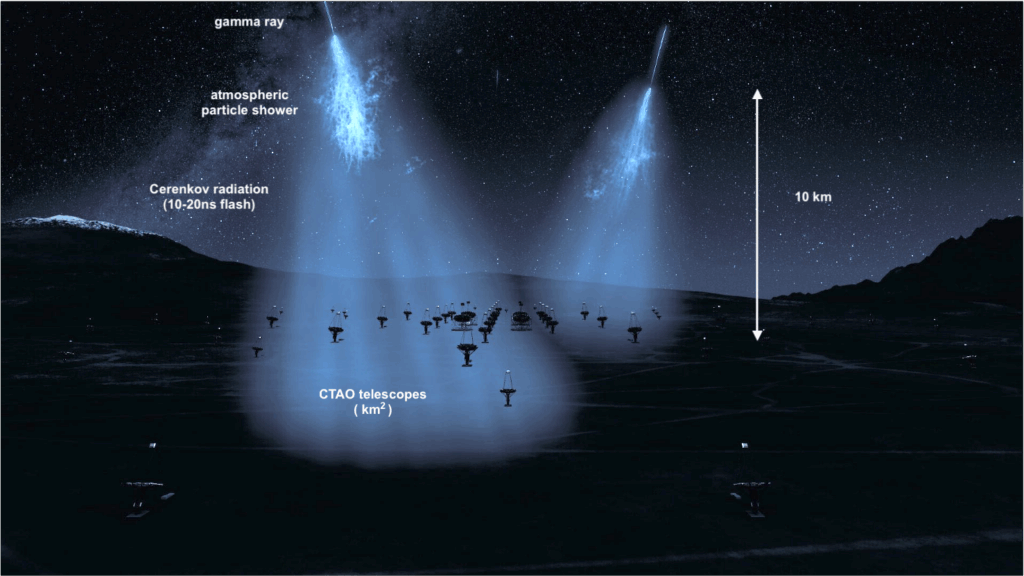
A major challenge for ground-based gamma-ray astronomy with large Cherenkov telescope arrays such as CTAO or H.E.S.S. is identifying contamination from high-energy cosmic rays coming from all directions in the sky. Gamma rays do not penetrate our atmosphere but are absorbed, producing a brief cascade of secondary particles that emit faint flashes of bluish Cherenkov light in just a few billionths of a second (see Figure 1). However, all high-energy cosmic rays can create secondary particle showers in the Earth’s atmosphere that produce Cherenkov radiation similar to that of “gamma” showers. As a result, gamma-ray signals are often contaminated by this background noise.
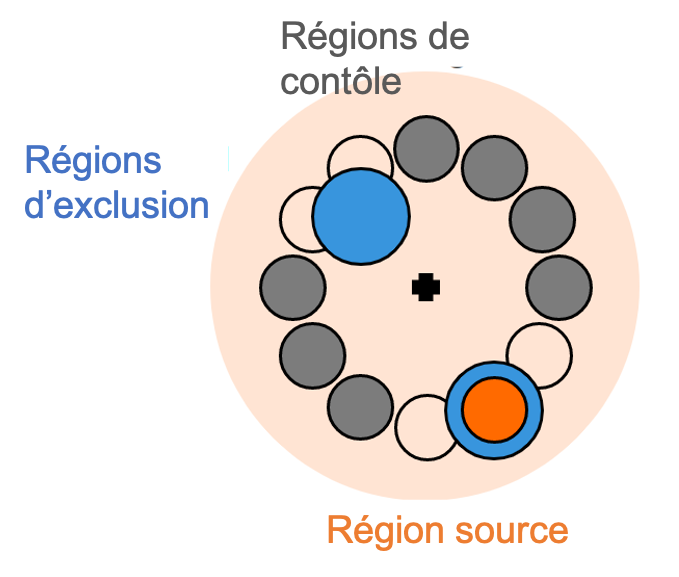
Background attenuation is achieved in two steps: the first one consist of the reconstruction of all detected events from a given region of the sky and keep only those where a “gamma” shower is identified; the second one is to statistically estimate the residual background in so-called control regions—where background dominates—using the list of events associated with the source after reconstruction.
To address residual background noise in the event list, various statistical methods have been developed, depending on whether the source position is known a priori. One conventional technique uses an annular region around the signal region to estimate the background (Figure 2). Another method uses multiple control regions to obtain a more reliable background estimate by averaging over spatial fluctuations. The isotropy assumption in the first method may not always hold—especially in regions with complex background structures. In the second, reducing statistical fluctuations requires careful selection of control regions to avoid biases in background estimation.
Component Separation with Neural Networks
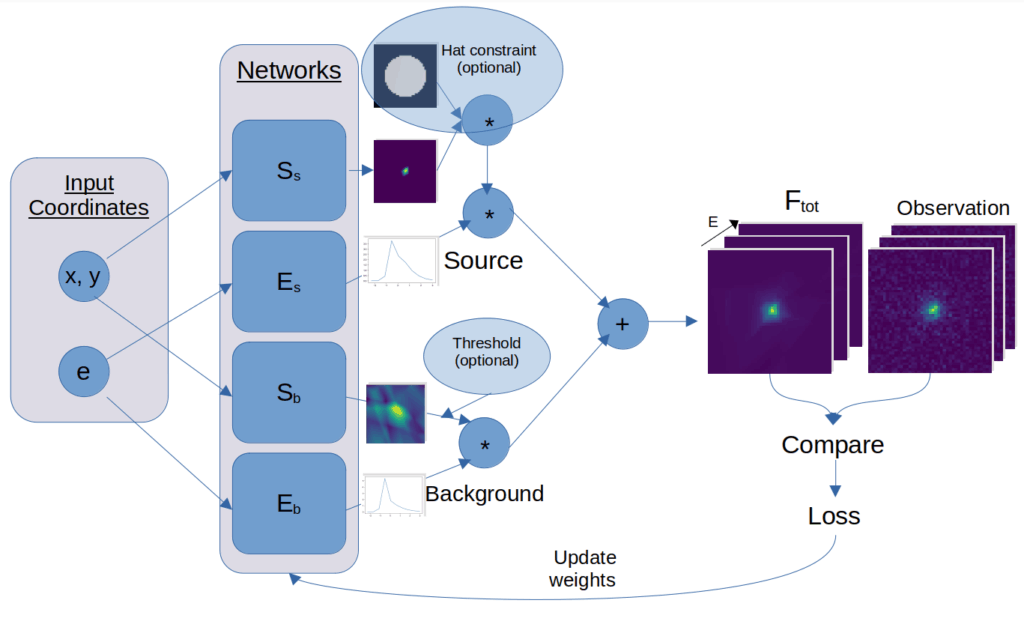
Neural networks have proven effective in component-separation tasks across various domains. Here, a proof of concept based on a neural network is presented to address background contamination—serving as a first step toward the more general problem of multi-component separation in VHE astrophysics. The approach jointly estimates the mean fields of the signals corresponding to astrophysical sources and background noise in the region of interest by maximizing the likelihood of a given observation, while providing uncertainties that account for both model limitations and statistical noise in the data.
e treat a given observation—i.e., a list of events (x, e), grouped into spatial coordinates (x) and energy (e)—as a Poisson realization of an underlying mean field Fₜₒₜ. We assume Fₜₒₜ is the sum of two components: one for the source emission (Fₛ) and one for the background (Fᵦ). These can be factorized into spatial and energy components (Sₛ, Eₛ) and (Sᵦ, Eᵦ), such that: Fₜₒₜ(x, e) = Sₛ(x) × Eₛ(e) + Sᵦ(x) × Eᵦ(e). To estimate Sₛ, Eₛ, Sᵦ, and Eᵦ from their mixture in the observed field, we build four separate dense (i.e., each layer of the network is deeply connected to the previous layer) neural networks—one for each component (Figure 3). The architectures are deliberately simple and computationally efficient. Using distinct dense networks for each component ensures better control over the parametrization and keeps them independent by default.
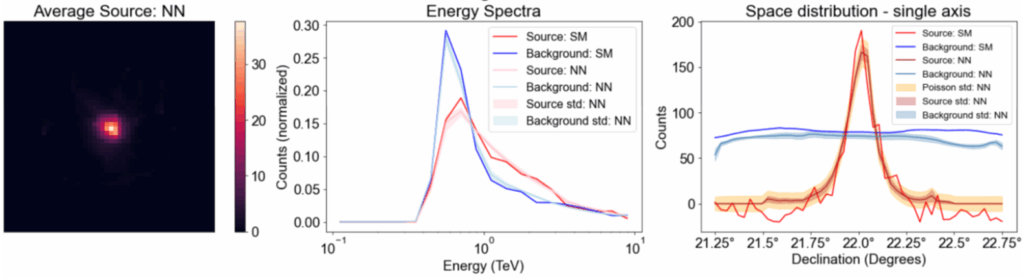
This procedure was applied both to simulated observations, a simplified model and a realistic one simulating dark matter annihilation in the Galactic Centre, and to public observations from the H.E.S.S. array for the Crab Nebula and the pulsar-wind nebula MSH 15-52. Our method performs well in the simulated cases and compares favourably to conventional analysis approaches when applied to real observations (see Figure 4).
In the simulated case of a dark matter annihilation signal in the Galactic Centre, our work opens new possibilities for component separation in this complex high-energy region of the sky. Future work on this topic includes steps toward generalization, such as adding temporal evolution of the source or extending to a variable number of sources. Experimenting with diverse network architectures should further help optimize results.
This approach, using an ensemble of low-parameter dense networks, has proven highly efficient. Two key factors are crucial for achieving optimal and accurate final estimates: using prior constraints on the source and background shapes guides the model toward more realistic and reliable solutions; applying an appropriate weighting method when combining individual ensemble results helps automatically discard more erroneous estimates while allowing equally plausible ones to contribute to the final average.
This methodology provides a robust framework for source–background separation in the presence of statistical fluctuations, improves result accuracy, and offers a clear representation of model uncertainty. Future research can build on these results to refine and extend the applicability of this approach to a broad range of astrophysical problems.
Contact: Emmanuel Moulin
References : Ullmo, M., & Moulin, E. (2025). Nonparametric signal separation in very-high-energy gamma ray observations with probabilistic neural networks. Journal Of Cosmology And Astroparticle Physics, 2025(01), 014. https://doi.org/10.1088/1475-7516/2025/01/014