
The Big Bang has created equal amounts of matter and antimatter. So, why is there far more matter than antimatter in the universe? Irfu participates to the preparation of Hyper-Kamiokande, an experiment aiming to measure the oscillations of neutrinos produced by an accelerator, which may shed light on this mystery.
The Universe is filled with matter, while antimatter is very rare. The predominance of matter allowed complex structures, like galaxies, stars, planets, and ultimately us, to form and exist as observed nowadays. The Big Bang has created the same amount of matter and antimatter: thus, each particle should therefore have annihilated with a corresponding antiparticle to fill the Universe with light (photons) and nothing else. A small asymmetry between matter and antimatter is necessary to avoid such catastrophic end. A very enigmatic particle, the neutrino, may hold the key to this mystery.
The neutrino is the least known particle of the Standard Model, one of the few things we know about it is that neutrinos must exist in at least 3 flavors (electron, muon and tau) and those states ‘oscillates’ when neutrinos propagate in space and time. Specifically, neutrinos are created in interactions of the other Standard Model particles in a state of definite flavor but they propagate as states of definite mass, which correspond to linear combinations (quantum superpositions) of flavor states. Therefore, a neutrino of a given energy created in a given flavor state, has a well-defined probability to be detected in a different flavor state after having traveled a given distance. This phenomenon is possible only if neutrinos are massive particles, contrarily to what is predicted by the Standard Model. Very interestingly, this phenomenon opens the possibility of a new source of matter-antimatter asymmetry in the Universe: if neutrinos and antineutrinos (their antiparticles) oscillate differently, they may have played a crucial role in the mechanism which caused the strong dominance of matter in the Universe.

From T2K to Hyper-Kamiokande
Neutrino oscillations have been discovered in the late 90s and rewarded by the Nobel Prize in physics in 2015. Since then, neutrino oscillations have been studied in various experiments, notably exploiting neutrinos produced by cosmic rays, by the Sun, by nuclear reactor and particle accelerator facilities. The latter have the unique capability of producing a beam of either neutrinos or antineutrinos with optimized flavor and energy in the desired direction. A complex of detectors, positioned near the neutrino source, is used to characterize the amount of neutrinos produced and their probability to interact with matter. A large ‘far’ detector intercepts the neutrinos hundreds of kilometers away from the source to measure the oscillation probability from one flavor to another. This approach is exploited today by the Tokai To Kamioka (T2K) experiment, in Japan, which Irfu gives crucial contributions to.
T2K will run until 2027 when its successor HyperKamiokande (HK) will take over. HK will feature a neutrino beam more than twice intense and a far detector more than 8 times larger than T2K. The recently upgraded T2K near detector (ND280) will be inherited by HK. Thanks to the huge increase in the statistics of neutrinos produced and detected, HK will be able to discover the possible asymmetry between the oscillation of neutrinos and antineutrinos, and give new insights on the big mystery of matter-antimatter asymmetry in the Universe [1].
Hyper-Kamiokande@Irfu
Irfu is at the forefront of this major experimental endeavor: it already has a leading role in the ND280 upgrade and it is now contributing to the construction of the new HK far detector. The big challenges for this new detector are related with its size: a cylindrical vessel of 72 m height x 68 m diameter containing 260 kilotons of water (see figure 2), where the Cherenkov light produced by charged particles from neutrino interactions will be collected by about 13 000 photomultiplier tubes (PMTs). The PMT signals will be read-out by more than one thousand of electronics cards. In order to enable precise measurements of neutrino oscillations, all the readout-units of such huge detector must be properly time-synchronized and inter-calibrated in energy to ensure the uniformity of their response. Irfu is at the core of these challenges, and especially develops a new electronic module for the system distributing the clock to the thousands of readout-units. Irfu is also supporting, through its Antenna at CERN, the development of the test bench that will be used to calibrate precisely all read- out electronic units and ensure their compliance with the specifications.
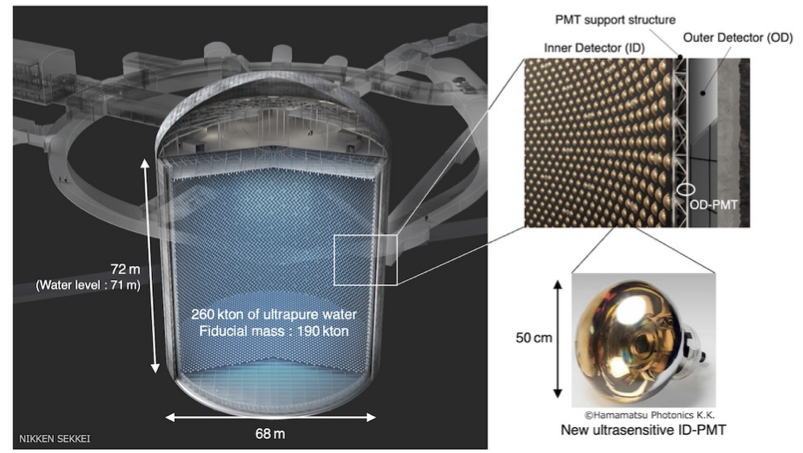
To gauge the technological challenge we are facing, let us mention that we need to ensure a precision in neutrino energy scale around 0.5% which induces a requirement of 0.1% on the calibration of the charge linearity of the read-out electronics cards. Moreover, in order to ensure a spatial resolution better than 15 cm for Cherencov-light paths as long as 100 meters, a distribution system capable to dispatch a clock with a time jitter better than 100 ps to 13,000 PMTs distributed over a cylindrical surface of more than 15,000 square meters needs to be built. To this aim, a multi-stage approach is implemented and Irfu develops the first stage of this system: the new electronics module shown in figure 3 features a random (deterministic) jitter below 4ps (2ps).

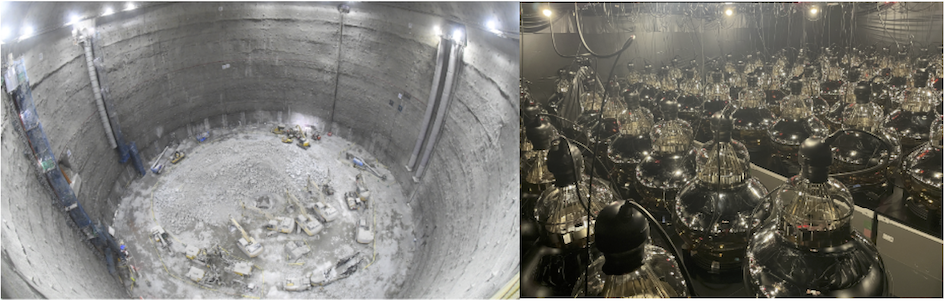
The construction of the HK detector is on-going. As shown in figure 4, the excavation of the cavern and the procurement of PMTs are well advanced. The data taking phase is planned to start at the beginnning of 2028.
The Hyper-Kamiokande sensitivity to CP-violating phase
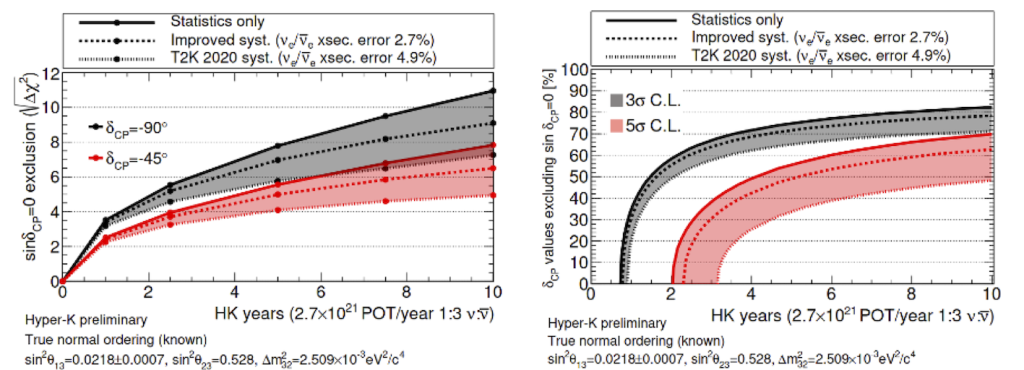
Irfu is also leading the main analysis effort to estimate precisely the sensitivity of the HK experiment for the oscillation measurements and, notably, for the possible discovery of CP violation in neutrino oscillations (see figure 5).
T2K recent results hint to a very large neutrino-antineutrino asymmetry, in which case HK can definitely conclude on the existence of this asymmetry in about 2 years of data taking (at 5 standard deviations). In figure 5, the impact of the systematic uncertainties on the oscillation measurements is also estimated, quantifying the crucial role of the near detector ND280 to enable such important discovery. Indeed, in order to measure precisely neutrino oscillations, we need to model correctly the neutrino interaction probability with matter in the detector. IRFU has largely participated to the development of nuclear-physics models for neutrino interactions [2-7] and it is a major contributor to their direct measurements with ND280 data [8-13].
In summary, Irfu, thanks to its crucial contribution to both the near and far detector of HK, owing to a unique expertise on nuclear physics and covering a leading role in neutrino oscillation analysis, will be a major actor of the future HK discoveries.
Références
[1] A. Granelli et al., Phys.Rev.D 108 (2023) 10, L101302
[2] A. Ershova et al., Phys.Rev.D 108 (2023) 11, 112008
[3] A. Ershova et al., Phys.Rev.D 106 (2022) 3, 032009
[4] L. Munteanu et al., Phys.Rev.D 101 (2020) 9, 092003
[5] G.D. Megias et al., Phys.Rev.C 101 (2020) 2, 025501
[6] S. Dolan et al., Phys.Rev.D 101 (2020) 3, 033003
[7] S. Dolan et al., Phys.Rev.C 98 (2018) 4, 045502
[10] T2K collaboration, Phys.Rev.D 101 (2020) 11, 112004
[11] T2K collaboration, Phys.Rev.D 101 (2020) 11, 112001
[12] T2K collaboration, Phys.Rev.D 98 (2018) 3, 032003
[13] T2K collaboration, Phys.Rev.D 93 (2016) 11, 112012
Press release “Excavation of the Colossal Cavern for Hyper-Kamiokande Completed“
Contacts