
At the EPS-HEP 2025 conference, the ATLAS Collaboration presented its results on the exceptionally rare decay of the Higgs boson into a pair of muons, using data collected during the third run (Run-3) of the Large Hadron Collider (LHC) – an analysis in which IRFU plays a central role. This process provides the best opportunity to study the interaction of the Higgs boson with second-generation fermions and helps shed light on the origin of mass. It also allows physicists to better understand how closely the Higgs boson’s behavior aligns with the Standard Model.
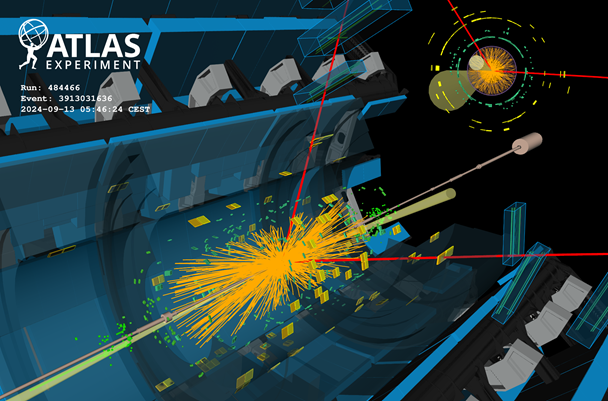
Since the discovery of the Higgs boson in 2012, physicists have made tremendous progress in exploring its properties. Does this mean the story is complete? Far from it! In new results presented [2,3] at this year’s European Physical Society Conference on High Energy Physics (EPS-HEP) in Marseille, the ATLAS Collaboration focused on an exceptionally rare Higgs boson decay, using data from Run-3 of the LHC. This study provides deep insights into how the Higgs boson’s behavior compares with Standard Model predictions.
The ATLAS team at IRFU has a long-standing experience in Higgs boson research and made significant contributions to its discovery as well as to the measurement of its properties. The team is strongly involved in this Higgs-to-two-muons analysis, thanks to its major role in muon reconstruction and identification, Run-3 data quality assurance, and the development of physics analysis guidelines. Their contributions enabled the exploitation of Run-3 data (2022–2024) and, by combining them with Run-2 data (2015–2018), led to the observation of this rare decay.
The process under study is the decay of the Higgs boson into a pair of muons (H→μμ). Despite its rarity—occurring in only one out of 5,000 Higgs decays—this process offers the best opportunity to study the Higgs interaction with second-generation fermions and to shed light on the origin of mass across different generations.
Searching for needles in a haystack
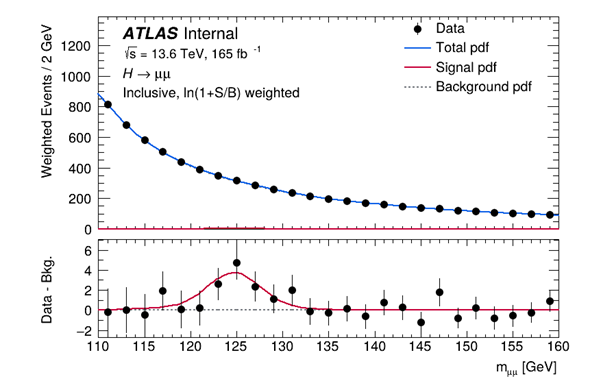
Identifying this rare decay is a true challenge. For H→μμ, researchers searched for a small excess of events clustering near a dimuon mass of 125 GeV (the Higgs boson mass). This signal can be easily hidden among the thousands of muon pairs produced by other processes (“background”).
To enhance sensitivity, ATLAS physicists combined the first three years of Run-3 data (165 fb-1, collected between 2022 and 2024) with the full Run-2 dataset (140 fb-1, from 2015 to 2018). They also developed a sophisticated method to better model background processes, classify recorded events according to specific Higgs production modes, and improve event-selection techniques to maximize the chances of spotting genuine signals. Figure 1 shows the dimuon mass distribution obtained from 2022–2024 data, combined across all categories.
Highlight
In the previous H→μμ search using the full Run-2 dataset, the ATLAS Collaboration [4] reported its first hint of this process at the 2-sigma level (i.e. the hypothesis that the observed result was solely due to background fluctuations was rejected at the 2-standard-deviation level, corresponding to a probability of about 1 in 22). The comparable CMS result [5] reached an observed (expected) significance of 3 (2.5) sigma.
Now, with the combined Run-2 and Run-3 datasets, the ATLAS Collaboration has observed evidence for the H→μμ process with an observed (expected) significance relative to the background-only hypothesis of 3.4 (2.5) sigma [1]. This means the probability that the result is just a statistical fluctuation is less than 1 in 1,500!
These results were made possible thanks to the excellent and extensive dataset delivered by the LHC, the outstanding efficiency and performance of the ATLAS experiment, and the use of new analysis techniques. With more data on the horizon, the journey of exploration continues!
Contact: Rosy Nikolaidou
References :
- Evidence for the dimuon decay of the Higgs boson in proton-proton collisions with the ATLAS detector
- EPS 2025 presentation by Fabio Cerutti: ATLAS Highlights
- EPS 2025 presentation by Tamar Zakareishvili: Search for rare processes and lepton-flavor-violating decays of Higgs boson at the ATLAS experiment
- A search for the dimuon decay of the Standard Model Higgs boson with the ATLAS detector (Phys. Lett. B 812 (2021) 135980, arXiv: 2007.07830, see figures)
- CMS Collaboration: Evidence for Higgs boson decay to a pair of muons (JHEP 01 (2021) 148)