
For the first time, an international collaboration of over 800 scientists has joined forces to track down the sources of high-energy cosmic neutrinos. By combining neutrino observations with gamma-ray observations, this multimessenger approach opens a new window onto the most violent phenomena in the Universe.
Led by Fabian Schüssler (Particle Physics Department of IRFU, for the H.E.S.S. collaboration), this study marks a turning point: four atmospheric Cherenkov telescope arrays (FACT, H.E.S.S., MAGIC, VERITAS) and the Large Area Telescope (LAT) on the Fermi satellite pooled their data for the first time to search for gamma-ray events in their data that would come from the same source as the neutrinos detected by IceCube in 2017. An unprecedented cooperation between facilities that are usually in competition!
The analysis includes follow-up observations of high-energy neutrino events observed by the four observatories between September 2017 (after the IceCube-170922A event) and January 2021. The study found no association between gamma-ray sources and the observed neutrino events but provided combined upper limits on the very high-energy gamma-ray flux that these sources could emit. These limits are more constraining than those obtained by a single telescope because they rely on increased sensitivity due to the combination of data.
These limits allow certain theoretical models of cosmic ray acceleration to be ruled out. If a model predicts a gamma-ray flux higher than the established limits, it must be revised.
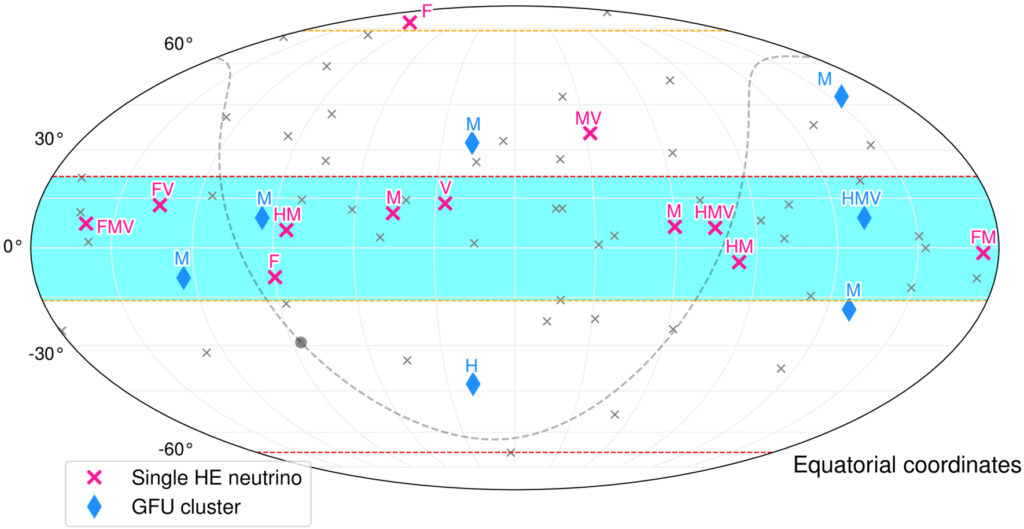
Sky map in equatorial coordinates showing the positions of IceCube alerts between September 2017 and January 2021.
Alerts followed by atmospheric Cherenkov telescopes are shown in color (according to alert type), while those not followed are in gray.
The letters indicate which telescopes participated in the observations (F: FACT, H: H.E.S.S., M: MAGIC, V: VERITAS)
source: “Prompt Searches for Very-High-Energy Gamma-Ray Counterparts to IceCube Astrophysical Neutrino Alerts,” J. Abhir et al 2026 ApJ 997 141.
Why Look for Gamma Rays Associated with Neutrinos?
Astronomy has entered the era of “multimessenger” astrophysics, where cosmic phenomena are studied not only using electromagnetic radiation but also gravitational waves and neutrinos.
When a neutrino is produced in an astrophysical source (such as a blazar or a supernova remnant), it should be accompanied by high-energy gamma rays. These gamma rays, unlike neutrinos, are easier to detect, and if gamma rays are detected, it confirms that the source is indeed a cosmic accelerator. If nothing is detected, it is still possible to establish an upper limit on the gamma-ray flux that this source could emit.
The researchers have:
- Searched for known gamma-ray sources linked to neutrino events detected by IceCube between September 2017 and January 2021.
- Coordinated observations from multiple gamma-ray telescopes (H.E.S.S. for the southern sky, MAGIC, VERITAS, and FACT for the northern sky, as well as the Fermi Large Area Telescope (LAT)).
- Combined their data to establish joint upper limits on the gamma-ray flux associated with each neutrino event.
Result:
If the telescopes had detected gamma rays in coincidence with the neutrinos, it would have confirmed the identity of the source.
Since no significant detection was made in most cases, the researchers were able to establish upper limits on the gamma-ray flux that these sources could emit. These limits are more constraining than those obtained by a single telescope because they rely on complete sky coverage and increased sensitivity due to the combination of data.
A Concrete Example: The Case of the Blazar 1ES 1312-423
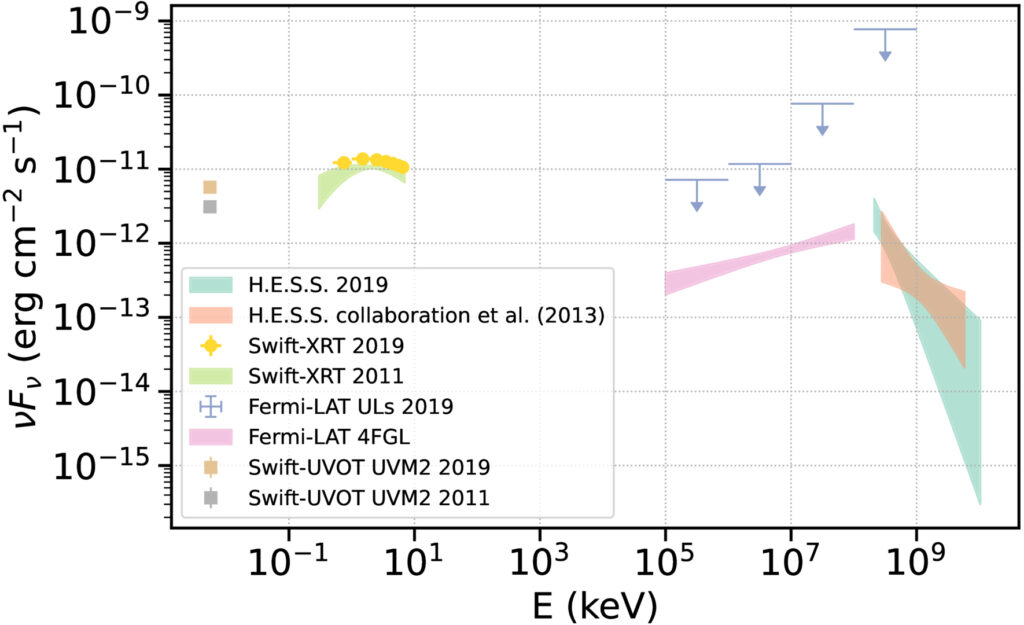
In the study, one particular case caught attention: in March 2019, H.E.S.S. detected very high-energy gamma rays from the blazar 1ES 1312-423 after IceCube detected a cluster of neutrinos in the same region of the sky. However, after a thorough analysis, the researchers concluded that:
- The observed gamma-ray flux was consistent with the “normal” emission of this blazar.
- The neutrinos detected by IceCube were probably not linked to this blazar but rather to a random fluctuation in the neutrino background.
- The upper limits established for the other sources allowed the conclusion that no source showed a clear correlation between neutrinos and gamma rays during the studied period.
What Do These Limits Mean for Science?
- Ruling Out Theoretical Models: The study provides a “reference dataset” that constrains theoretical models of neutrino emission. For example, if a model predicts that a source should emit a gamma-ray flux higher than the upper limit set by the joint analysis, then that model is invalid and must be revised.
- It demonstrates the ability of the current generation of Cherenkov telescopes to operate as a global network, responding quickly to alerts from the IceCube Neutrino Observatory.
- This work paves the way for the future of time-domain astronomy. The lessons learned from these coordinated searches are essential for the future Cherenkov Telescope Array Observatory (CTAO), which will offer improved sensitivity and rapid response times.
- Additionally, the global network is preparing to follow up on alerts from next-generation neutrino observatories such as KM3NeT, which will significantly increase our ability to capture these violent cosmic events in the act.
Contact DPHP: Fabian SCHUSSLER
Reference :
Collaborations FACT, H.E.S.S., MAGIC, VERITAS, Fermi-LAT et IceCube, “Prompt Searches for Very-High-Energy Gamma-Ray Counterparts to IceCube Astrophysical Neutrino Alerts,” J. Abhir et al 2026 ApJ 997 141.
https://hess-experiment.eu/